


Tyrian Purple from Murex — The Most Precious Dye in Human History
Tyrian purple is the single most famous dye ever produced. Extracted from the hypobranchial glands of predatory sea snails — primarily Bolinus brandaris and Hexaplex trunculus — this pigment coloured the robes of Phoenician kings, Roman emperors, and Byzantine rulers for over two thousand years. At its peak, Tyrian purple was worth more than gold by weight. The colour was so closely associated with power that Roman law restricted its use to the emperor alone — wearing unauthorised purple was a capital offence.
The dye molecule is 6,6'-dibromoindigo, a brominated derivative of indigo. It forms through a remarkable photochemical process: the mucus secreted by the snail's hypobranchial gland is initially yellowish-green. Exposure to sunlight and air triggers a series of enzymatic and photochemical reactions that convert precursor molecules into the final purple pigment. This light-dependent step is why ancient dye works were located in open, sunny areas — the vats needed direct sunlight to develop the colour.
The ancient process centred on the Phoenician cities of Tyre and Sidon (modern Lebanon). Archaeological excavations at Sidon have uncovered massive deposits of crushed murex shells — millions of snails were harvested to supply the dye industry. Pliny the Elder describes the process in detail: the glands were extracted, salted, soaked for three days, then slowly heated in water for ten days. The resulting liquid was the dye bath. The smell was legendarily foul — ancient sources describe it as one of the worst odours imaginable, a combination of rotting shellfish and sulphur compounds.
Maagizo
Obtain fresh murex snails
Obtain fresh murex snails
Source live or freshly killed murex snails — either Bolinus brandaris (the spiny murex, native to the Mediterranean) or Hexaplex trunculus (the banded murex). You need approximately 60-80 snails to dye 10 g of wool a medium purple — this gives some sense of why Tyrian purple was worth more than gold. The snails must be fresh; the dye precursors in the hypobranchial gland degrade within hours of death. In antiquity, dye workers processed snails immediately after harvesting from the sea.
Vifaa kwa hatua hii:
 Konokono wa mureksi60 vipande
Extract the hypobranchial glands
Extract the hypobranchial glands
Crack each shell carefully and extract the small hypobranchial gland — a pale, yellowish mucus-producing organ located near the head of the snail. In Bolinus brandaris, the gland is a small strip about 1 cm long. Work quickly, as exposure to light begins the photochemical conversion immediately. Collect the gland secretions into a ceramic or glass bowl. The fresh secretion is yellowish-green and has a garlic-like smell at this stage. Wear gloves — the secretion stains skin immediately and permanently.
Zana zinazohitajika:
 Glavu za mpira
Salt the gland extract and rest for three days
Salt the gland extract and rest for three days
Add coarse sea salt to the collected gland secretions at a ratio of roughly 1 part salt to 5 parts secretion by weight. Mix thoroughly. The salt acts as a preservative and helps break down the gland tissue, releasing more of the dye precursor molecules. Cover the bowl loosely and leave in a cool, shaded place for three days. During this period, enzymatic processes within the gland tissue convert stored precursor compounds into the intermediates that will eventually become dibromoindigo. The mixture will develop an increasingly strong, unpleasant smell — this is normal and unavoidable.
Vifaa kwa hatua hii:
 Chumvi ya Bahari Mbichi50 g
Zana zinazohitajika:
 Mitungi ya kioo yenye vifuniko
Dilute with water and heat slowly for several days
Dilute with water and heat slowly for several days
After the three-day salt rest, add water to the extract — approximately 10 parts water to 1 part salted extract. Transfer to a dye pot and heat very slowly to approximately 50-60°C. Hold at this temperature for 7-10 days, adding water as needed to maintain the level. Do not boil — excessive heat destroys the dye precursors. This prolonged gentle heating completes the chemical transformation. The liquid will gradually darken from yellowish-green through stages of green, blue-green, and finally a deep reddish-purple. The smell during this stage is extremely foul — ancient dye works were located downwind from cities for this reason.
Zana zinazohitajika:
 Sufuria kubwa ya mchuzi
 Kipimajoto cha kupikia
Expose the dye to sunlight for colour development
Expose the dye to sunlight for colour development
The photochemical step is what makes murex purple unique among ancient dyes. Place the heated extract in a shallow, wide vessel in direct sunlight for 1-2 days. Ultraviolet light drives the final conversion of the intermediate compounds into 6,6'-dibromoindigo — the actual purple pigment. Without this sunlight exposure, the colour remains an indeterminate blue-green. With UV exposure, it shifts decisively to the famous reddish-purple of antiquity. The liquid should become a deep, clear purple-red. Hexaplex trunculus produces a bluer purple; Bolinus brandaris produces a redder, more violet purple.
Strain the dye bath
Strain the dye bath
Strain the purple liquid through muslin cloth to remove all solid matter — shell fragments, gland residue, and salt deposits. The strained liquid is your Tyrian purple dye bath. It should be a deep, rich purple-red to violet, depending on the species of murex used and the duration of sunlight exposure. The concentration is very low compared to plant dyes — this is why so many snails are needed for even a small amount of dyed textile.
Zana zinazohitajika:
 Chujio la matundu madogo
 Kitambaa cha Muslini ya Pamba
Dye wool in the purple bath
Dye wool in the purple bath
Pre-wet clean wool (mordanting is not strictly necessary — dibromoindigo is a vat dye that bonds directly to fibre, similar to indigo). Lower the wool into the dye bath and heat gently to 50-60°C for several hours. Ancient dyers reportedly left textiles in the vat for extended periods. The wool will absorb the purple gradually. The final colour is the legendary Tyrian purple — a deep, rich reddish-violet to purple that does not fade in washing and actually improves with sunlight exposure (unlike most dyes, which fade). This extraordinary lightfastness is why Tyrian purple was so valued. The colour was said to become more beautiful with age and wear.
Vifaa kwa hatua hii:
 Fungu la uzi wa sufu10 g
Rinse and dry in sunlight
Rinse and dry in sunlight
Remove the wool from the dye bath, squeeze gently, and rinse in lukewarm seawater or clean water. Then dry the wool in direct sunlight. This final sun exposure continues to develop and fix the colour — Tyrian purple is one of the only dyes that benefits from sun drying rather than shade drying. The finished colour ranges from reddish-violet (Bolinus brandaris) to blue-violet (Hexaplex trunculus). Archaeological colour analysis of ancient textiles shows these colours were remarkably consistent across centuries of production — testament to the skill of Phoenician dyers who standardised this complex process.
Vifaa
3- 60 vipandeKishikilia Nafasi
- Kishikilia Nafasi
- Kishikilia Nafasi
Zana Zinazohitajika
6- Kishikilia Nafasi
- Kishikilia Nafasi
- Kishikilia Nafasi
- Kishikilia Nafasi
- Kishikilia Nafasi
- Kishikilia Nafasi
Vifaa vya Michoro Iliyounganishwa
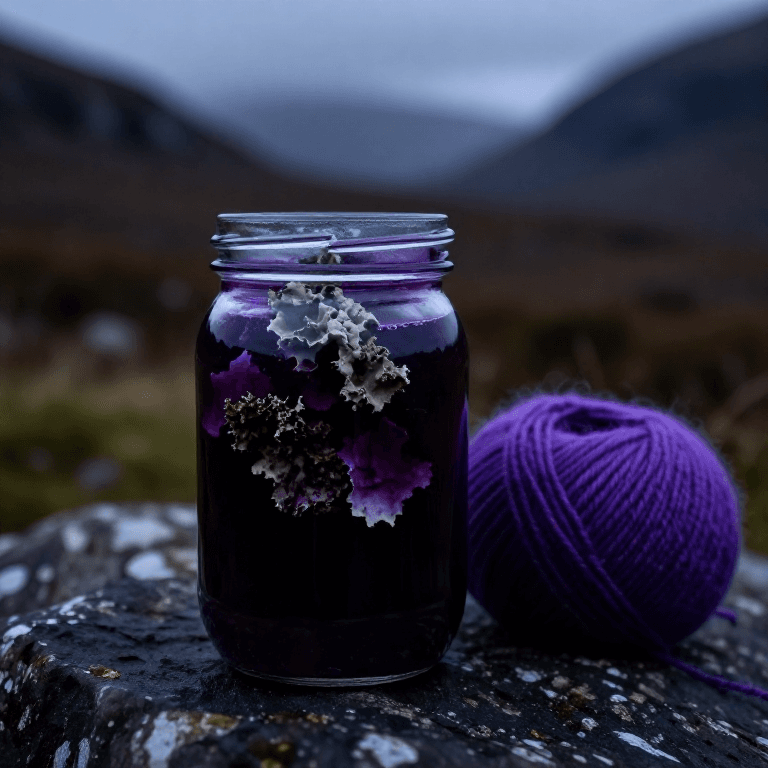
Mchoro huu unatengeneza

Blueprint zinazohusiana
Blueprint hizi zinashiriki maarifa — mbinu, vifaa au kanuni
CC0 Umma Wote
Mchoro huu umetolewa chini ya CC0. Uko huru kunakili, kubadilisha, kusambaza, na kutumia kazi hii kwa madhumuni yoyote, bila kuomba ruhusa.
Saidia Mtengenezaji kwa kununua bidhaa kupitia Mchoro wao ambapo wanapata Kamisheni ya Mtengenezaji iliyowekwa na Wachuuzi, au unda marudio mapya ya Mchoro huu na uiunganishe kama kiungo katika Mchoro wako kuchangia mapato.