
Understanding Carbon Through Charcoal Making — The Element of Life and Fire
Carbon (C, element 6) is the fourth most abundant element in the universe by mass and the second most abundant in the human body (after oxygen). It is the only element that forms the backbone of an entire branch of chemistry — organic chemistry — because carbon's four valence electrons allow it to form stable chains, rings, and branched structures of essentially unlimited length and complexity. Every protein, every strand of DNA, every fat molecule, every sugar, every vitamin is built on a carbon skeleton.
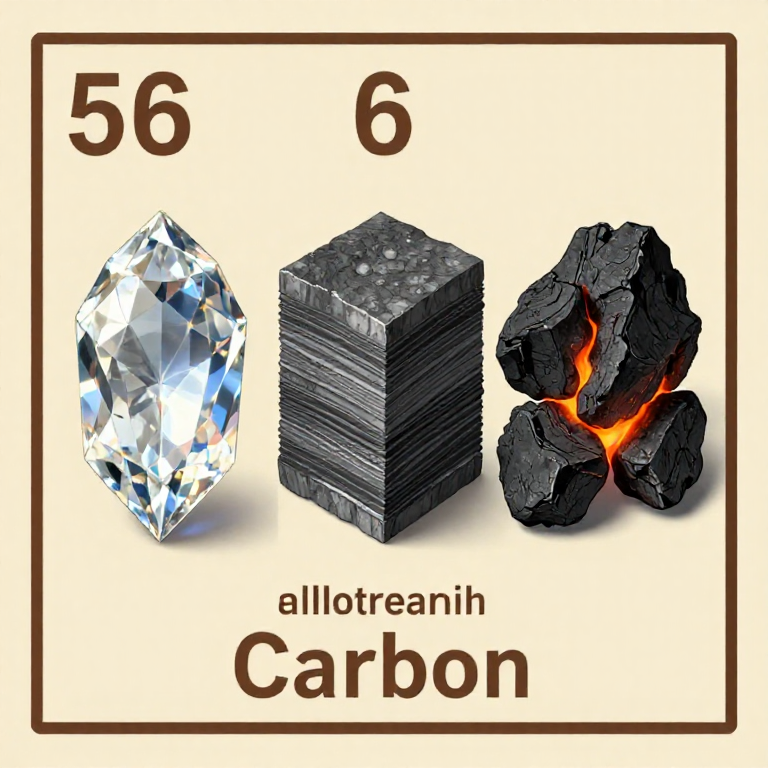
Carbon exists in three well-known allotropes with wildly different properties: diamond (each carbon atom bonded to four others in a rigid tetrahedral network — the hardest natural material, Mohs 10), graphite (carbon atoms bonded in flat hexagonal sheets that slide over each other — one of the softest minerals, Mohs 1-2, and an electrical conductor), and amorphous carbon (charcoal, soot, coal — disordered carbon with no long-range crystal structure). The same element is both the hardest and among the softest naturally occurring substances.
This blueprint teaches you to understand carbon by making charcoal — the simplest and oldest way humans have transformed carbon from one form to another. Charcoal making (pyrolysis of wood in limited oxygen) is one of humanity's earliest chemical processes, predating metallurgy. Without charcoal, there would be no bronze, no iron, no steel — because charcoal provides both the heat and the chemical reducing agent needed to smelt metal ores.
Maagizo
Understand carbon's properties and place in the periodic table
Understand carbon's properties and place in the periodic table
Carbon (C, element 6) sits in Group 14 (carbon group), Period 2. It has an atomic weight of 12.011 and electron configuration [He] 2s² 2p². With four valence electrons and a small atomic radius, carbon forms exceptionally strong covalent bonds — the C–C bond (346 kJ/mol) and C–H bond (411 kJ/mol) are among the strongest single bonds in chemistry. Carbon can also form double bonds (C=C, 614 kJ/mol) and triple bonds (C≡C, 839 kJ/mol).
This bonding versatility explains why carbon forms more known compounds than all other elements combined — over 10 million organic compounds have been cataloged. Carbon is unique in its ability to catenate (form long chains of atoms bonded to themselves); silicon can do this to a limited degree, but Si–Si bonds are weaker and silicon chains rarely exceed a few atoms before becoming unstable. Carbon chains can extend to thousands of atoms (polymers, proteins) while remaining completely stable at room temperature.
Examine carbon's three allotropes: diamond, graphite, and amorphous carbon
Examine carbon's three allotropes: diamond, graphite, and amorphous carbon
Diamond: each carbon atom is sp³ hybridized, bonded tetrahedrally to four neighbors in a rigid 3D network. This structure makes diamond the hardest natural material (Mohs 10), an excellent thermal conductor (2200 W/m·K — five times copper), but an electrical insulator (no free electrons). Diamond is transparent because the bandgap (5.5 eV) is too wide for visible light to excite electrons.
Graphite: each carbon is sp² hybridized, bonded to three neighbors in flat hexagonal sheets (graphene layers). The fourth electron is delocalized across the sheet, making graphite an electrical conductor along the planes. The sheets are held together only by weak van der Waals forces, so they slide easily — this is why graphite is an excellent lubricant and why pencils leave marks on paper (sheets shear off).
Amorphous carbon: charcoal, soot, coal, and carbon black have no long-range crystal order. They consist of tiny graphite-like domains randomly oriented, often with hydrogen and oxygen atoms trapped in the structure. Charcoal's porous, disordered structure gives it an enormous internal surface area — activated charcoal can have over 1000 m² per gram, making it an exceptional adsorbent for water filtration and poison treatment.
Select hardwood for charcoal making
Select hardwood for charcoal making
Choose dense hardwoods — oak, beech, maple, hickory, or birch. Dense wood produces denser charcoal with higher carbon content and longer burn time. Softwoods (pine, spruce) produce lighter, more porous charcoal that burns quickly and is less useful for metallurgy. The wood should be well-seasoned (air-dried for at least 6 months) to reduce the energy wasted evaporating moisture during pyrolysis.
Cut or split the wood into pieces of roughly uniform size — approximately 5–8 cm in diameter and 30–50 cm long. Uniform size ensures even carbonization; thin pieces will over-burn to ash while thick pieces retain an uncarbonized wooden core.
Vifaa kwa hatua hii:
 Kuni za mti mgumu
Build a pit kiln for pyrolysis
Build a pit kiln for pyrolysis
Dig a pit approximately 1 meter in diameter and 50 cm deep in well-drained ground, away from trees and buildings. The pit method is the oldest charcoal-making technique, used since the Mesolithic period (~10,000 years ago). The principle is simple: wood must be heated to 300–500 °C in an oxygen-starved environment. With oxygen, wood burns to ash (CO₂ + H₂O); without oxygen, it pyrolyzes — the volatile compounds (water, methanol, acetic acid, tars) are driven off as gases and smoke, leaving behind a carbon-rich solid.
Line the bottom of the pit with a bed of small kindling. Stack the prepared hardwood pieces vertically in the pit, packed tightly together with minimal air gaps. Leave a small central chimney channel for lighting.
Vifaa kwa hatua hii:
Kuni za mti mgumuZana zinazohitajika:
 Sepetu ya kuchimba
Light the kiln and seal it to restrict oxygen
Light the kiln and seal it to restrict oxygen
Light the kindling at the central chimney channel. Allow the fire to establish and begin heating the surrounding wood for 15–30 minutes. Watch for thick white smoke — this is water vapor being driven from the wood as temperature rises past 100 °C. Once the wood is well-alight and the pit is hot, cover the top with a layer of green leaves or grass, then a thick layer of earth (10–15 cm). Leave 2–3 small vent holes around the edges.
The earth cover restricts oxygen supply, converting the process from combustion (burning) to pyrolysis (thermal decomposition). The vent holes allow volatile gases and smoke to escape — if sealed completely, pressure buildup can blow the earth cover off. Adjust vents: more open means more oxygen and faster burn (risking over-burning to ash); more closed means slower, more complete carbonization.
Zana zinazohitajika:
 Sepetu bapa
 Mchokoo wa moto
Monitor the pyrolysis by observing smoke color
Monitor the pyrolysis by observing smoke color
The smoke color tells you what stage the pyrolysis has reached. White smoke (first hours): water vapor — the wood is drying. Yellow-brown smoke: tars and volatile organic compounds are being driven off — pyrolysis is actively converting wood to charcoal. This is the critical stage; maintain it by adjusting vent holes. Thin blue smoke (or nearly invisible): the volatile compounds are exhausted and only carbon remains — the charcoal is ready. No smoke with continued heat: the charcoal itself is burning to ash — you have waited too long.
The entire process takes 6–12 hours for a small pit kiln, depending on wood size and density. When smoke turns from yellow to blue, begin sealing all vents with additional earth to smother the fire completely.
Zana zinazohitajika:
Sepetu bapaSeal the kiln and let it cool completely
Seal the kiln and let it cool completely
Once the smoke turns blue, seal all vent holes with earth. The kiln must cool completely before opening — at least 12–24 hours, preferably longer. Opening a kiln prematurely exposes hot charcoal to oxygen, and it will spontaneously ignite and burn to worthless ash. Patience at this stage is critical; historically, charcoal burners slept beside their kilns for days, monitoring for hot spots and sealing any cracks that appeared.
SAFETY: A charcoal kiln generates carbon monoxide (CO) — a colorless, odorless, lethal gas. Never build a kiln in an enclosed space. Stay upwind while monitoring. CO is produced whenever carbon burns with insufficient oxygen: 2C + O₂ → 2CO. This same reaction is what makes charcoal a powerful reducing agent for smelting metal ores: the CO strips oxygen from metal oxides.
Zana zinazohitajika:
Sepetu bapaOpen the kiln and extract the charcoal
Open the kiln and extract the charcoal
After the kiln has cooled completely, carefully remove the earth cover. The charcoal pieces should be black, lightweight, and retain the shape of the original wood but significantly smaller (charcoal shrinks ~25% during pyrolysis). Good charcoal is jet black throughout, rings with a metallic sound when pieces are tapped together, and breaks with a clean, conchoidal fracture showing a glassy black surface.
Separate the good charcoal from any under-burned pieces (brown interior, heavier than expected) and any over-burned ash. Well-made hardwood charcoal is approximately 75–85% pure carbon by weight, with the remainder being ash minerals and residual volatile compounds. Industrial-grade charcoal for metallurgy must exceed 80% carbon.
Zana zinazohitajika:
 Koleo la forji
 Ndoo ya chuma
Test charcoal quality: burn characteristics and carbon content
Test charcoal quality: burn characteristics and carbon content
Light a small piece of charcoal with a flame. Good charcoal ignites easily, burns with a blue flame (complete combustion: C + O₂ → CO₂) and minimal smoke, and glows steadily at high temperature. Poor charcoal (under-burned) produces yellow flames and heavy smoke as residual volatiles burn off. Charcoal burns hotter than wood because it is nearly pure carbon — a charcoal fire easily reaches 1100 °C with a bellows, compared to 600–800 °C for a wood fire. This is why charcoal, not wood, enabled the Bronze Age: smelting copper from ore requires sustained temperatures above 1085 °C.
The ash residue after complete combustion should be fine, white, and minimal — less than 5% of the original charcoal weight for good-quality material. High ash content indicates impurities.
Demonstrate graphite's electrical conductivity with a pencil
Demonstrate graphite's electrical conductivity with a pencil
Draw a thick, heavy line of pencil graphite on paper — at least 10 cm long and 5 mm wide, pressing hard to deposit maximum graphite. Touch the leads of a multimeter (set to resistance) to each end of the graphite line. The meter will show a finite resistance — typically a few kilohms — proving that graphite conducts electricity. Charcoal is a poor conductor; diamond is an insulator; but graphite conducts because its delocalized electrons can flow freely along the hexagonal sheets.
This simple demonstration illustrates a profound principle: the same element (carbon) can be an insulator, a semiconductor, or a conductor depending entirely on how the atoms are arranged. Structure determines properties — the central insight of materials science.
Zana zinazohitajika:
 Penseli ya kuweka alama
Understand carbon's connections to civilization
Understand carbon's connections to civilization
Carbon connects to virtually every domain of human activity. Metallurgy: charcoal is the reducing agent that made the Bronze Age and Iron Age possible — without carbon to strip oxygen from copper oxide (CuO + C → Cu + CO) and iron oxide (Fe₂O₃ + 3C → 2Fe + 3CO), humans could never have smelted metals from ores. Steel is iron with 0.2–2.1% dissolved carbon — the carbon atoms lock into the iron crystal lattice, making it harder and stronger. Energy: coal (fossilized carbon from ancient plants) powered the Industrial Revolution; petroleum and natural gas (carbon-hydrogen compounds) power the modern world. Agriculture: biochar (charcoal mixed into soil) improves soil fertility, retains water, and sequesters carbon for centuries — Amazonian terra preta soils contain charcoal added by pre-Columbian farmers over 2000 years ago and remain fertile today. Medicine: activated charcoal treats poisoning by adsorbing toxins in the gut. Writing: carbon ink (lampblack suspended in gum) is the oldest writing medium, used in Egypt and China for over 4000 years.
Carbon is not just an element — it is the element. The entire chemistry of life, the entire history of energy technology, and the entire arc from Stone Age fire to modern industrial civilization is, at its core, the story of humanity learning to manipulate carbon.
Vifaa
1- 1 kipandeKishikilia Nafasi
Zana Zinazohitajika
6- Kishikilia Nafasi
- Kishikilia Nafasi
- Kishikilia Nafasi
- Kishikilia Nafasi
- Kishikilia Nafasi
- Kishikilia Nafasi
Mchoro huu unatengeneza
CC0 Umma Wote
Mchoro huu umetolewa chini ya CC0. Uko huru kunakili, kubadilisha, kusambaza, na kutumia kazi hii kwa madhumuni yoyote, bila kuomba ruhusa.
Saidia Mtengenezaji kwa kununua bidhaa kupitia Mchoro wao ambapo wanapata Kamisheni ya Mtengenezaji iliyowekwa na Wachuuzi, au unda marudio mapya ya Mchoro huu na uiunganishe kama kiungo katika Mchoro wako kuchangia mapato.