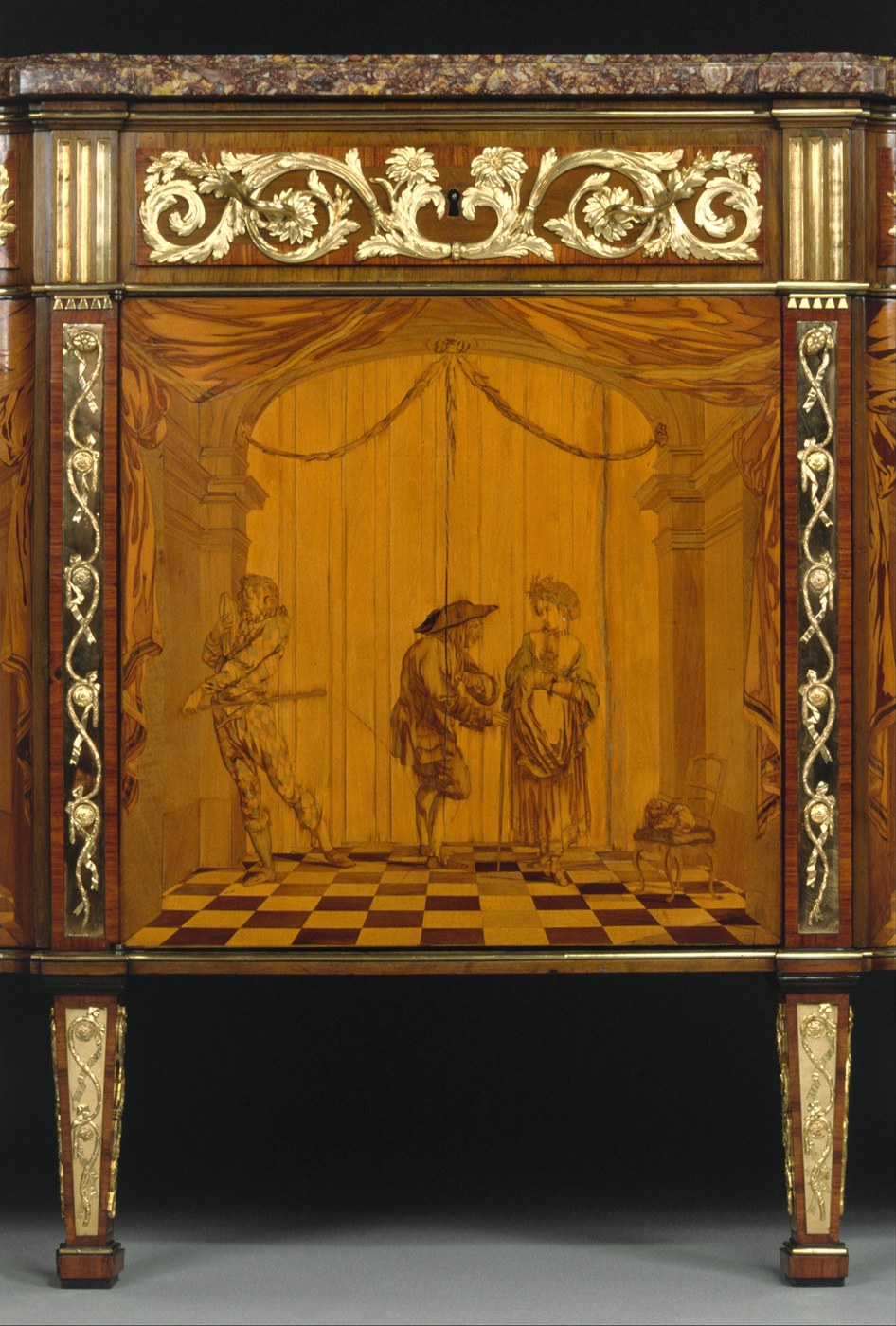


Veneer Marquetry
Marquetry is picture-making in wood. Thin veneers of different species are cut to shape and assembled into a pattern like a jigsaw, then glued down onto a solid carcass as a single sheet. All the drawing is done with the natural grain, figure and colour of the timber — no stain, no paint.
It is worth separating two words people mix up. Marquetry assembles a picture from veneers and lays it on a surface. Intarsia cuts recesses into solid wood and inlays pieces into them. Both are old and both are Italian Renaissance specialities, but they are different operations, and a source that treats them as synonyms is being loose.
The traditional cutting method stacks the veneers and saws all the layers at once, so every piece is cut with the identical kerf and they fit each other by construction. That trick — cut once, fit everywhere — is the whole craft in one idea.
Maagizo
Draw the design at full size
Draw the design at full size
Draw the design full size on paper with clear closed outlines. Keep shapes chunky — anything narrower than 3 mm will break during handling.
Choose veneers by grain, not just colour
Choose veneers by grain, not just colour
Pick a species for each area and note the grain direction on your drawing. Grain running the length of a shape reads as movement; grain across it reads as texture. This is the drawing medium.
Vifaa kwa hatua hii:
 Karatasi ya ukoko wa mbao1 karatasiKaratasi ya ukoko wa mbao1 karatasiKaratasi ya ukoko wa mbao1 karatasi
Stack the veneers into a packet
Stack the veneers into a packet
Stack the veneers with a scrap sheet top and bottom, tape the edges, and pin the stack at two corners outside the design. Sawing all layers together is what makes the pieces fit.
Paste the drawing onto the packet
Paste the drawing onto the packet
Paste the paper drawing onto the top scrap sheet. You saw through the paper — it is a cutting guide that gets destroyed, which is why it goes on a sacrificial layer.
Pierce a starter hole for each internal shape
Pierce a starter hole for each internal shape
Drill a 1 mm hole inside every enclosed shape so the saw blade can be threaded through. Drill inside the waste area, never on the line.
Saw the packet on the line
Saw the packet on the line
Thread a fine blade and saw the whole packet, following the line exactly. Every layer is being cut to the same shape at the same time — that is the point, so wandering off the line spoils every piece at once.
Zana zinazohitajika:
 Msumeno wa kukata mikunjo
Sort the pieces by layer
Sort the pieces by layer
Open the packet and sort every cut piece by which veneer it came from. You now have the same shape in each species — pick and mix to build the picture.
Assemble face down on gummed tape
Assemble face down on gummed tape
Lay the picture out face down and hold it together with gummed paper tape across the joints. The tape goes on the show face — it is removed after glue-up, and masking tape leaves adhesive that blocks finish.
Zana zinazohitajika:
 Utepe wa karatasi yenye gundi
Prepare the groundwork
Prepare the groundwork
Flatten the substrate and key it with 120 grit. Veneer telegraphs every lump beneath it, and a hollow will show as a visible dip once light rakes across the finished panel.
Vifaa kwa hatua hii:
 Bati la mbao za kubandika1 kipande
Zana zinazohitajika:
 Sandarusi (karatasi ya kusugua)
Warm the hide glue
Warm the hide glue
Warm hide glue to about 60 °C — thin cream consistency. Too cool and it gels before the veneer is down; too hot for too long and it loses strength.
Vifaa kwa hatua hii:
 Gundi ya ngozi ya wanyama100 ml
Hammer veneer the panel down
Hammer veneer the panel down
Brush glue on both surfaces, lay the taped assembly tape-side up, and work a veneer hammer from the centre outward in overlapping strokes to squeeze out glue and air. Reheat any lifted spot and re-press — hide glue re-melts, which is the whole reason it is still used.
Zana zinazohitajika:
 Nyundo ya kubandika bamba jembamba
Tap for voids
Tap for voids
Once cool, tap across the panel with a fingernail. A hollow tick means a void — reheat that spot with an iron through paper and press it down again.
Damp off the tape and level
Damp off the tape and level
Damp the gummed tape, peel it off, and level the surface with a card scraper. Sand only lightly — veneer is under a millimetre thick and sanding through is unrecoverable.
Zana zinazohitajika:
Sandarusi (karatasi ya kusugua)Oil the surface
Oil the surface
Wipe on boiled linseed oil and wipe off the surplus. Oil deepens the colour differences between species and is the moment the picture actually appears.
Vifaa kwa hatua hii:
 Mafuta ya Kitani Yaliyochemshwa50 ml
History & Context
History & Context
Marquetry is not intarsia. Intarsia sets pieces of wood — sometimes with bone, ivory or mother-of-pearl — into recesses cut in a solid matrix: floors, walls, table tops. Marquetry assembles a pattern out of veneers and glues the assembled sheet onto a carcass. The inlay tradition centred on Siena from around the 11th century and was heavily used for church furniture and panelling; during the Italian Renaissance wood inlay decorated both furniture and walls. The two words are often used interchangeably, including by people who should know better.
The donkey. Early marquetry was cut with a fretsaw or a "donkey" — a horizontal fretsaw with a foot-operated clamp that grips the packet and leaves both hands free to steer. It was the only practical way to work the heavy sawn veneers of up to 6 mm that early marquetry used. Modern veneer is far thinner, which is why a hand fretsaw is now enough.
Why stack-cutting is the whole idea. Cutting all layers at once means the saw kerf is identical for the piece and the hole it drops into. Cut them separately and every joint carries the error of two independent cuts. This is the same principle as transferring dovetails from the tails to the pins rather than measuring both: let one physical cut define both mating surfaces.
Hide glue, again. Hammer veneering with hide glue is reversible with heat and moisture, which means marquetry can be repaired almost indefinitely — lifted, re-laid, patched, taken apart by a conservator two centuries later. That is why antique marquetry survives at all. A panel laid with modern PVA is a one-shot object.
Grain as pigment. The discipline of marquetry is that you have no paint. Shade comes from choosing a darker species, movement from grain direction, shimmer from figured timber that reflects light differently as you move. Some traditions scorch pieces in hot sand to shade an edge — a burn used as a gradient. Working within that constraint is what gives good marquetry its particular quiet quality.
Vifaa
4- 1 karatasiKishikilia Nafasi
- 1 kipandeKishikilia Nafasi
- Kishikilia Nafasi
- Kishikilia Nafasi
Zana Zinazohitajika
5- Kishikilia Nafasi
- Kishikilia Nafasi
- Kishikilia Nafasi
- Kishikilia Nafasi
- Kishikilia Nafasi
Mchoro huu unatengeneza

CC0 Umma Wote
Mchoro huu umetolewa chini ya CC0. Uko huru kunakili, kubadilisha, kusambaza, na kutumia kazi hii kwa madhumuni yoyote, bila kuomba ruhusa.
Saidia Mtengenezaji kwa kununua bidhaa kupitia Mchoro wao ambapo wanapata Kamisheni ya Mtengenezaji iliyowekwa na Wachuuzi, au unda marudio mapya ya Mchoro huu na uiunganishe kama kiungo katika Mchoro wako kuchangia mapato.