예술
뷰티 및 웰니스
공예
문화 및 역사
엔터테인먼트
환경
음식 및 음료
역공학
과학
스포츠
기술
웨어러블
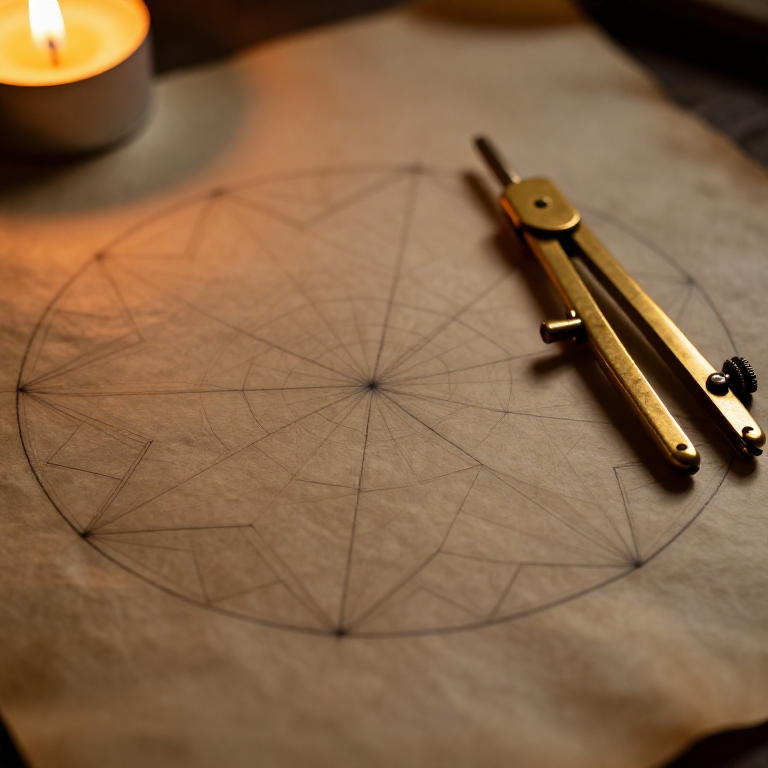


Measuring Pi — Archimedes' Method of Squeezing a Circle Between Polygons
Pi is the ratio of any circle's circumference to its diameter — the same number for every circle. You can measure it roughly with a string, but around 250 BC Archimedes found it exactly, with no measuring at all. He trapped a circle between a polygon drawn just inside it and one just outside, then doubled the sides again and again until the two polygons closed in on the circle from both directions. With 96-sided polygons he proved pi lies between 3+10/71 and 3+1/7. This blueprint walks through both the string measurement and Archimedes' rigorous squeeze.
중급
30 minutes
안내
1
1
Understand what pi is
Understand what pi is
Pi is the ratio of a circle's circumference (the distance around) to its diameter (the distance across). It is the same for every circle, large or small. Its value begins 3.14159… and never ends or repeats.
2
2
Measure pi with a string
Measure pi with a string
Wrap a cord snugly around a round object and mark its circumference, then measure straight across for the diameter. Divide circumference by diameter — you will get about 3.14. Try several sizes; the ratio stays the same every time.
필요한 도구:
 면 조리용 실
 줄자
줄자3
3
See the limit of measuring
See the limit of measuring
A cord and ruler give only two or three good digits — small measuring errors spoil the rest. To pin pi down exactly you need geometry, not string. This is the leap Archimedes made.
4
4
Trap the circle between two polygons
Trap the circle between two polygons
Draw a circle, then a regular polygon just inside touching it and another just outside enclosing it. The circle's circumference must lie between the two polygon perimeters — smaller than the outer, larger than the inner.
필요한 도구:
 붉은오리나무 판재
 먹줄통(초크라인)
5
5
Start with hexagons
Start with hexagons
Begin with six-sided polygons — the easiest to draw, since a hexagon's side equals the circle's radius. Their perimeters already bracket pi between 3 and about 3.46. Good, but still loose.
6
6
Keep doubling the sides
Keep doubling the sides
Double the sides: 6 to 12 to 24 to 48 to 96. Each doubling makes both polygons hug the circle more closely, so the inner and outer perimeters squeeze together and the gap that must contain pi shrinks.
7
7
Reach Archimedes' bounds
Reach Archimedes' bounds
At 96 sides Archimedes proved pi is greater than 3+10/71 (about 3.1408) and less than 3+1/7 (about 3.1429). The true value 3.14159… sits right in that gap — found by pure reasoning, with no ruler touching the circle.
8
8
Go as far as you like
Go as far as you like
The doubling never stops: more sides give more digits of pi, as many as your patience allows. Archimedes' squeeze was the best method known for almost two thousand years, until calculus offered faster ones.
관련 블루프린트
이 블루프린트들은 지식을 공유합니다 — 기술, 재료 또는 원리

CC0 퍼블릭 도메인
이 블루프린트는 CC0로 공개되었습니다. 어떤 목적으로든 자유롭게 복사, 수정, 배포 및 사용할 수 있습니다.
제품 구매를 통해 메이커를 지원하세요. 판매자가 설정한 메이커 커미션 을 받거나, 이 블루프린트의 새로운 반복을 만들어 연결로 포함시킬 수 있습니다.