

Building a Lever-and-Weight Olive Press — Mechanical Extraction
안내
Crush the Olives
Crush the Olives
Before pressing, the olives must be crushed to a paste (including the pits) to rupture the oil-containing cells. Use a stone olive mill (trapetum) — a large stone basin with a rounded stone roller that crushes olives as it is rotated. Alternatively, crush the olives in a stone mortar with a heavy pestle, or tread them underfoot on a clean stone surface. The paste should be uniform, with no whole olives remaining. Including the crushed pits is important — the hard pit fragments act as channels that help oil drain through the paste during pressing. Allow the paste to rest for 30-60 minutes before pressing to let oil begin separating.
Build the Press Frame
Build the Press Frame
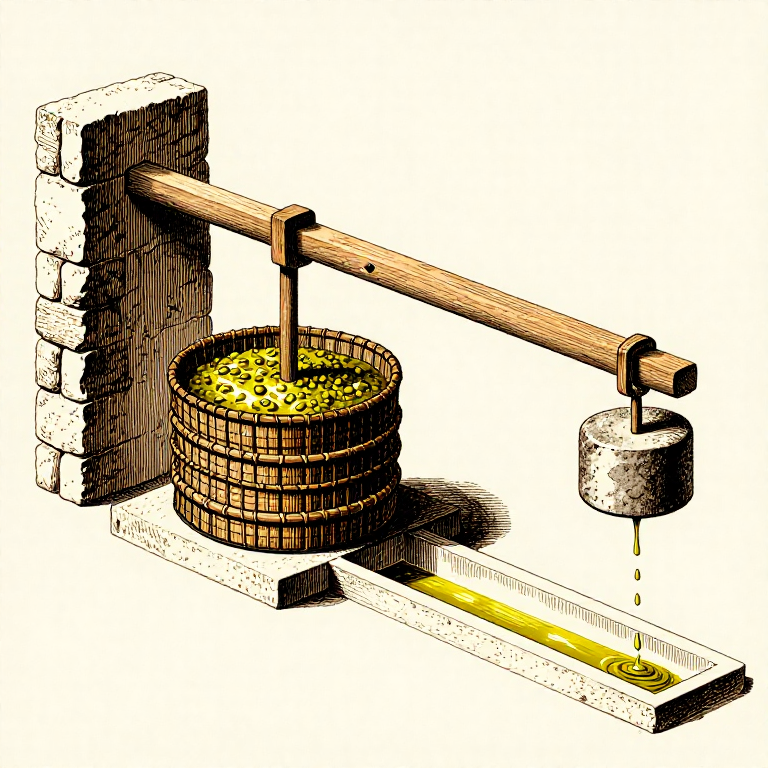
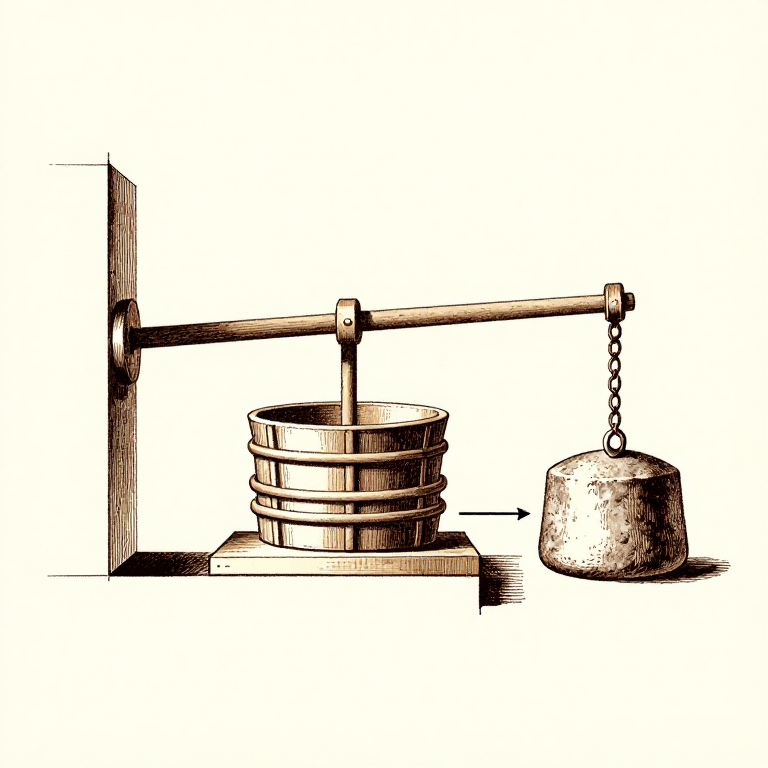
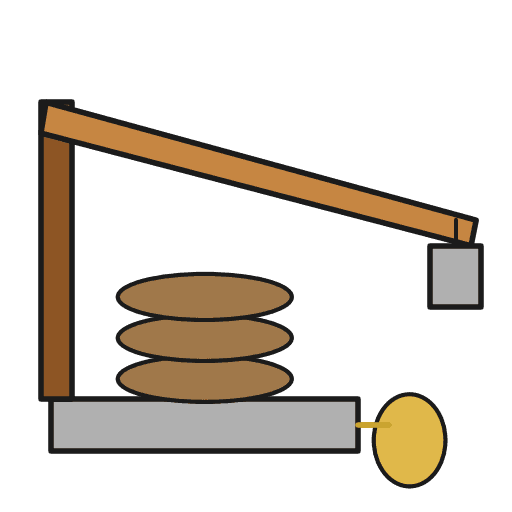
The lever press consists of a heavy beam anchored at one end and free to pivot at the other. Fix the thick end of the beam into a slot carved in a stone wall or between two upright stone pillars (orthostats) — this is the fulcrum. The beam must be rigidly held at this point so it can only move up and down like a see-saw. The free end extends 3-5 metres outward. Beneath the beam, near the anchor point, construct a flat stone pressing platform with a channel around its perimeter to collect the expressed oil and direct it into a stone basin. This is a class 2 lever — the load (olive paste) is between the fulcrum and the effort (weights).
이 단계의 재료:
 장작1 beam, 3-5 m long, 20-30 cm diameter m
Stack the Press Baskets
Stack the Press Baskets
Spread the crushed olive paste onto flat, round woven rush baskets (called frails or fiscoli), building a stack 5-10 baskets high beneath the beam. Each basket holds 5-10 kg of paste, spread 3-5 cm thick. The woven structure allows oil to seep through the rush fibers while retaining the solid pomace. Place flat wooden or stone discs between every 2-3 baskets to distribute pressure evenly through the stack. Position the stack directly beneath the beam, centred on the pressing platform. The collection channel around the platform catches all expressed oil and drains it into the stone basin.
Apply Pressure and Extract Oil
Apply Pressure and Extract Oil
Hang heavy stone weights from the free end of the beam using ropes. The lever effect multiplies the force of the weights — a 3-metre beam with weights at the end generates roughly 3 times the weight force at the pressing point. Add weights gradually to increase pressure slowly. Sudden pressure causes the paste to squeeze out of the baskets rather than releasing oil. Oil begins flowing within minutes of initial pressure application. Continue adding weights over several hours. The first pressing (cold-pressed) produces the finest quality oil — pale green, fragrant, and lowest in acidity. After the first pressing, the pomace can be remixed with hot water and pressed again for a lower-quality second pressing.
Separate Oil from Water
Separate Oil from Water
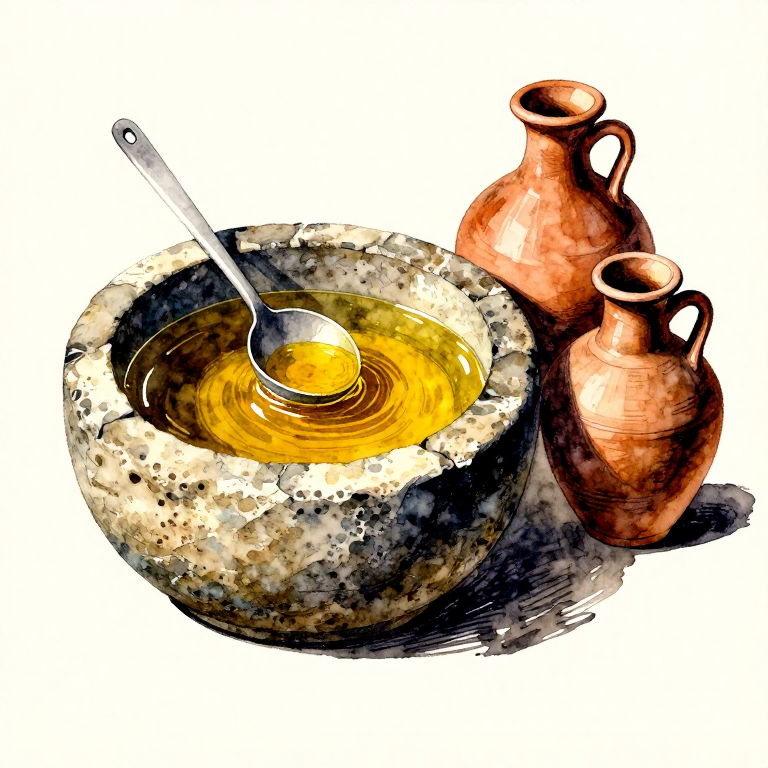
The liquid collected in the basin is a mixture of olive oil and water (vegetation water from the fruit). Because oil is less dense than water (olive oil density is approximately 0.91 g/cm3), it floats naturally to the surface. Allow the mixture to settle in a deep stone or clay vessel for several hours. Skim the oil layer off the top using a flat ladle or shell, or decant it by siphoning. Transfer the oil through progressively smaller settling vessels to remove residual water and sediment — three stages of settling was standard in ancient oil production. Well-settled olive oil stores for up to two years in sealed clay amphorae kept in a cool, dark place. The ancient Mediterranean economy ran on olive oil — it was used for cooking, lighting, bathing, religious ritual, medicine, and as the base for perfumes and cosmetics.
재료
11- 1 beam, 3-5 m long, 20-30 cm diameter m플레이스홀더
- 1 beam, 3-5 m long, 20-30 cm diameter 개플레이스홀더
- 2 stones with slots, or a stone wall niche 개플레이스홀더
- 2-4 large stones, 50-100 kg each 개플레이스홀더
- 5-10 flat round baskets 개플레이스홀더
- 1 large basin 개플레이스홀더
- 100+ kg 개플레이스홀더
- 2 개플레이스홀더
- 1 미터플레이스홀더
- 플레이스홀더
- 플레이스홀더
필요 도구
3- 플레이스홀더
- 플레이스홀더
- 플레이스홀더
이 블루프린트로 만드는 것
CC0 퍼블릭 도메인
이 블루프린트는 CC0로 공개되었습니다. 어떤 목적으로든 자유롭게 복사, 수정, 배포 및 사용할 수 있습니다.
제품 구매를 통해 메이커를 지원하세요. 판매자가 설정한 메이커 커미션 을 받거나, 이 블루프린트의 새로운 반복을 만들어 연결로 포함시킬 수 있습니다.