
Constructing a Wooden Ard Plow — The Scratch Plow
안내
Select and Shape the Main Components
Select and Shape the Main Components
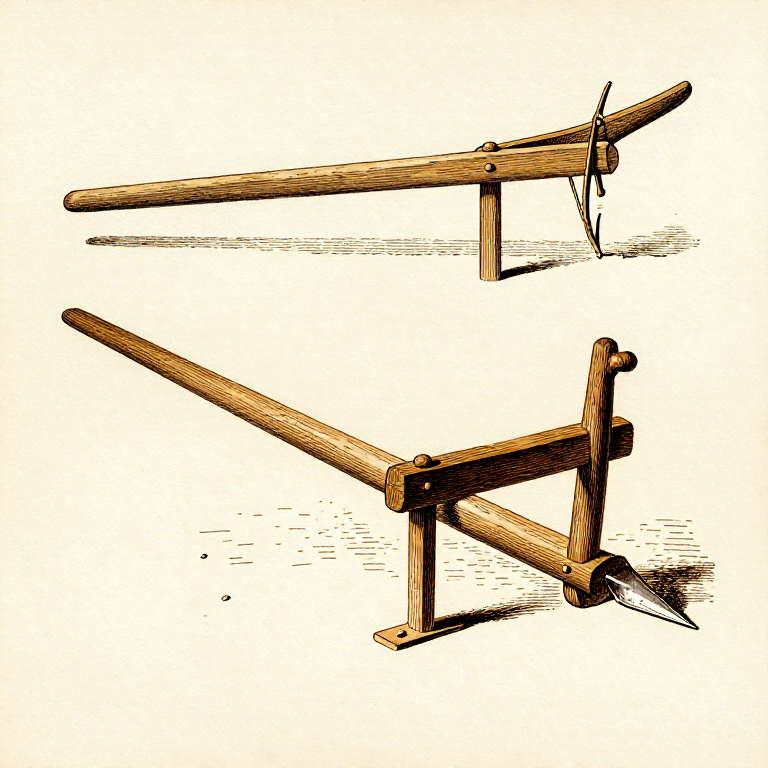
The ard has three main components: the beam (which connects to the yoke and draft animal), the stilt or handle (which the plowman holds to guide the plow), and the share or sole (the pointed piece that penetrates the ground). The simplest ard is made from a single naturally forked branch where the fork provides the junction between beam and share. Select a sturdy hardwood branch with a natural Y-fork at roughly 30-40 degrees. The longer arm becomes the beam (2-3 metres), and the shorter arm becomes the share (40-60 cm). Trim and shape both arms with a stone adze.
이 단계의 재료:
 경목 재1 large branching piece or 3 separate pieces 개
 노끈·밧줄3-5 m m
 단단한 나무 손잡이1 piece 개
필요한 도구:
 자귀
자귀 부싯돌 칼
부싯돌 칼 불
불Shape the Share
Shape the Share
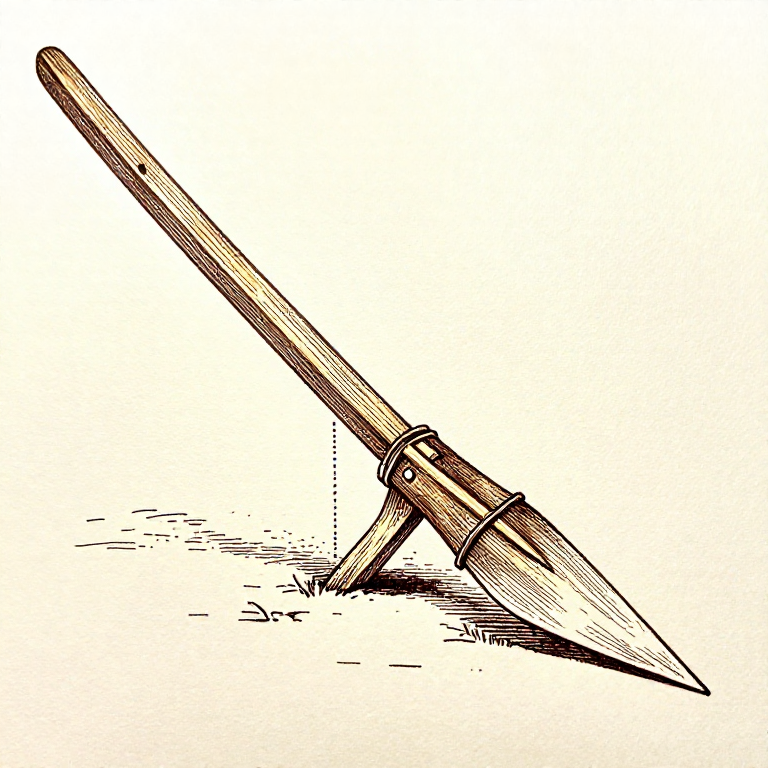
The share is the working end that cuts through the soil. Shape it to a pointed or chisel-like tip that penetrates hard ground. For durability, fire-harden the tip by charring it lightly over coals — this drives out moisture and cross-links the wood polymers, significantly increasing surface hardness. Alternatively, tip the share with a stone or (in later periods) a bronze or iron shoe. The share should angle downward at approximately 15-25 degrees from horizontal when the plow is in working position — too steep and it digs in and stalls; too shallow and it rides over the surface without cutting.
Attach the Stilt Handle
Attach the Stilt Handle
The stilt (handle) rises upward from the junction of beam and share, allowing the plowman to press down on the share and guide its direction. If your forked branch has only two arms, add a separate stilt by drilling or burning a mortise hole through the beam near the fork and inserting a straight handle, lashing it securely with rawhide or sinew. The stilt should rise to a comfortable working height (approximately waist to chest height on the plowman). Some ards have two stilts for better control. The stilt must be sturdy — the plowman applies significant downward force through it to keep the share engaged in the soil.
Attach the Draft Connection
Attach the Draft Connection
The front end of the beam connects to the draft animal (oxen were the primary draft animals in the ancient Near East). Drill a hole through the beam tip and insert a peg or pin that connects to the yoke via a rope or leather strap. The connection must allow some lateral movement so the plow can adjust to uneven ground without breaking. The beam length (2-3 metres) keeps the plowman at a safe distance behind the animals. The yoke sits across the necks of a pair of oxen, distributing the draft force. The connection angle between beam and ground should allow the share to maintain its cutting angle during steady forward motion.
이 단계의 재료:
경목 재1 large branching piece or 3 separate pieces 개노끈·밧줄3-5 m m단단한 나무 손잡이1 piece 개Plowing Technique
Plowing Technique
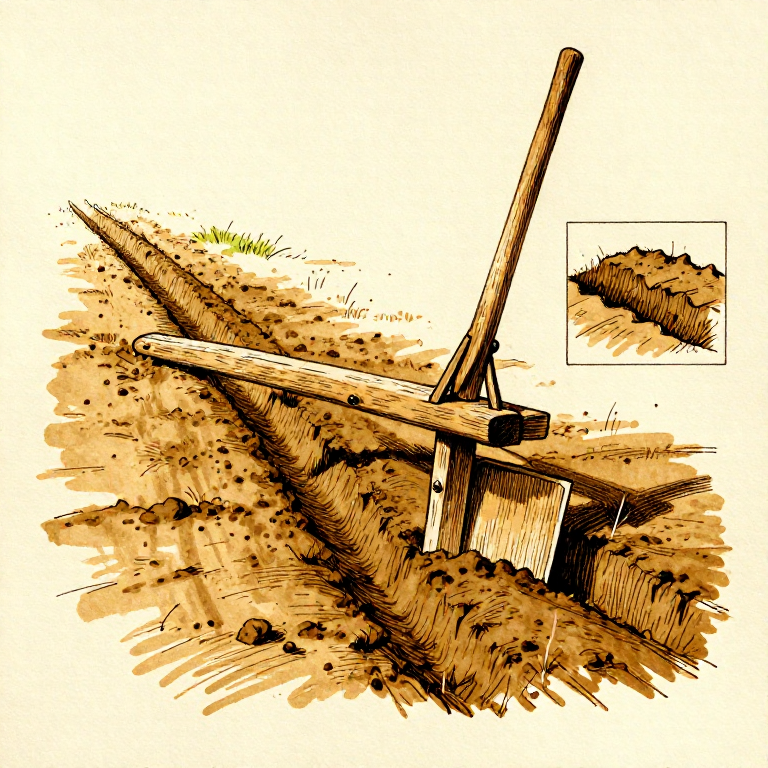
To plow, the draft animals pull the ard forward while the plowman walks behind, pressing down on the stilt to maintain the share's penetration depth (typically 10-15 cm for an ard). The ard cuts a narrow V-shaped furrow without turning the soil. Cross-plow the field in two passes at right angles — this breaks the soil into small blocks suitable for seeding. This cross-plowing technique is specifically suited to the light, dry soils of the Mediterranean and Near East. Sumerian administrative texts from the third millennium BCE describe teams of oxen plowing assigned field areas with specific seed-planting quotas, demonstrating sophisticated agricultural management. The ard remained the dominant plow type in the Mediterranean until the Roman period.
재료
3- 1 large branching piece or 3 separate pieces 개플레이스홀더
- 3-5 m m플레이스홀더
- 1 piece 개플레이스홀더
CC0 퍼블릭 도메인
이 블루프린트는 CC0로 공개되었습니다. 어떤 목적으로든 자유롭게 복사, 수정, 배포 및 사용할 수 있습니다.
제품 구매를 통해 메이커를 지원하세요. 판매자가 설정한 메이커 커미션 을 받거나, 이 블루프린트의 새로운 반복을 만들어 연결로 포함시킬 수 있습니다.