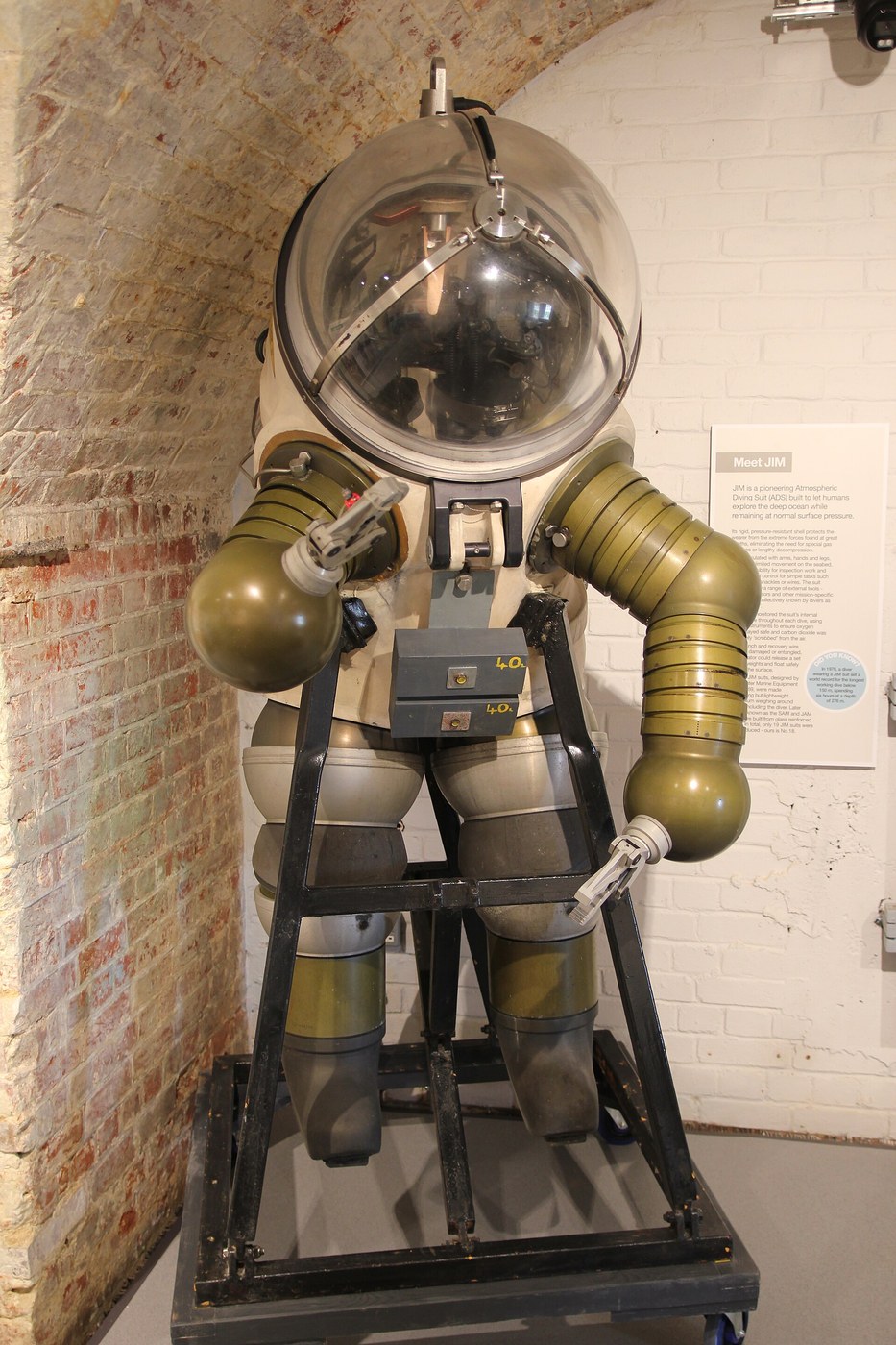


The Atmospheric Diving Suit
안내
Compare the two philosophies on one chart
Compare the two philosophies on one chart
필요한 도구:
 데스크톱 컴퓨터
Why an ordinary joint seizes under pressure
Why an ordinary joint seizes under pressure
Build the naive version and watch the sea defeat it.
- Make a simple rotating joint: two tubes with an O-ring seal between them, free to turn.
- Turn it in air and note the torque needed.
- Now pressurise the outside of the joint in a test vessel and try to turn it again.
- Increase the pressure in steps, measuring the torque each time.
Torque rises steeply with pressure, because the pressure is squeezing the seal harder against its running surface AND pressing the joint faces together. By a few tens of bar an ordinary joint cannot be turned by a human at all.
Now compute the force involved: at 600 m the pressure is about 61 bar, and on a joint 100 mm across that is roughly 4.8 tonnes trying to close it. The operator has to move an elbow against that, using human muscle, all day.
This is the entire engineering problem of the atmospheric diving suit, and it is why early rigid suits from the 1920s were nearly useless — the operator could reach the bottom in perfect physiological safety and then could not bend an arm to do anything once there.이 단계의 재료:
 알루미늄 환봉1 개
 오링 모음 키트1 키트
 투명 압력 용기1 개
필요한 도구:
 금속 선반
금속 선반 토크 렌치
토크 렌치 압력계
압력계 30갤런 공기 압축기
 얼굴 가리개
The fluid-supported rotary joint
The fluid-supported rotary joint
The fix is to stop the pressure from ever bearing on the sliding surface.
- Rebuild the joint with an oil-filled annular chamber between the two halves, sealed from the sea by a flexible diaphragm.
- The diaphragm lets sea pressure act on the OIL rather than on the bearing.
- Because the oil is at sea pressure on both sides of the bearing, the net force across the bearing is near zero.
- Pressurise and measure torque again.
Torque now stays nearly constant as pressure rises, because the joint is pressure-BALANCED — the load is carried by the oil, not by the sliding faces.
This is the same reasoning as the SF6 breaker shaft seal and the rocket turbopump's purged interspace: put a fluid between the two things that must not meet, and keep it at a pressure that cancels the load. The catalogue has now met that pattern three times in three unrelated domains.
Modern ADS joints such as the JIM and Newtsuit families use exactly this, with the joint segments cut at compound angles so a chain of simple rotations produces a natural-looking bend. The arm does not have an elbow; it has a stack of rotating rings that together behave like one.이 단계의 재료:
알루미늄 환봉1 개 식품용 광유1 리터오링 모음 키트1 키트
 고무 시트1 장
필요한 도구:
금속 선반 밀링 바이스 4인치토크 렌치압력계얼굴 가리개
Life support, and the CO2 that matters more than oxygen
Life support, and the CO2 that matters more than oxygen
Follow the loop, and note which sensor is primary. The operator is not going to run out of oxygen — a small cylinder lasts many hours. What runs out is the scrubber's ability to absorb carbon dioxide, and rising CO2 is far more dangerous because the body's alarm for it is unreliable at depth.
Breathlessness is triggered by CO2 in normal circumstances, but in a closed loop with adequate oxygen the warning is muted — the classic pattern is a headache, then poor judgement, then nothing.
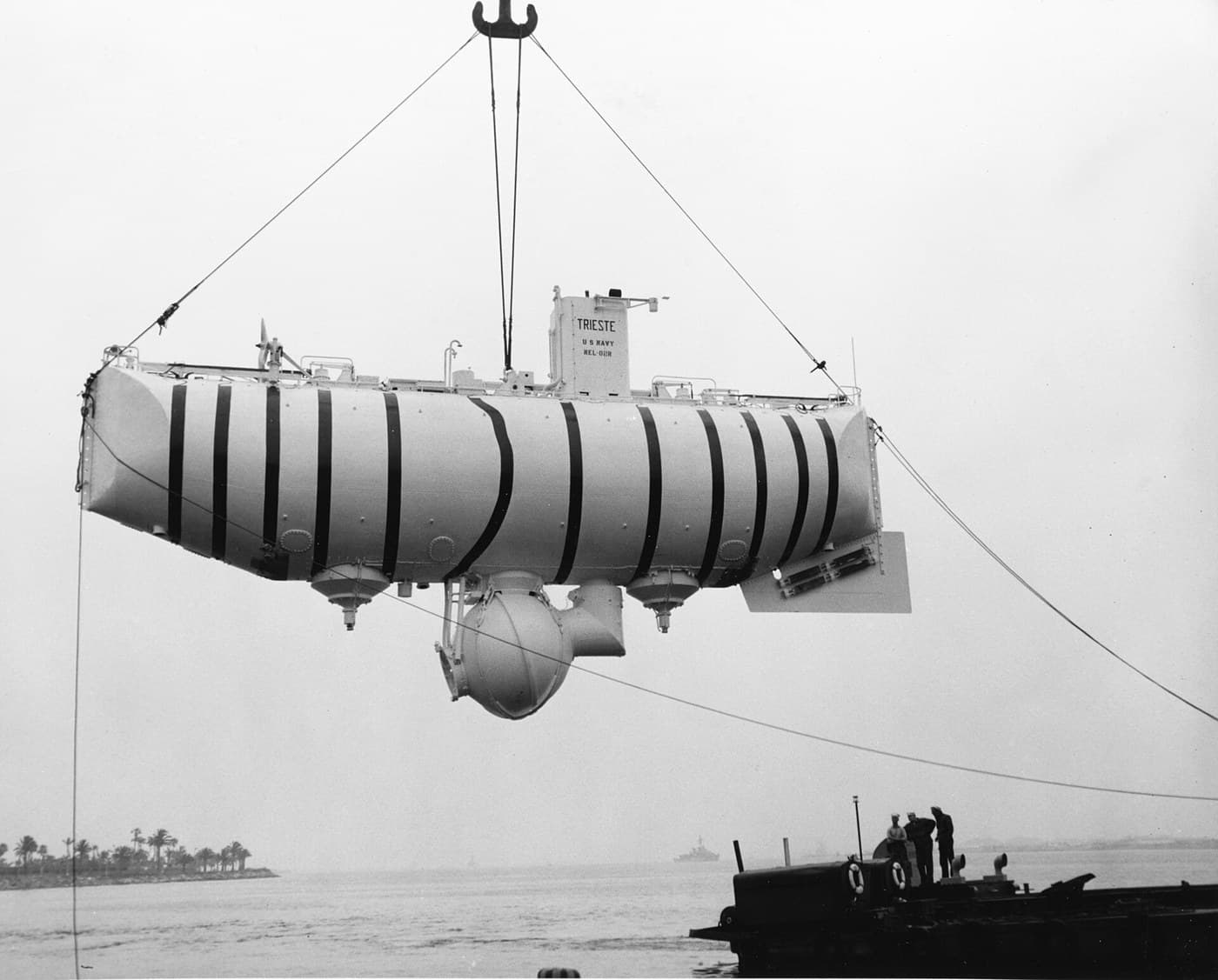
Reverse-engineering note: an ADS carries 48 hours or more of reserve for a dive of a few hours, because the failure mode is being stuck rather than being flooded. The suit is designed so a trapped operator survives long enough to be recovered — and like the bathyscaphe, releasing ballast makes it float, so the default failure is upward.Flow
이 단계의 재료:
 소다석회 (이산화탄소 흡수제)1 kg
 CO2 센서 모듈(NDIR)1 개
 산소 센서 셀1 개
필요한 도구:
데스크톱 컴퓨터 실험실급 디지털 멀티미터
 납땜 스테이션
Where the ADS wins, and where it does not
Where the ADS wins, and where it does not
Close the batch by placing every method on one axis.
- Tabulate: helmet diving, scuba, saturation diving, ADS, and a remotely operated vehicle.
- For each, record depth limit, decompression obligation, dexterity, endurance and cost.
- Mark which task each one wins.
The ADS gives depth and zero decompression and takes away dexterity. Manipulators are clumsy compared with a gloved hand, so delicate work still goes to a saturation diver who can feel what they are doing — at the cost of weeks of their life per job.
And the honest end of the story: for most deep work, the winning answer removed the human entirely. An ROV has no decompression, no life support, no fatigue and no limit but its tether, and modern ones have manipulators approaching a diver's usefulness.
That is the same move this session keeps finding. The turbojet deleted the propeller, staging deleted the exponential, nuclear power deleted the need to breathe, and the ROV deleted the diver. Optimising within a constraint has a ceiling; removing the constraint does not. The ADS is the last and cleverest answer to the question of how to put a person very deep — and the question itself turned out to be optional.필요한 도구:
데스크톱 컴퓨터재료
8- 1 개플레이스홀더
- 1 키트플레이스홀더
- 1 개플레이스홀더
- 1 리터플레이스홀더
- 1 장플레이스홀더
- 1 kg플레이스홀더
- 플레이스홀더
- 1 개플레이스홀더
관련 블루프린트
이 블루프린트들은 지식을 공유합니다 — 기술, 재료 또는 원리


CC0 퍼블릭 도메인
이 블루프린트는 CC0로 공개되었습니다. 어떤 목적으로든 자유롭게 복사, 수정, 배포 및 사용할 수 있습니다.
제품 구매를 통해 메이커를 지원하세요. 판매자가 설정한 메이커 커미션 을 받거나, 이 블루프린트의 새로운 반복을 만들어 연결로 포함시킬 수 있습니다.