

Bell Telephone
The telegraph could send a click. Sending a voice is a different problem entirely: speech is a continuously varying pressure wave, and a click is a switch. You cannot build a voice out of on and off, however fast you go.
The answer is to stop switching and start varying. A membrane moves with the sound pressure, that motion varies a current continuously, and at the far end the varying current pulls a second membrane through the same motion. Nothing is coded. The wire carries an electrical analogue of the sound wave — which is where the word analogue comes from.
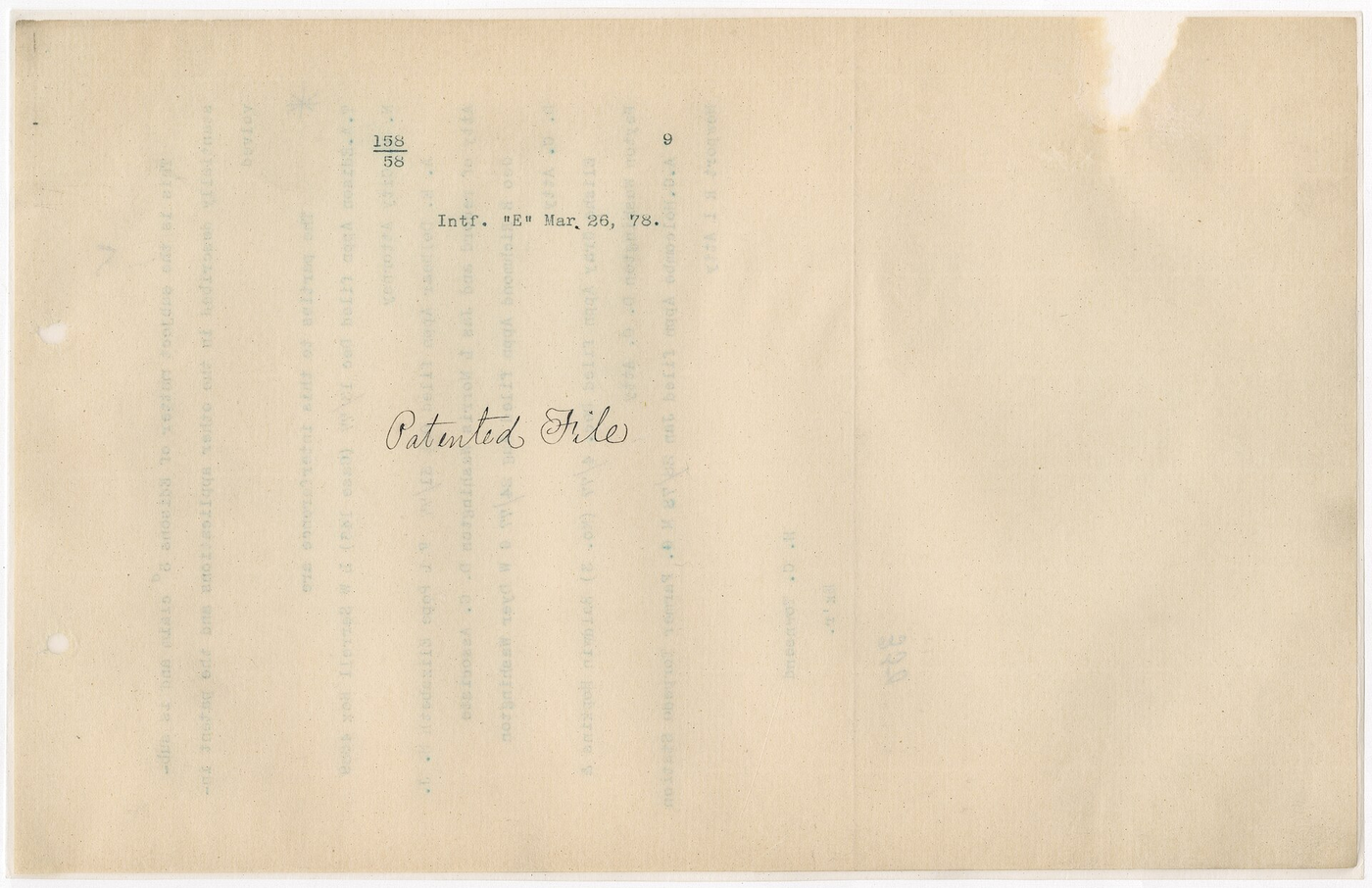
The patent is titled "Improvement in Telegraphy", not telephone. US Patent 174,465, granted to Alexander Graham Bell on 7 March 1876 — arguably the most valuable and most litigated patent ever issued, and one whose priority is still argued about.
안내
Read US 174,465 and note the title
Read US 174,465 and note the title
It is called "Improvement in Telegraphy". Bell was funded to build a multiplexed telegraph; the telephone emerged from that work and the paperwork never caught up.
Prove a switch cannot carry a voice
Prove a switch cannot carry a voice
Wire a buzzer through a key and try to say a word with it. You can send code arbitrarily fast and it still is not speech — the signal has no amplitude information.
Wind a coil on a soft iron core
Wind a coil on a soft iron core
Wind several hundred turns of fine enamelled wire onto an iron core. Two of these, identical, are the whole instrument.
이 단계의 재료:
 에나멜 피복 구리선50 미터
Fit a permanent magnet behind the core
Fit a permanent magnet behind the core
Mount a magnet against the core so the coil sits in a steady field. Without a bias magnet the output doubles in frequency and the voice is unrecognisable.
이 단계의 재료:
 네오디뮴 자석 모둠2 개
Cut a thin iron diaphragm
Cut a thin iron diaphragm
Cut a disc of thin ferrous sheet to sit just clear of the core. It must be thin enough to move with a voice and stiff enough to return.
이 단계의 재료:
 연강 판1 장
Set the air gap as small as you dare
Set the air gap as small as you dare
Under a millimetre, without touching. Sensitivity falls off sharply with gap — this single clearance decides whether the thing works at all.
필요한 도구:
 자
자Clamp the diaphragm only at its rim
Clamp the diaphragm only at its rim
Hold it around the edge so the centre is free to move. Clamped anywhere else it becomes a plate, not a membrane.
Build the second unit identically
Build the second unit identically
Make an exact copy. In Bell's design the transmitter and receiver are the SAME device — the effect runs in both directions.
Wire the two coils in a single loop
Wire the two coils in a single loop
Connect them with two wires and nothing else. No battery, no amplifier — the speaker's voice supplies all the energy.
이 단계의 재료:
 구리선20 미터
Speak loudly into one and listen at the other
Speak loudly into one and listen at the other
Press the second unit to your ear. It is faint and it is unmistakably a voice — this is a magneto telephone and it needs no power source.
Understand where the current comes from
Understand where the current comes from
The moving iron diaphragm changes the magnetic flux through the coil and induces a voltage — Faraday's law. Your voice is doing the generating.
Now build a carbon transmitter and compare
Now build a carbon transmitter and compare
Fill a small chamber with carbon granules behind a diaphragm and pass a battery current through it. Pressure changes resistance, so the battery is modulated instead of the voice generating power.
이 단계의 재료:
 덩어리 숯50 g
Measure how much louder the carbon version is
Measure how much louder the carbon version is
It is dramatically louder, because it is an amplifier — the voice controls battery energy rather than supplying it. Edison's carbon transmitter, not Bell's, is what made telephony practical over distance.
Lengthen the line and find the limit
Lengthen the line and find the limit
Add wire and re-test. The magneto version fades quickly; the carbon version carries much further. Line loss is why the network needed loading coils and later repeaters.
Compendium — an analogue, not a code
Compendium — an analogue, not a code
The patent. US 174,465, "Improvement in Telegraphy", granted 7 March 1876 to Alexander Graham Bell. Its commercial value was extraordinary and it was litigated more than almost any patent in history — the Bell company fought some six hundred challenges and won essentially all of them. Bell's famous first intelligible sentence to Thomas Watson came three days after the grant, on 10 March 1876.
The priority dispute is real and unresolved. Elisha Gray filed a caveat describing a liquid transmitter at the same patent office on the same day, 14 February 1876. Antonio Meucci had demonstrated voice-over-wire devices in New York from the 1850s but could not afford to maintain a patent caveat; in 2002 the US House of Representatives passed a resolution recognising his contribution. Johann Philipp Reis built a working sound transmitter in Germany in 1861. Bell got the patent and built the industry; the claim that he was the sole originator of the idea does not survive contact with the record, and it is worth stating that plainly rather than smoothing it over.
Two ways to modulate a wire. Bell's magneto instrument is a generator: a moving iron diaphragm alters the flux through a coil and induces a current directly, so the sound energy of the voice IS the signal energy. It needs no battery and it is symmetrical — the same unit works as microphone or earpiece. A carbon transmitter is instead a variable resistor: sound pressure squeezes carbon granules, resistance falls, and a battery current is modulated. That is amplification, and it delivered vastly more signal power to the line. Edison patented the carbon transmitter and it, combined with Bell's receiver, is what the telephone network actually ran on for a century.
Why the bias magnet matters. An iron diaphragm in front of a plain electromagnet is attracted regardless of current direction, so it responds twice per cycle and the output is distorted to double frequency. Adding a permanent magnet biases the system so the varying field adds to or subtracts from a steady one, and the diaphragm follows the waveform linearly. It is the same reason a loudspeaker has a permanent magnet, and the same class of trick as biasing an amplifier — build the signal on top of a steady offset so the response stays linear.
관련 블루프린트
이 블루프린트들은 지식을 공유합니다 — 기술, 재료 또는 원리


CC0 퍼블릭 도메인
이 블루프린트는 CC0로 공개되었습니다. 어떤 목적으로든 자유롭게 복사, 수정, 배포 및 사용할 수 있습니다.
제품 구매를 통해 메이커를 지원하세요. 판매자가 설정한 메이커 커미션 을 받거나, 이 블루프린트의 새로운 반복을 만들어 연결로 포함시킬 수 있습니다.