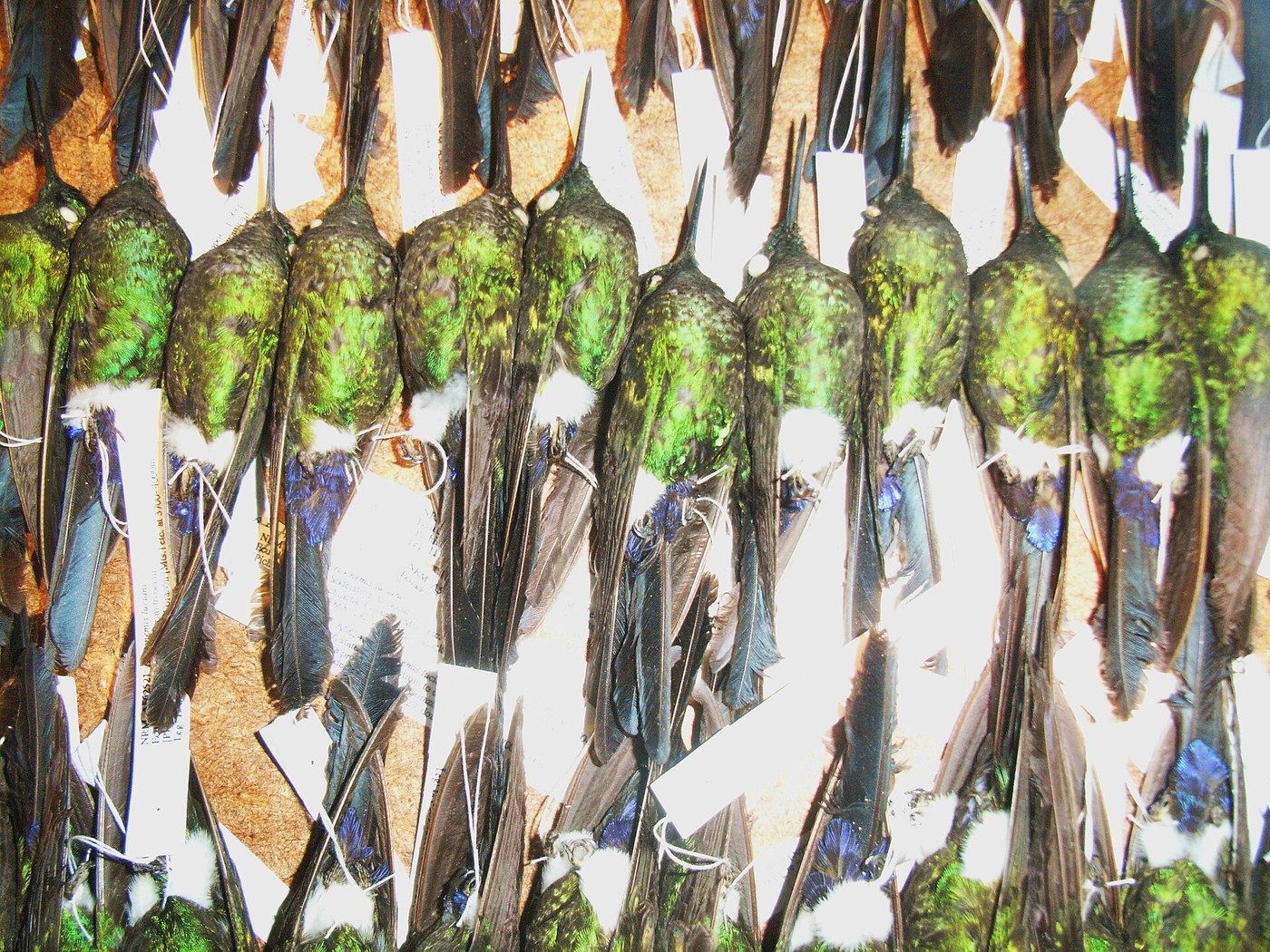


Bird Study Skin
A study skin is not a mounted display bird. It is a specimen prepared to a standard shape — wings folded, legs bound, laid on its back like a museum drawer full of identical parcels — so that hundreds can be stored in a small space and compared directly against one another.
The scientific value is almost entirely in the label. A beautifully prepared skin with no data is nearly worthless; a rough skin with full collection data is a permanent record. Museum collections built this way underpin ornithology, and specimens from the 1800s are still yielding new results — DDT thinning was demonstrated by measuring eggshells against historic collections, and modern work extracts DNA and isotopes from skins prepared long before either technique existed.
Before anything else, read the last step. Possessing wild birds — even ones found dead — is regulated in most countries, and in several it is a criminal offence without a permit.
안내
Confirm you may legally hold the bird
Confirm you may legally hold the bird
Check your national wildlife law first. In many countries possessing a wild bird, its parts, eggs or nest requires a permit even if the bird was found already dead. This is not optional and it is not a formality.
Record the data before you touch anything
Record the data before you touch anything
Write down the date, exact locality, who collected it and how it died. Do this first. A specimen without these is not scientific material, however well it is prepared.
Take measurements and weight
Take measurements and weight
Weigh the bird and measure wing, tail, tarsus and bill. Note moult state and any soft-part colours — eye, bill and leg colour fade or change entirely once dry, so they exist only in your notes.
필요한 도구:
 Steel Ruler
Wear gloves and work on a wipeable surface
Wear gloves and work on a wipeable surface
Gloves throughout. Wild birds can carry parasites and pathogens; this is ordinary hygiene, the same as handling raw poultry.
필요한 도구:
 Nitrile Gloves
Open the skin along the breast
Open the skin along the breast
Part the feathers to find the bare tract down the centre of the breast and cut the skin only — not the body wall. Birds have a natural feather-free line here, which is why the incision goes where it does.
필요한 도구:
 Scalpel
Work the skin free
Work the skin free
Ease the skin away from the body with fingers and the blunt side of the blade. Sprinkle cornmeal as you go to absorb moisture and stop the feathers matting — wet feathers are extremely hard to recover.
이 단계의 재료:
 Cornmeal200 g
Detach at the knees, wings and neck
Detach at the knees, wings and neck
Cut through at the knee joints and the wing joints, then work up to the skull and sever the neck. The body comes away as one piece, leaving the skin inside out.
Clean the skull and leg bones
Clean the skull and leg bones
Remove the brain, eyes and any flesh from the skull and leg bones, leaving the bones in place. Left-behind tissue is what makes a specimen rot or smell years later.
Rub the inside with borax
Rub the inside with borax
Work borax over every internal surface. Borax dries the skin and deters insects and fungi. It replaced the arsenic soap of the nineteenth century — see the last step for why that matters.
이 단계의 재료:
 Borax Powder200 g
Turn it back and fill with cotton
Turn it back and fill with cotton
Turn the skin right side out. Put a ball of cotton in each eye socket and form a cotton body around a dowel, sized to the original — not larger. An over-stuffed skin cannot be measured and takes more drawer space than it deserves.
이 단계의 재료:
 Cotton Wool100 g
Sew up and set the standard pose
Sew up and set the standard pose
Stitch the breast closed. Fold the wings against the body, cross the legs and tie them, and lay the bird on its back. Every study skin in a collection takes the same pose so that any two can be compared directly.
필요한 도구:
 Millinery Needle & Thread Set
Wrap and dry
Wrap and dry
Wrap loosely in a cotton sleeve or pin it to a board to hold the feathers in place, and dry in a cool airy place for one to two weeks. Heat cooks the skin and makes it brittle.
Tie the label to a leg
Tie the label to a leg
Write the scientific name, date, locality and preparator on a card label in permanent ink and tie it to a leg with thread. The label is the specimen. A skin whose label is lost cannot be recovered by any amount of later study.
이 단계의 재료:
 Card Stock1 장
History & Context
History & Context
Why the standard shape. Study skins are prepared to a uniform posture — on the back, wings folded, legs bound — because their purpose is comparison and storage, not display. Hundreds fit in one drawer, and any two can be laid side by side and measured against each other. A mounted bird in a lifelike pose is a display object; it takes fifty times the space and cannot be handled.
The label carries the science. Specimens are finished with a label giving scientific name, date and preparator, tied to a leg. Everything a specimen can tell you later depends on knowing where and when it came from — a skin without data cannot contribute to a distribution map, a moult study or a comparison across time.
Arsenic, and why we do not use it. Nineteenth and early twentieth century taxidermy relied heavily on arsenical soap, which preserved skins superbly and poisoned generations of preparators. Many historic museum specimens still contain arsenic and are handled with that in mind. Borax does the same job well enough without the toxicity, which is why this blueprint uses it and why no arsenic recipe appears here.
Old specimens answering new questions. The classic case is eggshell thinning: measuring museum eggs collected before and after DDT came into use demonstrated the effect and contributed to banning it. Skins prepared in the 1800s are now sampled for DNA, stable isotopes and pollutant residues — techniques their preparators could not have imagined. That is the argument for the standard shape and the careful label: you are preparing evidence for questions nobody has asked yet.
The legal position is serious. Many countries protect wild birds, their parts, eggs and nests, and possession without a permit can be a criminal offence regardless of how the bird died. Museums and licensed preparators work under specific permits. If you want to do this properly, the route is through a natural history museum or a licensed ringing scheme — not a bird found by the roadside.
재료
4- 200 g플레이스홀더
- 200 g플레이스홀더
- 100 g플레이스홀더
- 플레이스홀더
필요 도구
4- 플레이스홀더
- 플레이스홀더
- 플레이스홀더
CC0 퍼블릭 도메인
이 블루프린트는 CC0로 공개되었습니다. 어떤 목적으로든 자유롭게 복사, 수정, 배포 및 사용할 수 있습니다.
제품 구매를 통해 메이커를 지원하세요. 판매자가 설정한 메이커 커미션 을 받거나, 이 블루프린트의 새로운 반복을 만들어 연결로 포함시킬 수 있습니다.