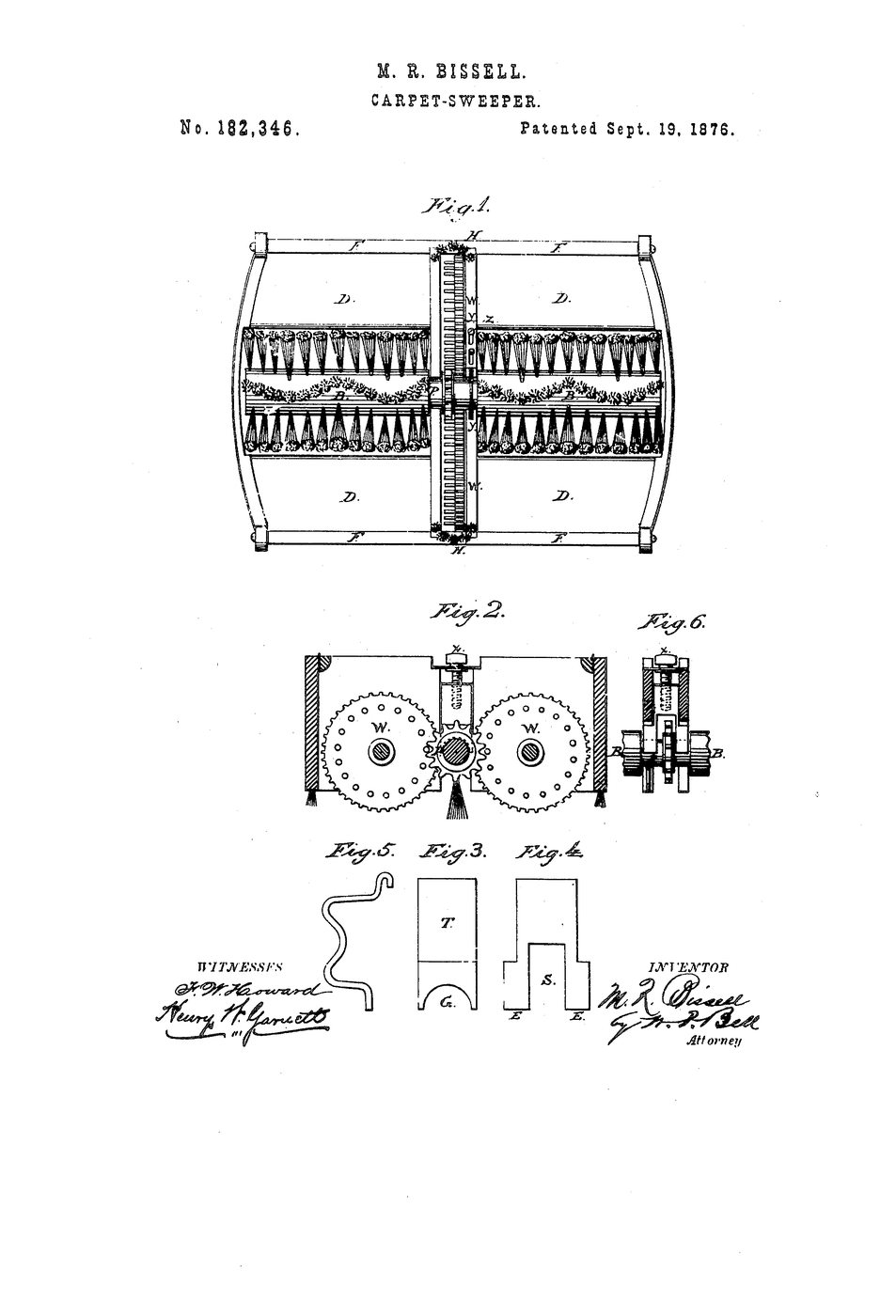


Carpet Sweeper
Before the vacuum cleaner, a carpet was cleaned by beating it or dragging a stiff broom over it — slow, dusty work that just pushed grit around. What people wanted was a box on wheels you could push that would pick the dirt up and hold it.
Bissell's carpet sweeper is exactly that: a wheeled case with a brush roller inside that spins as you push. The wheels grip the floor and, geared to the brush, whirl it round; the flicking bristles sweep crumbs and grit up off the carpet and throw them back into a dust pan inside the case.
His clever detail is the CENTRE drive: the brush is turned from the middle, not the ends, so the whole roller can tilt and rock to follow a bumpy or worn floor and keep sweeping evenly where a rigidly-mounted brush would lift off and miss.
US Patent 182,346, "Carpet-Sweeper", granted 19 September 1876 to Melville R. Bissell of Grand Rapids, Michigan.
안내
Read the claim: the wheels drive the brush
Read the claim: the wheels drive the brush
Bissell claims a wheeled case whose running wheels spin a brush roller that sweeps dirt into a pan — and the brush is driven from its centre so it can tilt to follow the floor. Note both.
Build a shallow open box
Build a shallow open box
Cut and fold a shallow open-bottomed box from stiff cardboard — this is the sweeper case that will roll on the floor.
이 단계의 재료:
 골판지 시트1 장
필요한 도구:
 공예용 칼
공예용 칼Fit an axle and two wheels each end
Fit an axle and two wheels each end
Push a dowel axle through each end of the box and add a wheel on each side. The box now rolls when you push it.
이 단계의 재료:
 목재 다월봉1 개
 캐스터 바퀴 세트1 세트
Make a brush roller on a central spindle
Make a brush roller on a central spindle
Wrap a stiff brush around a dowel to make a roller, and mount it across the middle of the box, just clearing the floor. This is the sweeping brush.
이 단계의 재료:
 자작나무 솔1 개목재 다월봉1 개
Couple the wheels to the brush
Couple the wheels to the brush
Loop a rubber band from a wheel axle to the brush spindle, or let a wheel rim rub the brush. Now turning the wheels turns the brush.
이 단계의 재료:
 아연 도금 강선1 미터
Push it and watch the brush spin
Push it and watch the brush spin
Roll the sweeper forward. The wheels drive the brush so it spins fast as you push — the sweeper makes its own sweeping motion from your push, no motor.
Scatter crumbs and sweep them up
Scatter crumbs and sweep them up
Sprinkle crumbs or rice on the floor and run the sweeper over them. The whirling bristles flick the dirt up and back into the box instead of just pushing it along.
Feel the centre drive
Feel the centre drive
Notice the brush is turned at its middle, its ends free. Press one end down: the roller tilts but keeps turning — the whole brush can rock to follow the floor.
Run it over a bump
Run it over a bump
Sweep across a ruler or a fold in a rug. The tilting brush stays in contact and keeps sweeping, where a stiff end-mounted brush would lift off and miss the dirt.
Compare with a plain broom
Compare with a plain broom
Sweep the same crumbs with a stiff broom. It pushes them into a pile you must then collect; the sweeper picks them up as it goes and stores them. Note the difference.
이 단계의 재료:
 비1 세트
비1 세트 쓰레받기1 세트
Set the brush height
Set the brush height
Lower the brush until it just kisses the floor. Too high misses dirt; too low drags and stalls. Find the sweet spot — real sweepers have a screw to adjust this.
Tip out the dust pan
Tip out the dust pan
Open the box and empty the collected dirt. Everything the brush threw up stayed inside — a self-emptying sweeper you carry, not a broom-and-pan two-step.
History & Context — the sweeper that swept the parlour
History & Context — the sweeper that swept the parlour
The patent. US 182,346, "Carpet-Sweeper", granted 19 September 1876 to Melville R. Bissell of Grand Rapids, Michigan. Bissell kept a crockery shop, and the straw packing dust made his wife Anna sneeze; he built the sweeper to clean it up. Anna ran the business into a global company after his early death — one of the first women to head a major American firm.
The mechanism is a friction gearing. The running wheels are, in effect, the drive: geared or belted to the brush spindle, they spin the roller far faster than the sweeper itself moves, so a gentle push whirls the bristles fast enough to flick grit up off the pile and into the pan (steps 5-7). No motor, no cord — the energy is entirely yours, just re-aimed from forward motion into rotation.
Bissell's real improvement was the centre drive and the compensating brush. Earlier sweepers drove the brush from its ends, which pinned the roller rigidly; on a worn or uneven carpet it would lift off in the low spots and miss the dirt. By driving from the middle and letting the ends float, Bissell let the brush rock and tilt to follow the floor (steps 8-9), sweeping evenly over bumps and hollows. It is the same idea as a floating cutting head on a lawn mower or a self-aligning bearing — let the working part follow the surface instead of forcing the surface to be flat.
Where it sits. The carpet sweeper ruled the parlour for decades and still sells today, quiet and cordless, for a quick clean-up. It is the direct ancestor of the powered vacuum's beater brush — Spangler's 1908 suction cleaner simply added a motor and a fan to the same rotating-brush idea. The little box you pushed here, wheels whirling a floating brush into a dust pan, is Bissell's machine in miniature, and it works for exactly the reason his did.
재료
7- 1 장플레이스홀더
- 1 개플레이스홀더
- 1 세트플레이스홀더
- 1 개플레이스홀더
- 1 미터플레이스홀더
- 1 세트플레이스홀더
- 1 세트플레이스홀더
이 블루프린트로 만드는 것
CC0 퍼블릭 도메인
이 블루프린트는 CC0로 공개되었습니다. 어떤 목적으로든 자유롭게 복사, 수정, 배포 및 사용할 수 있습니다.
제품 구매를 통해 메이커를 지원하세요. 판매자가 설정한 메이커 커미션 을 받거나, 이 블루프린트의 새로운 반복을 만들어 연결로 포함시킬 수 있습니다.