예술
뷰티 및 웰니스
공예
문화 및 역사
엔터테인먼트
환경
음식 및 음료
역공학
과학
스포츠
기술
웨어러블



Bore and Tone Holes: A Hole Can Be Made Bigger and Not Smaller
A wind instrument is a column of air with a length. Change the length and the note changes, and the whole craft is about changing it in controlled steps.
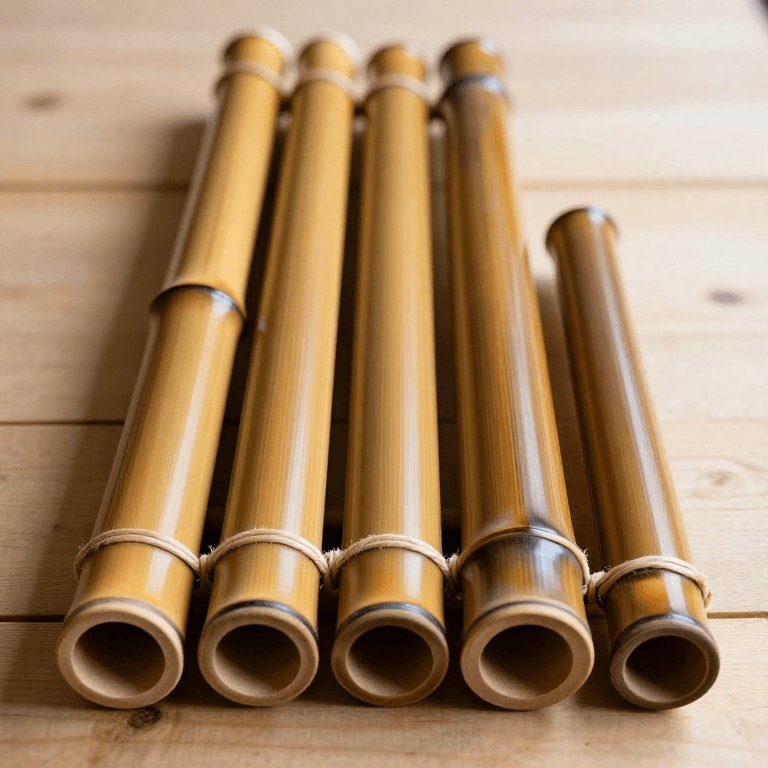
Two facts decide almost everything. A pipe closed at one end sounds an octave lower than an open one of the same length, which is why panpipes are surprisingly short. And a tone hole does not end the air column at the hole — it ends it somewhere below, by an amount that depends on how big the hole is.
That second fact is the working rule of the whole craft: cut every hole small and tune it by enlarging it, because wood cannot be put back.
중급
5 hours
안내
1
1
Open, closed, and how the instrument is excited
Open, closed, and how the instrument is excited
**An open pipe** — a flute, a recorder, a quena — resonates at a half wavelength and overblows to the octave, then the twelfth, giving the full harmonic series.
**A pipe closed at one end** — a panpipe, a stopped organ pipe, a clarinet — resonates at a quarter wavelength. It sounds an octave lower for the same length and it produces only the odd harmonics, so it overblows to the twelfth and skips the octave entirely. That is why a clarinet's fingering changes so awkwardly between registers, and why its lowest note is so low for its size.
How the column is set going is a separate question from its length:
**An air jet across an edge** — flute, quena, shakuhachi, panpipes, and the fipple of a recorder or whistle. The jet flaps in and out of the pipe at the resonance.
**A beating reed** — clarinet, oboe, bagpipe chanter. A tongue of cane opens and closes the entrance, and it acts as a closed end.
**A free reed** — sheng, khaen, accordion, harmonica. The tongue swings through a slot and its own stiffness sets the pitch, so the pipe is a resonator rather than the thing that decides the note.
이 단계의 재료:
 대나무3 개
필요한 도구:
 자
자 크로매틱 튜너와 메트로놈 (클립형)
2
2
Lengths, corrections and hole positions
Lengths, corrections and hole positions
Jupyter 노트북 불러오는 중…
필요한 도구:
 데스크톱 컴퓨터
3
3
Cutting and tuning a simple flute
Cutting and tuning a simple flute
Work in this order and nothing is wasted.
**Cut the tube long.** Longer than the calculation, by 20 mm or more. The overall length is the one dimension that can be corrected by cutting, and only in one direction.
**Make the embouchure or fipple first and tune the whole tube.** With no finger holes at all, the pipe sounds one note. Shorten it until that note is right. Now the length is known to be correct before a single hole is drilled.
**Mark the holes from the calculation, then drill them undersized.** Two millimetres under is a reasonable start.
**Tune from the bottom hole upwards**, enlarging each until it is in tune, because each hole's pitch depends on the ones below it being open.
**Undercut rather than enlarge, when the hole is already as big as a finger can seal.** Angling the walls of the hole inside the bore raises the pitch further while the opening the finger covers stays the same size. That is the traditional fix for a hole that has run out of room.
Check the tuning warm and with the pipe wet. Both change the pitch, and the instrument is played in that state, not cold and dry.
이 단계의 재료:
대나무2 개 밀랍1 개
밀랍1 개필요한 도구:
 드릴 비트 세트
 정밀 줄(니들 파일) 세트
 디지털 캘리퍼스 6인치크로매틱 튜너와 메트로놈 (클립형)
 고운 사포
고운 사포4
4
The bore is not just a hole through the middle
The bore is not just a hole through the middle
A cylinder is the simplest bore and not the only one, and the shape changes which harmonics line up.
**Cylindrical** — flute, clarinet, most bamboo flutes. Simple to make, and the harmonic behaviour follows the open or closed rule directly.
**Conical, widening towards the bell** — oboe, bassoon, saxophone, many folk shawms. A cone driven by a reed at its narrow end behaves like an OPEN pipe: it overblows to the octave and gives all the harmonics, although the reed closes one end. That is why a saxophone overblows an octave and a clarinet a twelfth, although both are single-reed instruments.
**Bore diameter changes the tone more than the pitch.** A wider bore for a given length is louder, darker, harder to overblow; a narrow bore is quieter, brighter and jumps to the upper registers easily. The shakuhachi's wide bore and the quena's narrow one are two deliberate answers.
**Small irregularities matter.** A ridge, a node left in a bamboo tube, or a rough patch sits somewhere in a standing wave, and its effect depends on where. Near a pressure maximum it changes the note; near a node it does almost nothing. This is why traditional makers ream and polish a bore, and why two tubes of identical length do not always play the same.
이 단계의 재료:
대나무3 개필요한 도구:
디지털 캘리퍼스 6인치 거친 줄고운 사포크로매틱 튜너와 메트로놈 (클립형)
관련 블루프린트
이 블루프린트들은 지식을 공유합니다 — 기술, 재료 또는 원리
CC0 퍼블릭 도메인
이 블루프린트는 CC0로 공개되었습니다. 어떤 목적으로든 자유롭게 복사, 수정, 배포 및 사용할 수 있습니다.
제품 구매를 통해 메이커를 지원하세요. 판매자가 설정한 메이커 커미션 을 받거나, 이 블루프린트의 새로운 반복을 만들어 연결로 포함시킬 수 있습니다.