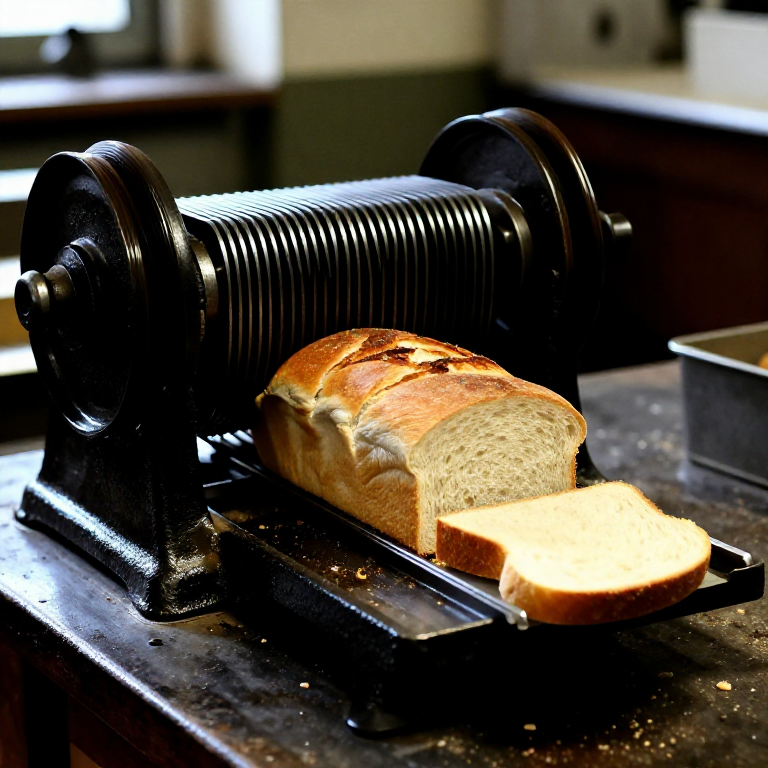


Bread Slicer
Slicing a loaf by hand is easy and slicing it evenly is not. The crust resists and the crumb does not, so the knife dives, and by the far end the slices are wedges. A machine has the same problem multiplied: cut a whole loaf at once and every blade must track true through a soft, compressible, uneven thing.
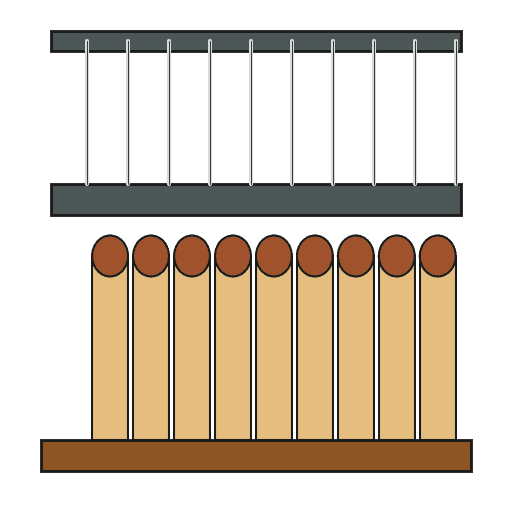
Otto Rohwedder's machine uses many thin bands running continuously. Not one blade making repeated cuts, but a set of parallel cutting bands moving at speed while the loaf is pushed through — so each blade is always cutting, never starting, and the loaf never has time to compress and drift.
The bigger obstacle was not slicing at all. A sliced loaf goes stale several times faster and falls apart on the shelf. US Patent 1,867,377, filed 26 November 1928 and granted 12 July 1932, is titled "Machine for slicing an entire loaf of bread at a single operation".
안내
Multiple exposed blades demand a guard first
Multiple exposed blades demand a guard first
Build the enclosure and the loaf pusher BEFORE fitting any blade. Nothing goes into this machine by hand at any point.
Slice a loaf by hand and measure every slice
Slice a loaf by hand and measure every slice
Cut ten slices and measure each. Record the spread. That variation is what the machine has to beat, and it is larger than most people expect.
필요한 도구:
 자
자Read US 1,867,377 and note 'at a single operation'
Read US 1,867,377 and note 'at a single operation'
The title is the specification. Rohwedder cuts the whole loaf in one pass, which is a completely different machine from one that cuts a slice at a time.
Build a rigid frame
Build a rigid frame
Make a heavy frame that will not flex. Blade spacing IS slice thickness, so any frame movement shows up directly in the bread.
이 단계의 재료:
 경목 판재2 개
필요한 도구:
 손톱(핸드소)
Mount pulleys top and bottom for continuous bands
Mount pulleys top and bottom for continuous bands
Fit a pair of pulley shafts so each blade runs as an endless loop. A moving band is always mid-cut; a reciprocating blade must stop and reverse.
Space the blades to your chosen slice thickness
Space the blades to your chosen slice thickness
Set them about 12 mm apart with accurate spacers. Every spacer error is permanent and appears in every loaf the machine ever cuts.
이 단계의 재료:
 띠톱 날6 개
Tension every band equally
Tension every band equally
Tension each blade the same. A slack blade wanders and produces one wedge-shaped slice in an otherwise perfect loaf.
Use a scalloped edge, not a plain one
Use a scalloped edge, not a plain one
Serrated or scalloped blades saw through crust rather than pressing on it. A plain edge crushes the loaf before it cuts.
Run the blades fast and feed the loaf slowly
Run the blades fast and feed the loaf slowly
High blade speed against low feed rate means each blade removes very little per pass, so the loaf is never pushed sideways.
Support the loaf on both sides through the cut
Support the loaf on both sides through the cut
Fit side plates that hold the loaf square as it passes. Unsupported, it compresses and springs back and the slices taper.
Drive the feed at a constant rate
Drive the feed at a constant rate
Use a screw or a driven belt rather than hand pressure. A human push is uneven and the unevenness is exactly what you are trying to remove.
이 단계의 재료:
 연강 환봉1 개
Slice a loaf and measure again
Slice a loaf and measure again
Repeat your step 2 measurements on machine-cut slices. The spread should collapse — that number is the machine's entire justification.
Now watch it go stale
Now watch it go stale
Leave a sliced loaf and an uncut one side by side for a day. The sliced one is noticeably drier — you have vastly increased the exposed surface area.
Wrap the sliced loaf immediately
Wrap the sliced loaf immediately
Wrap it as it leaves the machine and repeat the comparison. Slicing without wrapping is not a product — this is the step that made the invention viable.
Compendium — the slicing was the easy half
Compendium — the slicing was the easy half
The patent. US 1,867,377, "Machine for slicing an entire loaf of bread at a single operation", filed 26 November 1928 and granted 12 July 1932 to Otto Frederick Rohwedder of Missouri. He had been working on the problem since 1912. A fire at his factory in 1917 destroyed his prototype and his blueprints, and he began again. His first working machine went into service at the Chillicothe Baking Company in Missouri in July 1928, and the local paper announced the result as the greatest forward step in the baking industry since bread was wrapped — the origin of the phrase "the greatest thing since sliced bread".
Bakers refused it, and they were not being stupid. Rohwedder's early attempts held the slices together with hat pins, which failed immediately. The objection was real: cutting a loaf multiplies its exposed surface area enormously, so it dries out and goes stale far faster, and a sliced loaf collapses into a heap on a shelf. Bakers were being asked to sell a product with a shorter life and worse presentation. The invention only became viable in combination with wrapping — the machine had to slice AND package, and it is the pairing that succeeded, not the slicing.
Why continuous bands. Bread is soft, compressible and inhomogeneous: a tough crust over an open crumb. A reciprocating blade decelerates, stops and reverses, and at each reversal the loaf is pushed rather than cut. Continuous bands are always moving in the cutting direction at full speed, so cutting force stays constant and low, and the loaf has no chance to compress and drift. Serration matters for the same reason — a scalloped edge saws the crust rather than pressing on it. High blade speed with a slow, constant feed keeps the chip load per blade tiny, which is the same principle as any other cutting machine.
A footnote worth knowing. Sliced bread was briefly banned in the United States in January 1943 as a wartime conservation measure — the stated reasons included saving the heavier wax paper that sliced loaves required and reducing demand on steel for blades. Public objection was strong enough that the ban was rescinded within two months. It is a rare case of a technology being withdrawn and the public simply refusing, and a good measure of how completely a 1928 machine had reshaped an everyday expectation in fifteen years.
이 블루프린트로 만드는 것
관련 블루프린트
이 블루프린트들은 지식을 공유합니다 — 기술, 재료 또는 원리


CC0 퍼블릭 도메인
이 블루프린트는 CC0로 공개되었습니다. 어떤 목적으로든 자유롭게 복사, 수정, 배포 및 사용할 수 있습니다.
제품 구매를 통해 메이커를 지원하세요. 판매자가 설정한 메이커 커미션 을 받거나, 이 블루프린트의 새로운 반복을 만들어 연결로 포함시킬 수 있습니다.