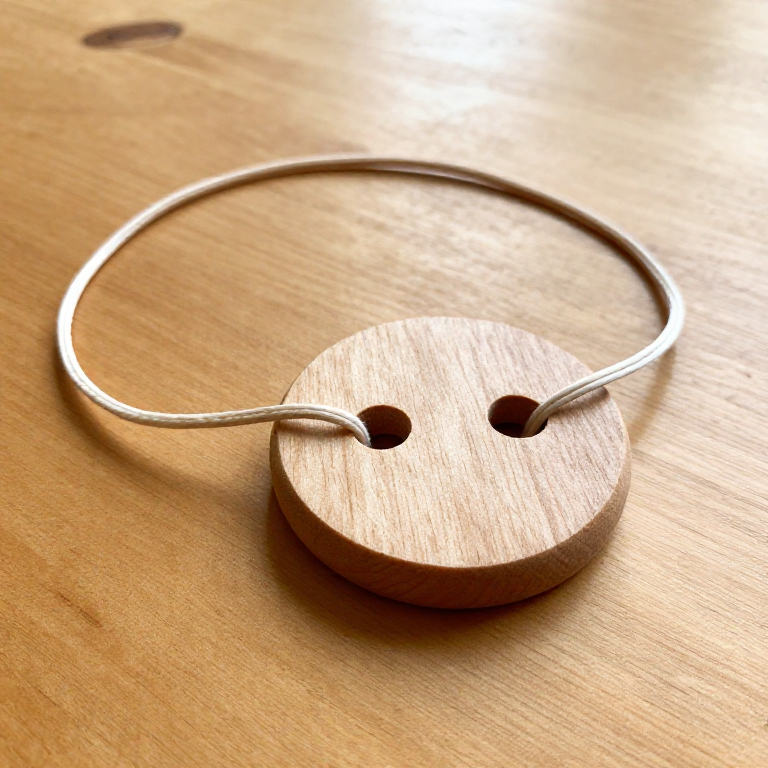


Buzzer Whirligig
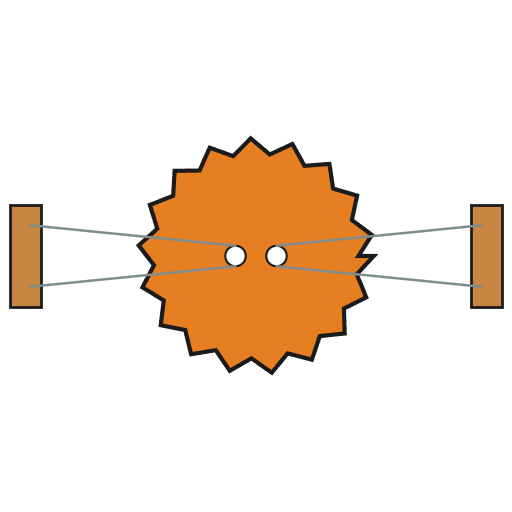
A disc on a twisted loop of cord. Pull the loop apart and the disc spins one way; the cord winds up the other way; pull again and it reverses, faster. Keep the rhythm and it screams.
It is one of the oldest toys we have physical evidence for — perforated discs that appear to be exactly this turn up in prehistoric contexts across several continents, and near-identical versions are recorded in unrelated cultures worldwide. It is one of those objects that humans seem to invent independently whenever they have a disc and a string.
The physics is worth chasing. The spinning disc stores rotational energy; when the cord runs out of twist the disc's own momentum drives it past the stopping point and rewinds the cord in the opposite sense. You are not powering the spin directly — you are topping up an oscillator, at exactly the right moment, like pushing a swing.
안내
Cut a disc
Cut a disc
Cut a 70 mm disc from 4 mm hardwood. Thin and wide spins better than thick and small — mass out at the rim is what stores the energy.
이 단계의 재료:
 경목 블록1 개
필요한 도구:
 실톱(코핑 소)
Find the exact centre
Find the exact centre
Mark the centre precisely with a compass. An off-centre disc wobbles violently at speed and will not buzz cleanly.
필요한 도구:
 나침반
나침반Drill two holes either side of centre
Drill two holes either side of centre
Drill two 3 mm holes, each 8 mm from the centre, on opposite sides. Two holes, not one — the cord must pass through both so the disc is driven by a twisting couple.
Sand the disc and holes smooth
Sand the disc and holes smooth
Sand both faces and ease the hole edges. A sharp hole edge saws through the cord within a few minutes of spinning.
이 단계의 재료:
 사포1 장
사포1 장Cut notches around the rim
Cut notches around the rim
Cut shallow notches all round the rim. These chop the air as the disc spins and turn a silent toy into the buzzing one it is named for.
필요한 도구:
 정밀 줄(니들 파일) 세트
Thread a continuous loop
Thread a continuous loop
Thread about 1.2 m of strong cord down through one hole and back up the other, then knot the ends into one continuous loop.
이 단계의 재료:
 결속 노끈1.2 미터
Centre the disc on the loop
Centre the disc on the loop
Slide the disc to the middle of the loop with equal cord on both sides. An off-centre disc pulls unevenly and stalls.
Wind up the cord
Wind up the cord
Hold a loop end in each hand and swing the disc over and over to twist both cords tightly. Twenty or thirty turns before the first pull.
Pull, then release
Pull, then release
Pull your hands apart — the disc spins and the cords unwind. As tension drops, let your hands come back in. The disc's momentum rewinds the cord the other way. Pull again as it finishes rewinding.
Find the resonant rhythm
Find the resonant rhythm
Pull in time with the winding, not faster. Pulling at the wrong moment fights the disc and it dies immediately. This is resonance — the same principle as pushing a swing.
Test how disc size changes the pitch
Test how disc size changes the pitch
Make a second disc at 50 mm and compare. The smaller disc spins faster but stores less energy, so it buzzes higher and dies sooner. Record both — that trade-off is the whole physics of a flywheel.
History & Context
History & Context
Very old, and invented repeatedly. Perforated discs consistent with buzzers are known from prehistoric archaeological contexts, and near-identical toys are recorded in cultures with no contact with each other. Caution is warranted on any specific claim — a perforated disc might be a spindle whorl, a button, or an ornament, and archaeologists cannot always tell. What is certain is that the object is very widespread and very simple, and simple objects get invented more than once.
Storing energy in rotation. The disc is a flywheel. Rotational energy scales with mass and with the square of the radius, so a wide thin disc stores far more than a narrow thick one of the same weight — which is why step 1 specifies thin and wide, and why potters' kick wheels are built the same way at a much larger scale.
Why it reverses on its own. When the cords fully unwind, the disc is still turning. Its momentum carries it past that point and begins twisting the cords the opposite way, converting rotational energy back into stored twist. The toy is an energy oscillator, swapping between rotation and elastic twist, and your pulls only replace what friction takes.
Resonance you can feel. Pull in time and it builds; pull out of time and it stops dead. That is a physical demonstration of driving an oscillator at its natural frequency, learned by hand in about a minute — usually long before anyone explains it.
The buzz. Notches chopping the air produce a tone whose pitch follows the rotation rate. As the disc slows and speeds through each cycle, the pitch rises and falls. The toy is also a simple siren, which is very likely why it has been popular with children for several thousand years.
이 블루프린트로 만드는 것
CC0 퍼블릭 도메인
이 블루프린트는 CC0로 공개되었습니다. 어떤 목적으로든 자유롭게 복사, 수정, 배포 및 사용할 수 있습니다.
제품 구매를 통해 메이커를 지원하세요. 판매자가 설정한 메이커 커미션 을 받거나, 이 블루프린트의 새로운 반복을 만들어 연결로 포함시킬 수 있습니다.