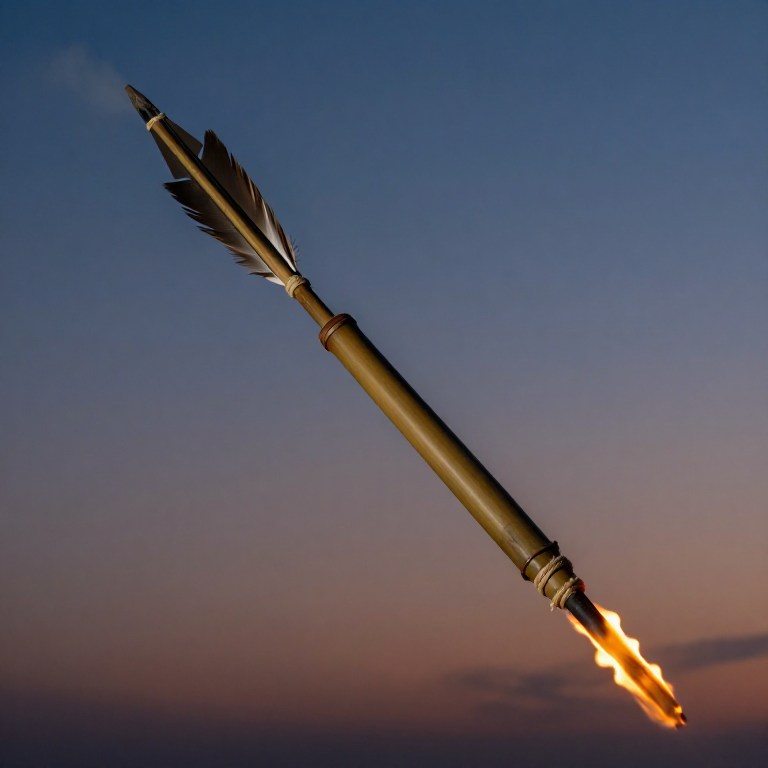


Building Chinese Fire Arrows — The First Rockets in Human History
Chinese fire arrows (火箭, huǒ jiàn — literally 'fire arrows') represent the birth of rocketry. First documented in military use around 969 AD during the Song dynasty, they consisted of a tube of gunpowder attached to a standard arrow shaft. When ignited, the burning propellant generated thrust that propelled the arrow farther and faster than any bow could achieve — and the burning tube set fire to whatever it struck.
The critical innovation was the realization that gunpowder could do more than explode — it could push. By leaving one end of the tube open, the expanding gases escaped in a directed jet, creating forward thrust according to the principle that Newton would not formally describe for another 700 years. The earliest fire arrows used bamboo tubes, but later versions adopted paper casings rolled tightly and sealed with lacquer for more consistent burn rates.
At the Battle of Kaifeng in 1232 AD, the Jin dynasty defenders launched fire arrows en masse against the Mongol besiegers — the earliest documented large-scale use of rocket weapons in warfare. The Wujing Zongyao military manual of 1044 AD contains detailed instructions for fire arrow construction, including multi-stage rocket configurations where one tube ignites the next for extended range. These bamboo-and-gunpowder arrows are the direct ancestors of every rocket ever built, from Congreve war rockets to the Saturn V.
이 블루프린트로 만드는 것

관련 블루프린트
이 블루프린트들은 지식을 공유합니다 — 기술, 재료 또는 원리



CC0 퍼블릭 도메인
이 블루프린트는 CC0로 공개되었습니다. 어떤 목적으로든 자유롭게 복사, 수정, 배포 및 사용할 수 있습니다.
제품 구매를 통해 메이커를 지원하세요. 판매자가 설정한 메이커 커미션 을 받거나, 이 블루프린트의 새로운 반복을 만들어 연결로 포함시킬 수 있습니다.