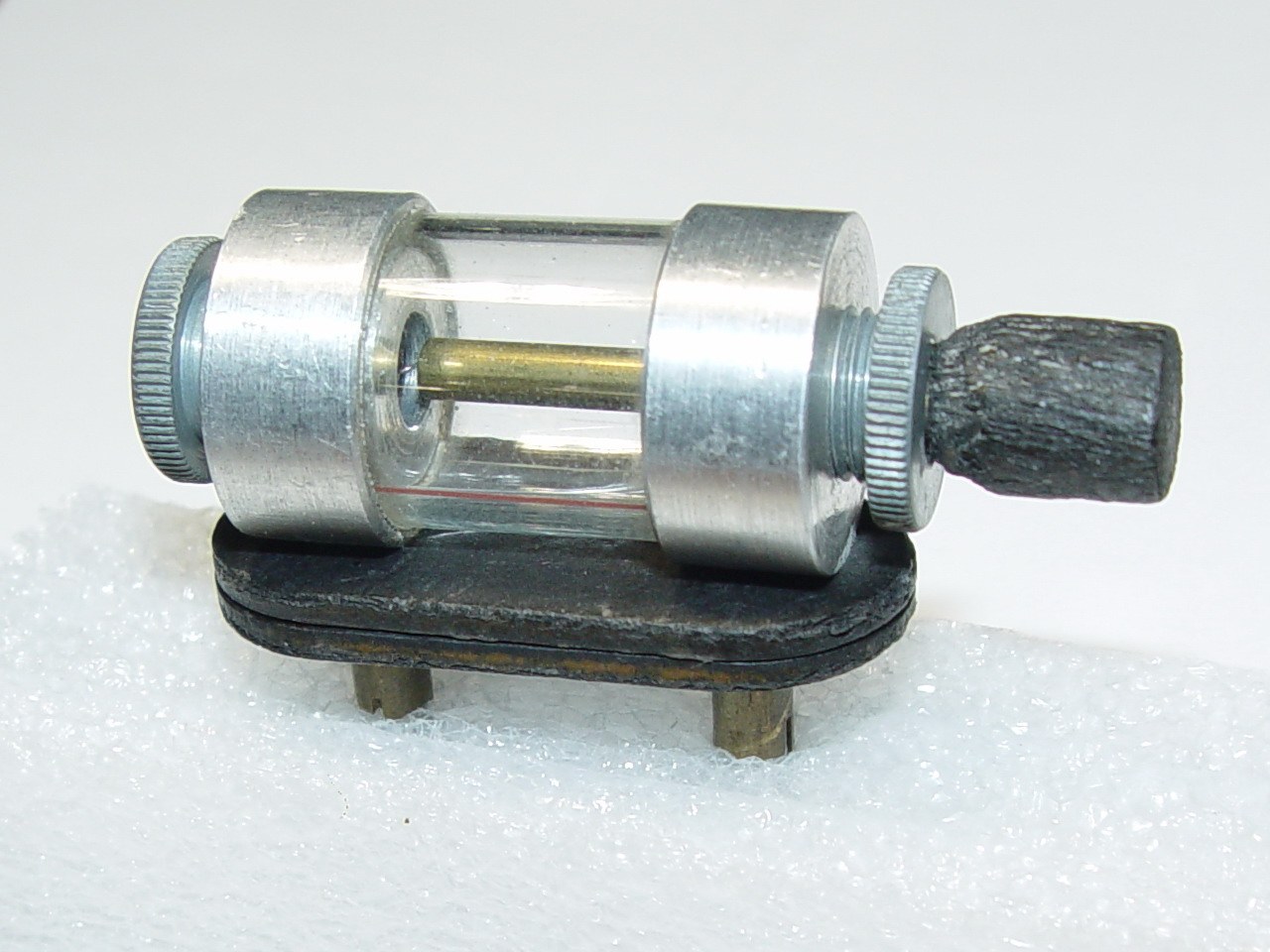

Crystal Detector
A radio wave arriving at an aerial is an alternating current, swinging positive and negative millions of times a second. Averaged over time it is zero, and a headphone connected straight to an aerial hears nothing at all. Something has to let current pass one way and block the other before there is any sound.
Greenleaf Whittier Pickard found that a fine metal point resting on a piece of silicon does exactly that. The contact conducts in one direction far better than the other, so it strips off half the wave and leaves the audio behind. He tested tens of thousands of material combinations to find it.
This is a semiconductor diode, patented in 1906 — forty years before anyone could explain why it worked, and the direct ancestor of every transistor since.
안내
Keep the aerial away from power lines
Keep the aerial away from power lines
A long-wire aerial near overhead power lines is lethal. String it well clear, bring it indoors through a window, and disconnect and earth it in a thunderstorm.
Mount a small crystal in a metal cup
Mount a small crystal in a metal cup
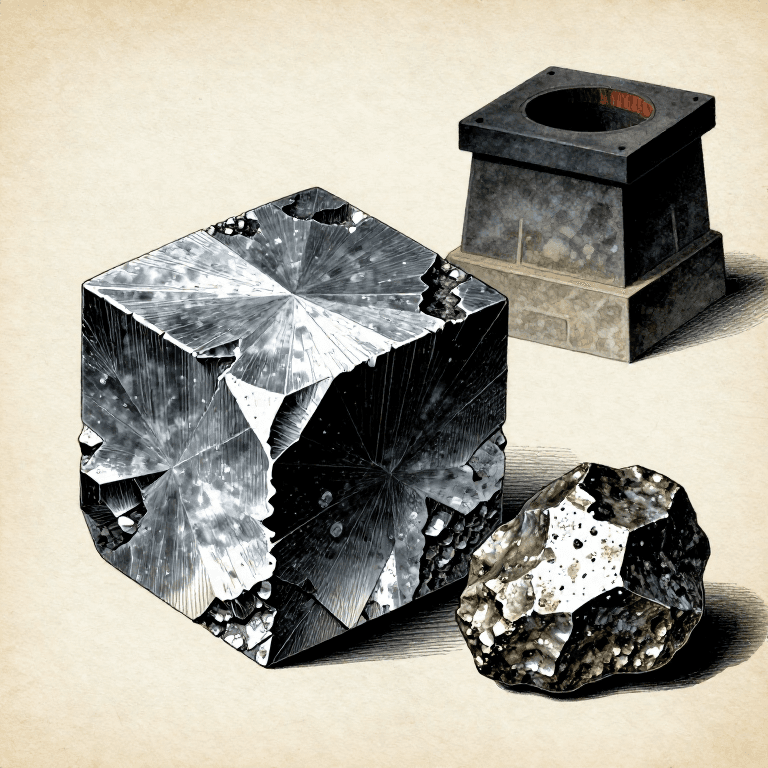
Set a piece of galena or silicon in a shallow brass cup, packing it with soft metal or conductive paste so the whole underside makes contact. One face must stand proud.
이 단계의 재료:
 Galena Crystal1 개
Leave the top face untouched
Leave the top face untouched
Do not polish or handle the exposed face. Skin oil and oxide films kill the sensitive spots, and there is no way to restore one once it is contaminated.
Make the cat's whisker
Make the cat's whisker
Coil a 30 mm length of fine springy wire — phosphor bronze about 0.1-0.2 mm — into a small helix with a straight tip. The coil provides gentle, constant contact pressure.
이 단계의 재료:
 Brass Rod1 미터
필요한 도구:
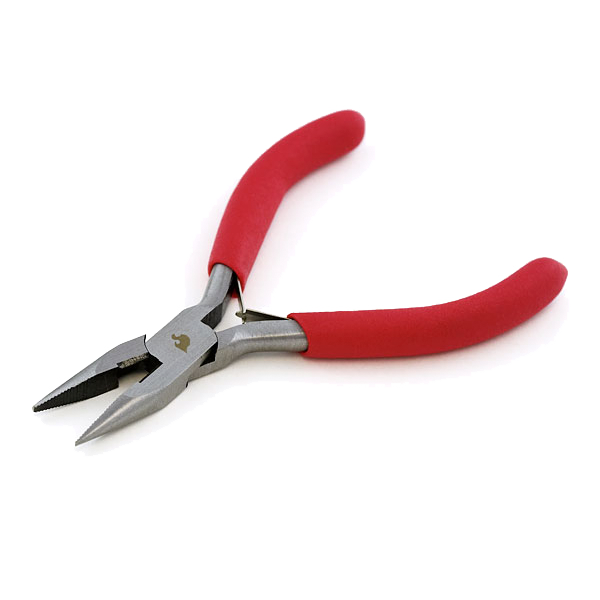 Needle Nose Pliers
Mount the whisker on an adjustable arm
Mount the whisker on an adjustable arm
Fit the whisker to an arm that can be swivelled and lowered over the crystal. You must be able to reach any point on the crystal face — that adjustability is Pickard's actual claim.
Set the contact pressure light
Set the contact pressure light
The tip should just rest on the surface. Pressing hard makes the contact ohmic — it conducts both ways equally and detects nothing.
Wind a tuning coil
Wind a tuning coil
Wind about 60 turns of enamelled wire on a 40 mm tube, tapping every ten turns. This selects the station.
String a long-wire aerial
String a long-wire aerial
Run 10-20 m of wire as high and as straight as you can. A crystal set has no amplification whatsoever — the aerial supplies every scrap of energy you will hear.
Make a real earth connection
Make a real earth connection
Clamp to a cold water pipe or an earth rod driven into damp ground. A poor earth is the commonest reason a crystal set stays silent.
Wire the circuit
Wire the circuit
Aerial to the top of the coil, earth to the bottom. Detector and high-impedance headphones in series across a tap. Four components and no power source of any kind.
Use high-impedance headphones
Use high-impedance headphones
Old crystal-set headphones of 2,000 ohms or more, or a modern low-impedance pair through a matching transformer. Ordinary earbuds load the circuit dead flat.
Hunt for a sensitive spot
Hunt for a sensitive spot
Lower the whisker and move it slowly across the crystal, a fraction of a millimetre at a time, listening. Most of the surface does nothing; a few points are dramatically sensitive.
Mark the spot when you find it
Mark the spot when you find it
Note where the whisker sits. Knock the set and you lose it, and finding it again takes minutes — this fragility is exactly why the vacuum tube replaced it.
Tune with the coil taps
Tune with the coil taps
Move the connection along the taps to change the tuned frequency. Fewer turns for higher frequencies. Expect to hear only strong local stations.
Compendium — the first semiconductor
Compendium — the first semiconductor
The patent. Greenleaf Whittier Pickard filed on 30 August 1906 and was granted US Patent 836,531 on 20 November 1906, for a means of receiving intelligence communicated by electric waves. The claim covers a detector using a crystal of a non-metallic element — silicon in particular — contacted by a spring-loaded metal point mounted so a sensitive spot can be found. Pickard reportedly tested tens of thousands of mineral and contact combinations to arrive at it.
What is physically happening. The point contact forms what we now call a Schottky barrier: a metal-semiconductor junction whose energy barrier lets carriers cross far more readily in one direction than the other. That asymmetry rectifies the radio-frequency signal, removing one half of the wave so what remains has a non-zero average that follows the audio envelope. None of this was understood in 1906 — band theory did not exist. Pickard had a device that demonstrably worked and no theory to explain it, which is why the search was empirical on such a scale.
Why sensitive spots exist. A natural crystal surface is not uniform. Impurities, grain boundaries and local doping mean rectification is good at some points and absent at others, and the effective junction is microscopic. Hunting for the spot with a whisker is, in effect, probing the semiconductor for a usable junction by hand. When Bell Labs returned to point-contact rectification in the 1940s, that work led directly to the point-contact transistor of 1947 — the crystal detector is its lineal ancestor, not merely an analogue.
Why it died, and why it survived. Vacuum tubes amplified and stayed adjusted, and the fragile whisker could not compete after about 1920. But a crystal set needs no power at all, so they were built from scrap by soldiers in both World Wars — foxhole radios, using a pencil lead or a rusty razor blade as the crystal. That is worth trying here: a blued razor blade and a pencil tip really will detect a broadcast station, which tells you how forgiving the underlying physics is.
필요 도구
1- Needle Nose Pliers10% 수수료₩35
연결된 블루프린트 재료


CC0 퍼블릭 도메인
이 블루프린트는 CC0로 공개되었습니다. 어떤 목적으로든 자유롭게 복사, 수정, 배포 및 사용할 수 있습니다.
제품 구매를 통해 메이커를 지원하세요. 판매자가 설정한 메이커 커미션 을 받거나, 이 블루프린트의 새로운 반복을 만들어 연결로 포함시킬 수 있습니다.