

Cyclone Separator
안내
Make the body
Make the body
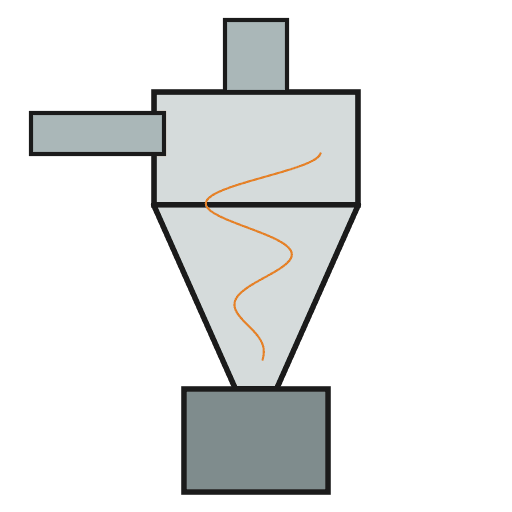
A cone above a collection jar is the whole machine.
- Cut the bottom from a clear plastic bottle, or roll a cone from stiff clear sheet.
- Fit it mouth-down over a sealed jar so everything that falls is caught.
- Seal the joint with tape — a leak here quietly ruins the separation.
이 단계의 재료:
 PVC 파이프1 length
Cut the tangential inlet
Cut the tangential inlet
This is the step that decides whether it works at all.
- Make the inlet hole near the top of the cone.
- Aim it along the wall, not at the centre — the incoming air must graze the inside surface.
- Fit a short tube and seal around it.
이 단계의 재료:
 고무관1 length
Fit the vortex finder
Fit the vortex finder
The clean-air outlet is a tube that hangs down into the body.
- Fit a tube through the centre of the lid.
- Let it project below the inlet — past it, into the cone.
- Seal around it.
Run it and measure the efficiency
Run it and measure the efficiency
Connect the outlet to a vacuum and feed dust in at the inlet.
- Weigh out a known mass of sawdust — 20 g is plenty.
- Feed it in steadily while the vacuum runs.
- Weigh what collects in the jar.
- Efficiency % = (mass caught / mass fed) x 100
이 단계의 재료:
 디지털 주방 저울1 개
Change one variable
Change one variable
Vary one thing at a time and re-measure.
- Narrow the inlet to raise the entry speed and repeat.
- Try a steeper cone.
- Try fine flour instead of sawdust.
History and context
History and context
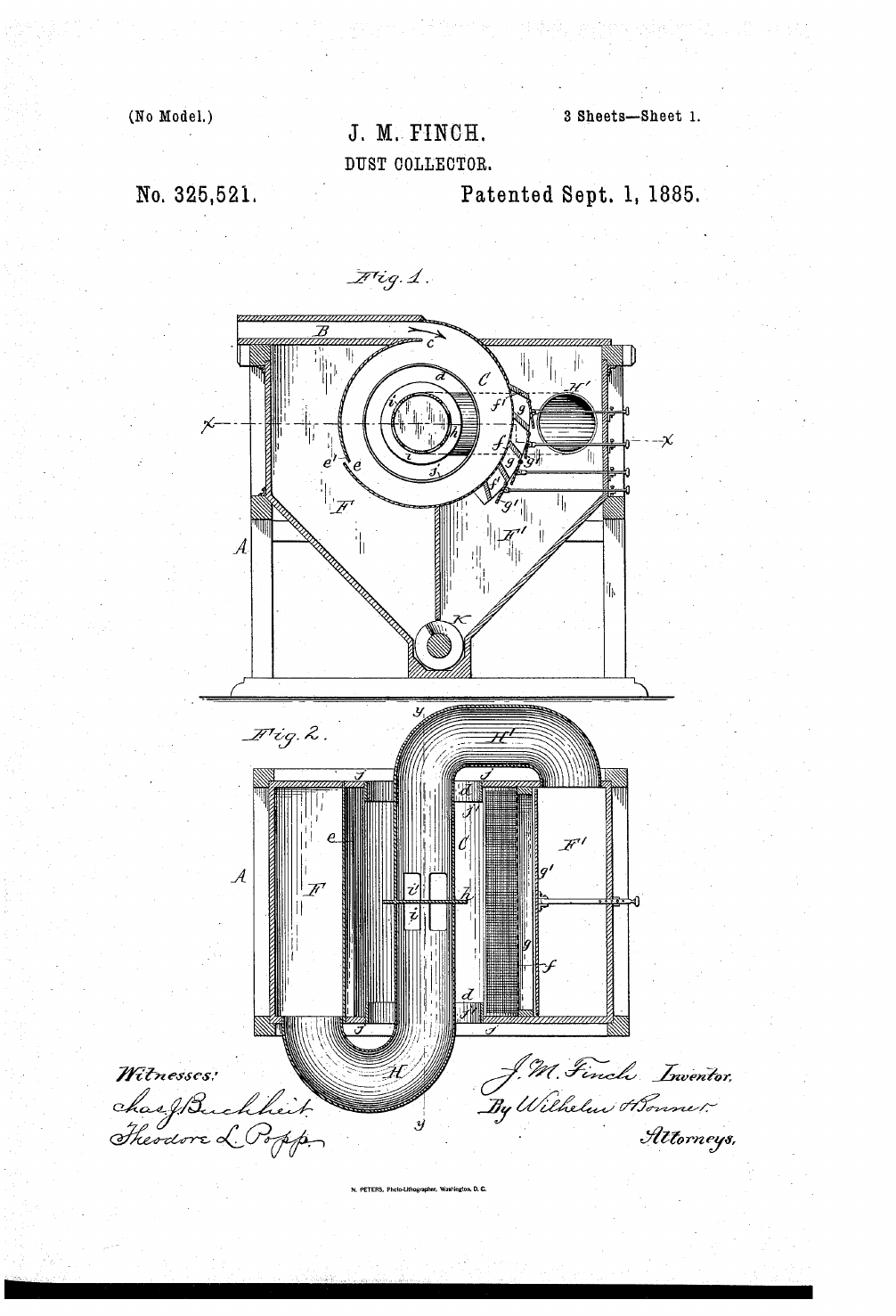
US patent 325,521, granted to John M. Finch on 1 September 1885, is titled Dust-Collector. The specification describes imparting to the dust-laden air current a rapid rotative motion in a suitable separating case, so that dust accumulates at the outer edge and is discharged into a dust chamber. That is a cyclone in all but name.
The drawing is not the cone you just built, and that matters. Finch's figures show a round separating case with a tangential inlet, a V-hopper beneath it and a screw conveyor to carry the settled dust away — cyclonic in principle, but not the tall narrow cone of a modern unit. The steep cone, the deep vortex finder and the proportions now treated as standard were worked out over the following decades by many hands. Finch patented the principle in one embodiment; the shape we build today is a later refinement of it.
Attribution here is genuinely muddy, so treat any single name with caution. The word cyclone was applied to such devices commercially rather than by one inventor, several similar patents appear in the same period, and secondary sources frequently credit other names for this exact patent number. What is solid is the number, the date, the title and the mechanism described in the specification — which is why those are what this blueprint asserts.
Why it endured: no filter medium means nothing to blind, nothing to replace, and a pressure drop that stays constant instead of climbing as a bag loads up. It handles hot, abrasive and wet dusts that would destroy a fabric filter. Cement kilns, sawmills, grain handling, catalytic crackers and bagless vacuum cleaners all rely on it.
The limit, stated honestly: cyclones are poor at fine particles. Below roughly 5 micrometres, capture falls away sharply, which is precisely the size range that matters most for lung damage. A cyclone is a first stage that removes the bulk cheaply, not a complete air-cleaning solution.
이 블루프린트로 만드는 것
관련 블루프린트
이 블루프린트들은 지식을 공유합니다 — 기술, 재료 또는 원리



CC0 퍼블릭 도메인
이 블루프린트는 CC0로 공개되었습니다. 어떤 목적으로든 자유롭게 복사, 수정, 배포 및 사용할 수 있습니다.
제품 구매를 통해 메이커를 지원하세요. 판매자가 설정한 메이커 커미션 을 받거나, 이 블루프린트의 새로운 반복을 만들어 연결로 포함시킬 수 있습니다.