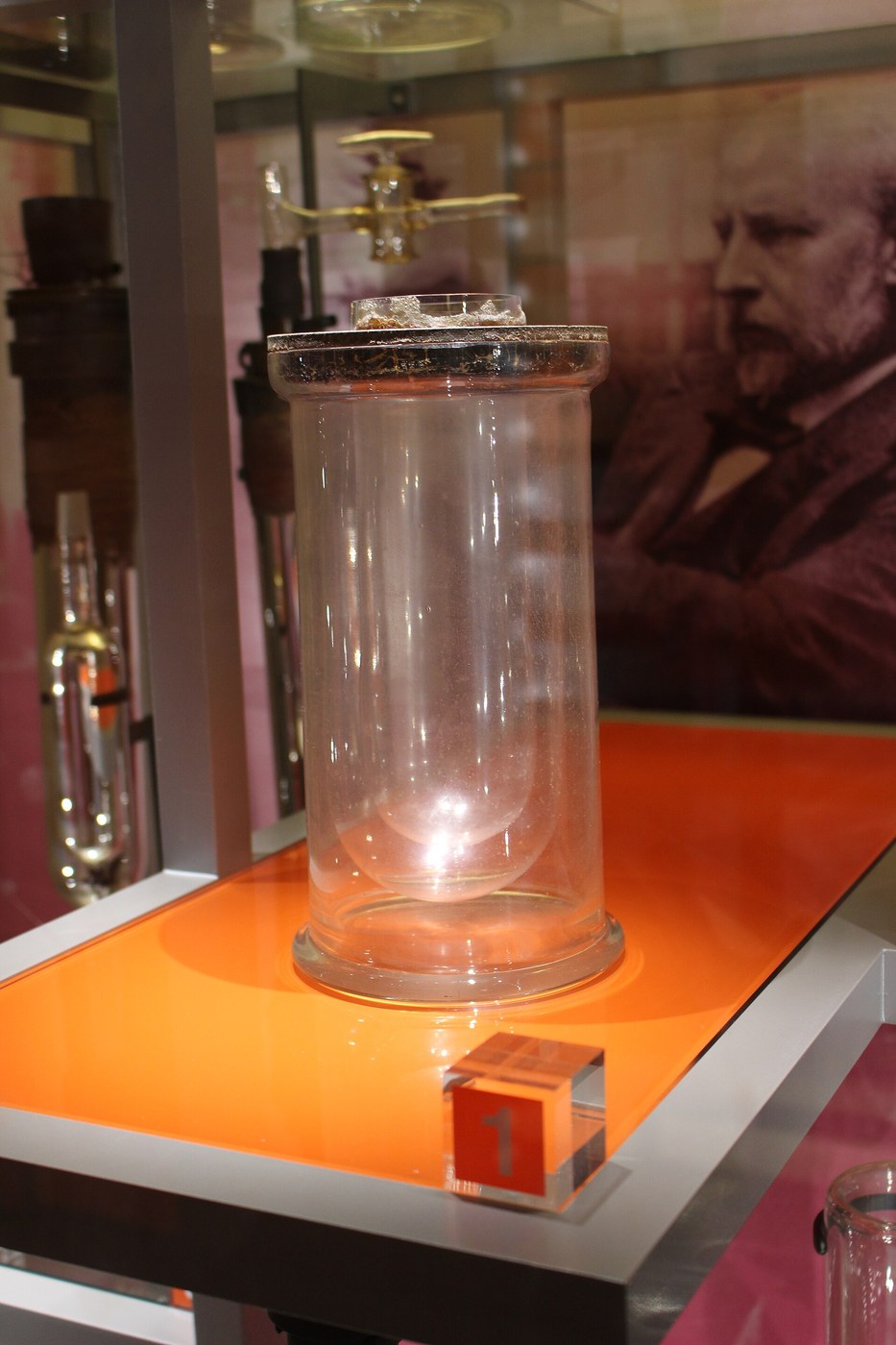


Vacuum Flask
A refrigerator moves heat out. A vacuum flask does the opposite job — it stops heat moving at all — and it does so with no power, no moving parts and no maintenance, for decades.
Heat crosses a gap three ways, and the flask blocks each one separately:
Conduction needs matter to pass through. Pump the air out from between two walls and there is almost nothing left to pass it. Only the narrow glass neck still joins inside to outside, which is why it is made long and thin.
Convection needs a fluid to circulate. No air, no circulation.
Radiation needs neither, and crosses a vacuum perfectly well — so both facing surfaces are silvered to reflect it straight back where it came from.
Miss any one of the three and the flask is ordinary. Silver a bottle without evacuating it and it barely works; evacuate without silvering and it leaks heat as light you cannot see.
James Dewar built it at the Royal Institution in 1892 to hold liquefied gases. He never patented it — and step 6 is about what that cost him, because it is a more useful story than the physics.
안내
Separate the three routes heat takes
Separate the three routes heat takes
Fill three identical jars with hot water at the same starting temperature. Leave one bare. Wrap the second in wool. Wrap the third in aluminium foil, shiny side inward, not touching the glass.
Log the temperature of each every five minutes for half an hour.
Expect wool to beat bare (it traps air, stopping convection and slowing conduction) and foil to help too, by a different mechanism — it turns back radiation.
Two different wrappings, two different physics. A flask needs both answers at once, which is why it has two of them.
이 단계의 재료:
 뚜껑 달린 유리병3 개
 알루미늄 포일1 롤
필요한 도구:
 온도계
온도계Take the air away and watch conduction fall off
Take the air away and watch conduction fall off
Put a warm sealed vessel inside a jar you can evacuate with a hand vacuum pump, and log its cooling with the jar at atmospheric pressure, then pumped down.
Expect the pumped-down case to hold heat noticeably longer.
You will not reach a real vacuum with a hand pump, and that is instructive: the insulation improves steadily as pressure falls rather than switching on. A flask that has "lost its vacuum" has usually only partly lost it, which is why it still works a little and people keep using it without noticing.
Find the neck, and understand why it is the weak point
Find the neck, and understand why it is the weak point
Look down a cut-away flask, or feel the outside of a working one after an hour of holding boiling water.
Almost all of it is at room temperature. The neck is warm.
That narrow ring of glass is the one place the two walls actually touch, so it is the only continuous path for conduction — a thermal short circuit that no amount of vacuum can remove.
Note the design response: necks are made long, thin and glass rather than short and metal. It is the same reasoning as a bridge expansion joint — where you cannot eliminate a path, you lengthen it and make it out of something that resists.
Show that silvering is doing real work
Show that silvering is doing real work
Compare two flasks of the same size, one with the silvering intact and one with it scratched or a cheap unsilvered vacuum vessel, both filled with boiling water.
Expect the silvered one to win by a wide margin.
The vacuum stops matter moving; it does nothing whatever to light. Hot water radiates infrared, the infrared crosses the vacuum unimpeded, and without a mirror it is simply absorbed by the outer wall and lost.
This is why the inside of a flask is a mirror and not painted black, and why the same silvered-vacuum sandwich turns up in spacecraft insulation, where there is nothing but radiation to stop.
Prove it does not know which way heat is going
Prove it does not know which way heat is going
Fill one flask with boiling water and an identical one with iced water. Log both against room temperature for an hour.
Expect each to hold its own, roughly symmetrically.
The flask has no idea what is inside it. It resists a temperature difference, in whichever direction that difference happens to point.
People find this surprising about a "hot flask", and it is the reason Dewar built the thing in the first place: he was not keeping tea warm, he was stopping room-temperature heat from boiling away liquefied gases at −200°C.
History & Context
History & Context
Built for cryogenics, not for tea. James Dewar made the first vacuum flask at the Royal Institution in 1892 as laboratory equipment — a vessel that could hold liquefied gases long enough to study them. He went on to liquefy hydrogen in 1898 using it. Physicists still call the vessels Dewars.
He never patented it, and lost everything as a result. Dewar judged the flask a laboratory instrument with no use outside cryogenics, so he filed nothing. In 1904 two German glassblowers commercialised the design, ran a competition to name it, and produced Thermos. Dewar sued and lost: he was acknowledged as the inventor, but having never filed, he had no standing to stop anyone. He earned nothing from the most widely owned object he ever designed.
Why he may have chosen that. Dewar had already been through a bruising patent fight with Alfred Nobel over cordite. Some accounts hold that he was simply uninterested in patents afterwards, others that he thought a scientific result should not be owned. Both readings are defensible and we do not know which is true — but the outcome is not in doubt, and it sits alongside Christensen's O-ring as a reminder that inventing a thing and owning it are unrelated skills.
What it enabled. Liquefied gases became storable, which made industrial oxygen, liquid nitrogen, LNG shipping, MRI magnets and the entire cryogenic supply chain possible. The vaccine cold chain runs on Dewar's principle. So does every flask on every building site.
Honest limits. A vacuum degrades — glass outgasses slowly and seals creep, so an old flask genuinely does insulate worse. Glass liners break if dropped, and the metal-walled versions that survive being dropped conduct more heat through the neck. And nothing stops the loss through the stopper, which is why the last surviving heat leak in a good flask is usually the lid you keep opening.
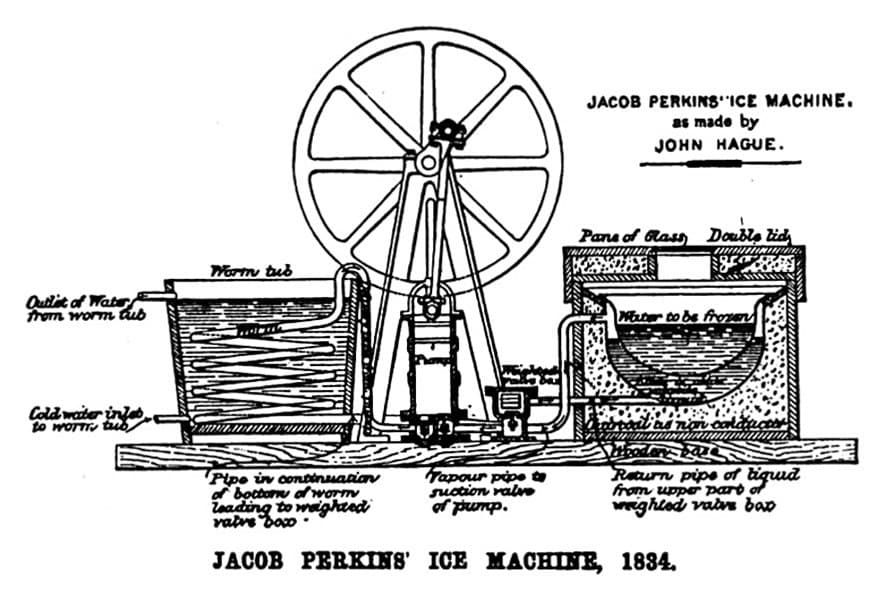

관련 블루프린트
이 블루프린트들은 지식을 공유합니다 — 기술, 재료 또는 원리
CC0 퍼블릭 도메인
이 블루프린트는 CC0로 공개되었습니다. 어떤 목적으로든 자유롭게 복사, 수정, 배포 및 사용할 수 있습니다.
제품 구매를 통해 메이커를 지원하세요. 판매자가 설정한 메이커 커미션 을 받거나, 이 블루프린트의 새로운 반복을 만들어 연결로 포함시킬 수 있습니다.