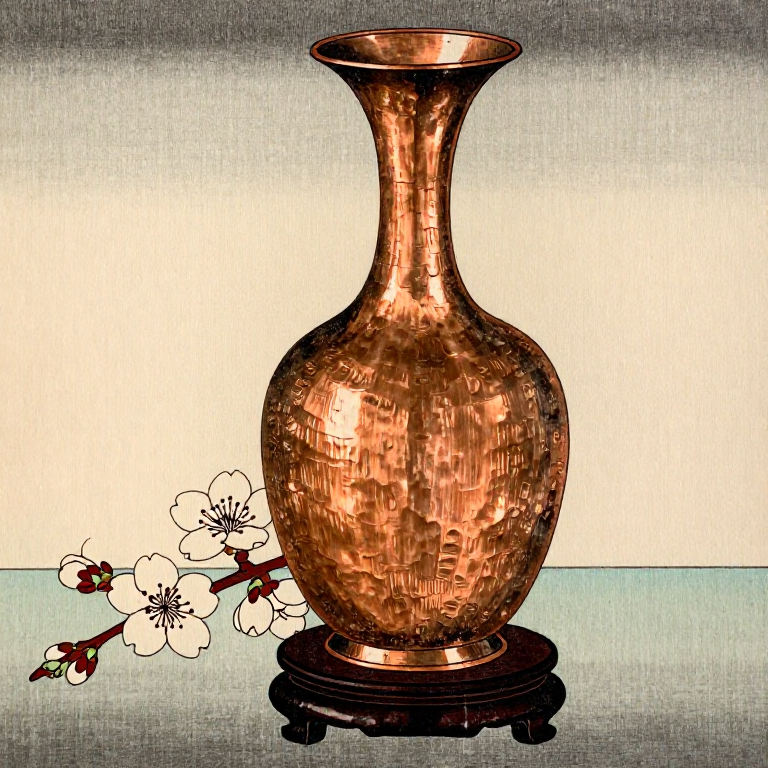


Raising a Copper Flower Vase by Hammering — Tsuiki Copperware
안내
Prepare and Anneal the Copper Disc
Prepare and Anneal the Copper Disc
Cut a circular disc from copper sheet, 25-30cm in diameter and 1-1.5mm thick. The disc diameter should be roughly 2.5 times the intended height of the finished vase. Mark concentric circles on the surface at 2cm intervals using a compass — these guide lines help maintain symmetry during raising. Anneal the disc by heating it evenly with a torch until it reaches dull red (approximately 500-600 degrees C), then quench it in water. This recrystallizes the copper's grain structure, making it soft and malleable. After quenching, pickle the disc in dilute acid to remove the black copper oxide scale, then rinse and dry it.
이 단계의 재료:
 구리판1 disc, 25-30cm diameter cm
 산 세척액(Sparex #2)1 litre 개
필요한 도구:
 단조 화덕
단조 화덕 강철 돋움 모루
 단조 망치
단조 망치 대장간 집게
 가죽끈
가죽끈Begin Raising Over the Stake
Begin Raising Over the Stake
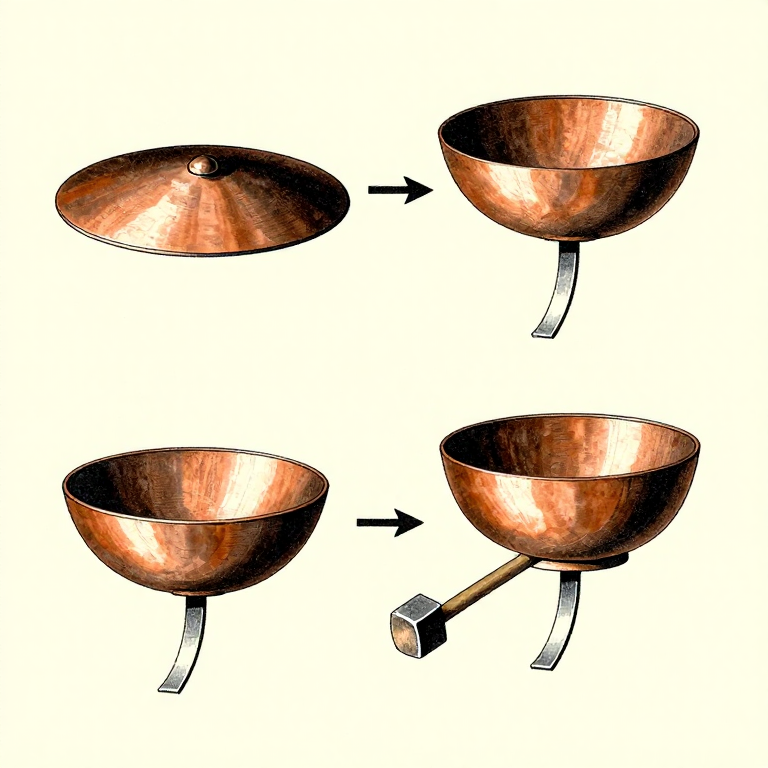
Clamp a rounded steel raising stake in a vise so it protrudes horizontally. Hold the copper disc against the stake at a slight angle, with the edge tilted upward. Strike the copper just below the point of contact with the stake using the raising hammer, working in concentric courses from the outer edge toward the centre. Each hammer blow compresses the metal against the stake, causing the edge to rise upward. Complete one full revolution before moving to the next inner course. After each complete pass, the disc takes on a shallow bowl shape. Copper work-hardens after 20-30% deformation, so anneal the piece whenever it becomes stiff and springy.
Continue Raising to Full Height
Continue Raising to Full Height
Continue the raising process over progressively narrower stakes as the vessel deepens. Each raising course lifts the walls higher and reduces the diameter. A typical vase requires 6-10 complete raising passes with annealing between each pass. The walls will thicken during raising as the diameter decreases — this is normal and desirable as it strengthens the vessel. To form the narrow neck of the vase, use a stake with a small-radius head and concentrate the raising blows on the upper portion. Check symmetry frequently by rotating the piece and viewing it at eye level. Correct any lopsidedness early, as asymmetry compounds with each subsequent pass.
Planish and Refine the Form
Planish and Refine the Form
Once the vase reaches its final shape, planish the surface by placing it over a smooth stake and striking with a flat-faced planishing hammer. Each planishing blow flattens one raising mark. Work systematically in tight overlapping courses, rotating the vase with each blow. Planishing both smooths the surface and hardens the copper, giving the finished piece structural rigidity. For a traditional tsuiki finish, leave subtle hammer marks visible rather than polishing to a mirror surface — the faceted texture catches light and is considered part of the artistic expression.
Finish the Rim and Patinate
Finish the Rim and Patinate
True the rim by filing it level, then either leave it as a clean-cut edge or fold it inward for strength. A folded rim adds visual weight and prevents the sharp edge from cutting flowers or the arranger's hands. For the final surface treatment, traditional Japanese coppersmiths apply a patina using rokusho, a chemical compound of copper acetate and salt. Dissolve rokusho in boiling water, immerse the cleaned copper vase, and the surface develops a rich brown to dark green patina depending on immersion time and concentration. Alternatively, a liver of sulfur (potassium polysulfide) solution produces warm brown to black tones. Seal the patina with a thin coat of clear lacquer or Renaissance wax to prevent further oxidation.
이 블루프린트로 만드는 것

CC0 퍼블릭 도메인
이 블루프린트는 CC0로 공개되었습니다. 어떤 목적으로든 자유롭게 복사, 수정, 배포 및 사용할 수 있습니다.
제품 구매를 통해 메이커를 지원하세요. 판매자가 설정한 메이커 커미션 을 받거나, 이 블루프린트의 새로운 반복을 만들어 연결로 포함시킬 수 있습니다.