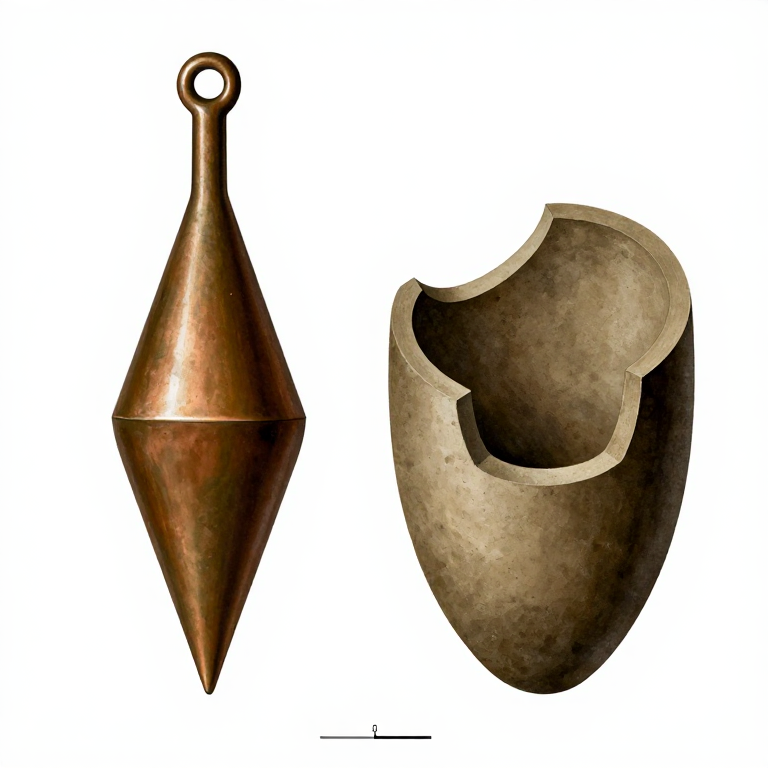


Egyptian Plumb Bob — Casting a Bronze Plumb Bob
안내
Carve the Wax Model
Carve the Wax Model
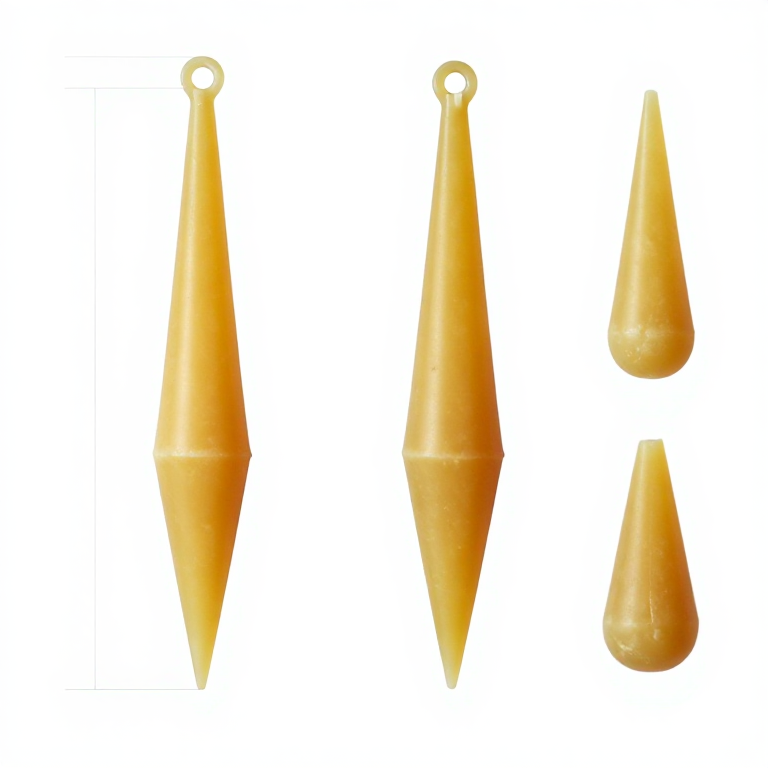
Warm beeswax until pliable and form it into a symmetrical conical or teardrop shape approximately 6-8 cm tall and 3-4 cm wide at the base, tapering to a sharp point at the bottom. At the top, form a small loop or pierced lug for attaching the suspension cord. The shape must be symmetrical around its central axis so the finished bob hangs true — any asymmetry will cause it to hang off-center, defeating its purpose. Archaeological examples from Kahun and Deir el-Medina show both conical and turnip-shaped profiles. Smooth the wax surface carefully, as every surface imperfection will transfer to the final bronze casting.
Build the Clay Investment Mold
Build the Clay Investment Mold
Attach a thin wax rod (sprue) to the top of the plumb bob model to create a channel for pouring metal and allowing air to escape. Apply a thin first coat of very fine clay slip mixed with animal dung or chaff over the entire wax model, taking care to capture all details. Let this inner layer dry completely. Then build up additional layers of coarser clay mixed with sand, allowing each coat to dry before applying the next, until the mold wall is 1-2 cm thick. This multi-layer technique, documented in Egyptian metalworking scenes at Beni Hasan and Saqqara, creates a mold strong enough to withstand the thermal shock of molten bronze at approximately 950-1050 degrees Celsius.
이 단계의 재료:
 밀랍 펠릿100-150 g for the model g
 숯 (부순 것)3-5 kg kg
Burn Out the Wax and Fire the Mold
Burn Out the Wax and Fire the Mold
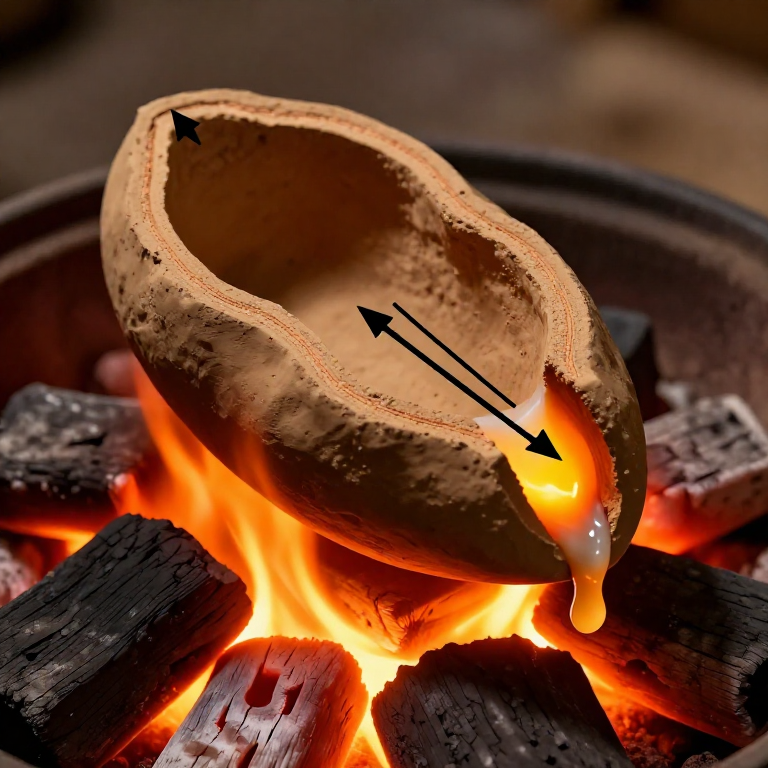
Place the clay mold upside down in a kiln or over a fire with the sprue opening facing downward. Heat gradually to approximately 300-400 degrees Celsius, which melts and burns out all the beeswax, leaving a hollow cavity in the exact shape of the plumb bob. The gradual heating is critical — if heated too fast, steam from residual moisture in the clay can crack the mold. Once the wax has fully drained and burned away, increase the temperature to 600-700 degrees Celsius to fully fire the clay into a hard ceramic shell. The mold must remain hot when the bronze is poured to prevent thermal shock cracking and to allow the metal to flow into all details of the cavity.
Melt and Pour the Bronze
Melt and Pour the Bronze
Place bronze (an alloy of approximately 88% copper and 12% tin) in a ceramic crucible and heat in a charcoal furnace with forced air from bellows until fully molten, reaching approximately 950-1050 degrees Celsius. Egyptian bronze was smelted in small clay crucibles holding 1-3 kg of metal, with workers operating reed blowpipes or foot-bellows to reach the required temperature. When the bronze is fully liquid with a bright orange surface, carefully pour it into the still-hot mold through the sprue hole in a single continuous stream. Pouring must be steady and uninterrupted to prevent cold shuts (visible seam lines where partially solidified metal fails to fuse). Allow the filled mold to cool slowly for at least one hour.
Break the Mold and Finish the Plumb Bob
Break the Mold and Finish the Plumb Bob
Once cooled to room temperature, carefully break away the clay mold with a hammer to reveal the bronze casting inside. Cut off the sprue with a hacksaw or chisel, and file the stub flush with the top surface. Use coarse files to remove any casting flash (thin fins of metal that seeped into mold cracks), then progressively finer abrasive stones to smooth the entire surface. Test the plumb bob by suspending it from a cord through the top loop — it should hang with the point directly below the suspension point. If it tilts, file material from the heavy side until it hangs true. Polish the surface with fine sand and a leather pad to achieve the characteristic golden-bronze finish seen on surviving Egyptian examples.
재료
8- 100-150 g for the model g플레이스홀더
- 3-5 kg kg플레이스홀더
- 100-150 g for the model 개플레이스홀더
- 200-300 g 개플레이스홀더
- 1-2 kg for the mold 개플레이스홀더
- 1 m for suspension line 개플레이스홀더
- 2 kg플레이스홀더
- 플레이스홀더
CC0 퍼블릭 도메인
이 블루프린트는 CC0로 공개되었습니다. 어떤 목적으로든 자유롭게 복사, 수정, 배포 및 사용할 수 있습니다.
제품 구매를 통해 메이커를 지원하세요. 판매자가 설정한 메이커 커미션 을 받거나, 이 블루프린트의 새로운 반복을 만들어 연결로 포함시킬 수 있습니다.