
식물에서 천연 염료 추출 — 정원에서의 색
Before synthetic dyes were invented (William Henry Perkin's mauveine, 1856), every colored fabric, thread, and yarn was dyed with pigments extracted from plants, insects, and minerals. This tradition spans at least 5,000 years — dyed textile fragments from Mohenjo-Daro (c. 3000 BCE) show evidence of madder red and indigo blue, the same dyes used throughout history.
Plant dyes work because certain molecules (chromophores) absorb specific wavelengths of visible light. The challenge is making these molecules bind permanently to fiber — most plant pigments wash out immediately without a mordant, a metallic salt that forms a chemical bridge between the dye molecule and the fiber. Alum (potassium aluminum sulfate) has been the most common mordant for millennia.
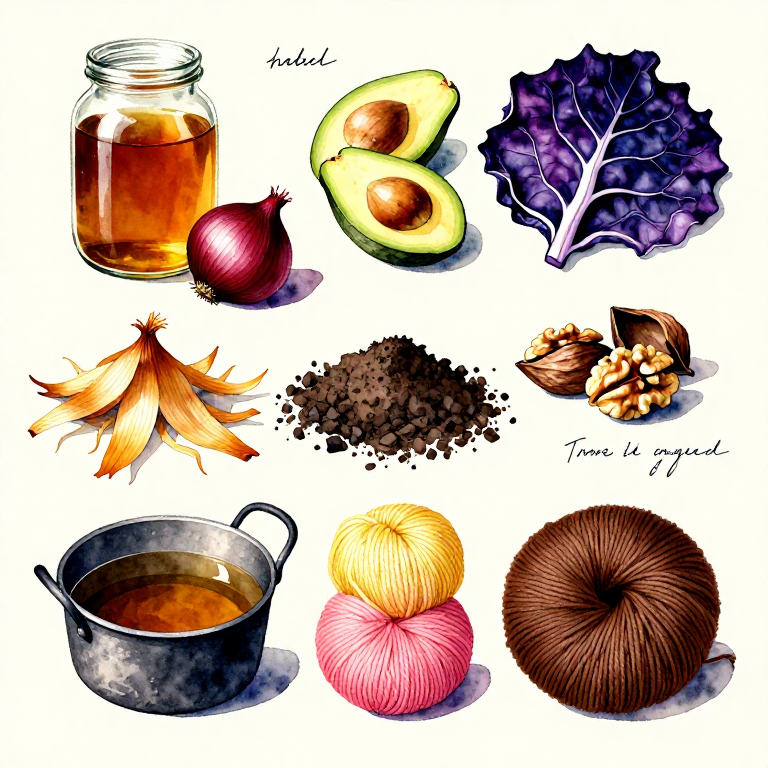
This blueprint covers harvesting common dye plants, preparing mordant solutions, and extracting dyes that produce a range of colors: yellow (onion skins, turmeric, chamomile), red-pink (avocado pits and skins, madder root), blue (red cabbage with iron modifier), brown-black (walnut hulls, oak galls), and green (combining yellow dye with iron modifier).
안내
염료 식물 재료 수집
염료 식물 재료 수집
The most accessible dye plants are common kitchen and garden materials. For beginners, start with these reliable sources: Yellow: dry onion skins (outer papery layers — the strongest and most lightfast natural yellow), fresh turmeric root, or chamomile flowers. Red-pink: avocado pits and skins (produces a surprising salmon-pink), or dried madder root (the classic historical red). Brown-black: black walnut hulls (collected green from the ground in autumn), or oak galls. Purple-blue: red cabbage leaves.
Collect generous quantities — plant dyes are typically weak compared to synthetic dyes. A rough rule: use equal weight of dye material to weight of fiber (a 1:1 ratio). For strong colors, use 2:1 or 3:1. Chop or tear the material into small pieces to maximize surface area for extraction.
이 단계의 재료:
 양파 껍질(말린 것, 노란색)1 개
 강황 가루1 개
 말린 꼭두서니 뿌리1 개
 호두 겉껍질1 개
 몰식자 (참나무 벌레혹)1 개
 적양배추1 개
필요한 도구:
 양동이
양동이매염제로 섬유 준비
매염제로 섬유 준비
Most plant dyes require a mordant to bond permanently with fiber. Without mordanting, the color washes out within a few launderings. The safest and most traditional mordant is alum (potassium aluminum sulfate, KAl(SO₄)₂), available from pharmacies and cooking suppliers (it's used in pickling).
Dissolve alum in hot water at approximately 15-20% of the dry fiber weight (e.g., 15g alum for 100g of fabric). Add the wet, pre-soaked fiber to the alum solution, bring to a gentle simmer (80-90°C), and hold for one hour. Do not boil — boiling makes wool felt and can damage protein fibers. Allow the fiber to cool in the mordant bath, then gently squeeze out excess liquid. The fiber is now mordanted and ready for dyeing. Natural fibers (cotton, linen, wool, silk) take mordant well; synthetic fibers do not.
이 단계의 재료:
 명반 매염제1 개
 물들이지 않은 모사1 개
필요한 도구:
 내열 유리 비커
 스테인리스 젓개
 니트릴 고무 장갑
염료 추출
염료 추출
Place the chopped dye material in a large pot, cover with water (approximately double the volume of plant material), and bring to a gentle simmer. Maintain the simmer for 1-2 hours — the water will gradually take on the dye color. Onion skins produce a deep amber-gold within 30 minutes; madder root needs a full hour at sub-boiling temperatures (never boil madder — temperatures above 80°C shift the color from red to brown).
After extraction, strain the dye bath through a cloth or fine sieve to remove all plant material. The clear, colored liquid is your dye bath. The color of the dye bath indicates the final fiber color, but will usually be darker than the finished result — the fiber absorbs only a fraction of the available dye.
필요한 도구:
 분급 체스테인리스 젓개니트릴 고무 장갑
매염된 섬유 염색
매염된 섬유 염색
Add the wet, mordanted fiber to the strained dye bath. Bring to a gentle simmer and hold for 1 hour, stirring occasionally to ensure even dye uptake. The fiber will gradually absorb color from the bath. For deeper color, leave the fiber in the cooling dye bath overnight — slow cooling allows more dye to bond with the mordant on the fiber.
Remove the fiber, gently squeeze out excess dye (do not wring — this distorts the fabric), and rinse in cool water until the rinse water runs relatively clear. Some color loss during initial rinsing is normal — the unbound dye is washing away, leaving only the mordanted, permanently fixed color.
필요한 도구:
스테인리스 젓개양동이니트릴 고무 장갑철과 pH로 색 수정
철과 pH로 색 수정
The same dye can produce different colors with chemical modifiers. Iron modifier (ferrous sulfate, FeSO₄, 'copperas'): adding a pinch to the dye bath or the rinse water shifts colors dramatically toward green, grey, and black. Onion-skin yellow becomes olive green; madder red becomes dark burgundy; walnut brown becomes near-black. Iron acts as both a mordant and a color modifier.
pH modifiers: adding vinegar (acid) or baking soda (alkali) shifts the pH of the dye bath, changing colors. Red cabbage is the most dramatic example — it produces blue in alkaline solution, purple in neutral, pink in acid. This is the same chemistry that makes red cabbage juice a pH indicator.
Document your combinations: dye source + mordant + modifier = specific color. Keep samples of each combination as a reference library. Traditional dyers maintained notebooks (pattern books) of hundreds of tested combinations passed down through generations.
이 단계의 재료:
 황산철1 개
 화이트 와인 식초1 개
 베이킹소다1 개
필요한 도구:
 유리 시료병니트릴 고무 장갑
염색된 섬유 건조 및 고정
염색된 섬유 건조 및 고정
Hang the dyed fiber to dry in shade — direct sunlight can fade fresh dyes before they have fully cured. Allow to dry completely, then wash gently with mild soap to remove any remaining unfixed dye. The color you see after this first wash is the permanent color — it will soften slightly with age and wear but should not wash out.
Natural dyes vary in lightfastness (resistance to fading in sunlight). Onion skin, madder, and walnut are among the most lightfast. Turmeric is beautiful but fades rapidly — it's fugitive (impermanent) without UV protection. Keep a sample card of all your dye results, noting the dye source, mordant, modifier, fiber type, and date. This is your personal dye reference that grows more valuable with every experiment.
재료
11- 플레이스홀더
- 1 개플레이스홀더
- 1 개플레이스홀더
- 1 개플레이스홀더
- 플레이스홀더
- 1 개플레이스홀더
- 1 개플레이스홀더
- 1 개플레이스홀더
- 1 개플레이스홀더
- 1 개플레이스홀더
- 1 개플레이스홀더
CC0 퍼블릭 도메인
이 블루프린트는 CC0로 공개되었습니다. 어떤 목적으로든 자유롭게 복사, 수정, 배포 및 사용할 수 있습니다.
제품 구매를 통해 메이커를 지원하세요. 판매자가 설정한 메이커 커미션 을 받거나, 이 블루프린트의 새로운 반복을 만들어 연결로 포함시킬 수 있습니다.