

Ferris Wheel
안내
Prove a rigid-spoke wheel is the wrong idea
Prove a rigid-spoke wheel is the wrong idea
Build the obvious version first and find its limit.
- Make a small wheel with stiff wooden spokes into a hub.
- Load the rim and watch where it deflects.
- Note that the spokes below the hub are being squashed.
이 단계의 재료:
 소나무 다월 세트1 세트
 발트 자작나무 합판1 팩
Build it in tension instead
Build it in tension instead
Replace the spokes with something that can only pull.
- Rebuild the wheel using taut cord or wire from hub to rim.
- Tension every spoke evenly so the rim runs true.
- Load the rim again.
이 단계의 재료:
 면 노끈1 롤
Hang the cars so they stay level
Hang the cars so they stay level
Passengers must remain upright through the whole revolution.
- Hang each car from a pivot at the rim rather than fixing it rigidly.
- Check it swings freely.
- Turn the wheel and watch the cars hold level by gravity alone.
Find where the load goes
Find where the load goes
Trace the path from a passenger to the ground.
- Load one car and feel which spokes tighten.
- Note the load runs: car → rim → upper spokes → axle → towers → foundations.
- Add cars all round and watch the tension even out.
History and context
History and context
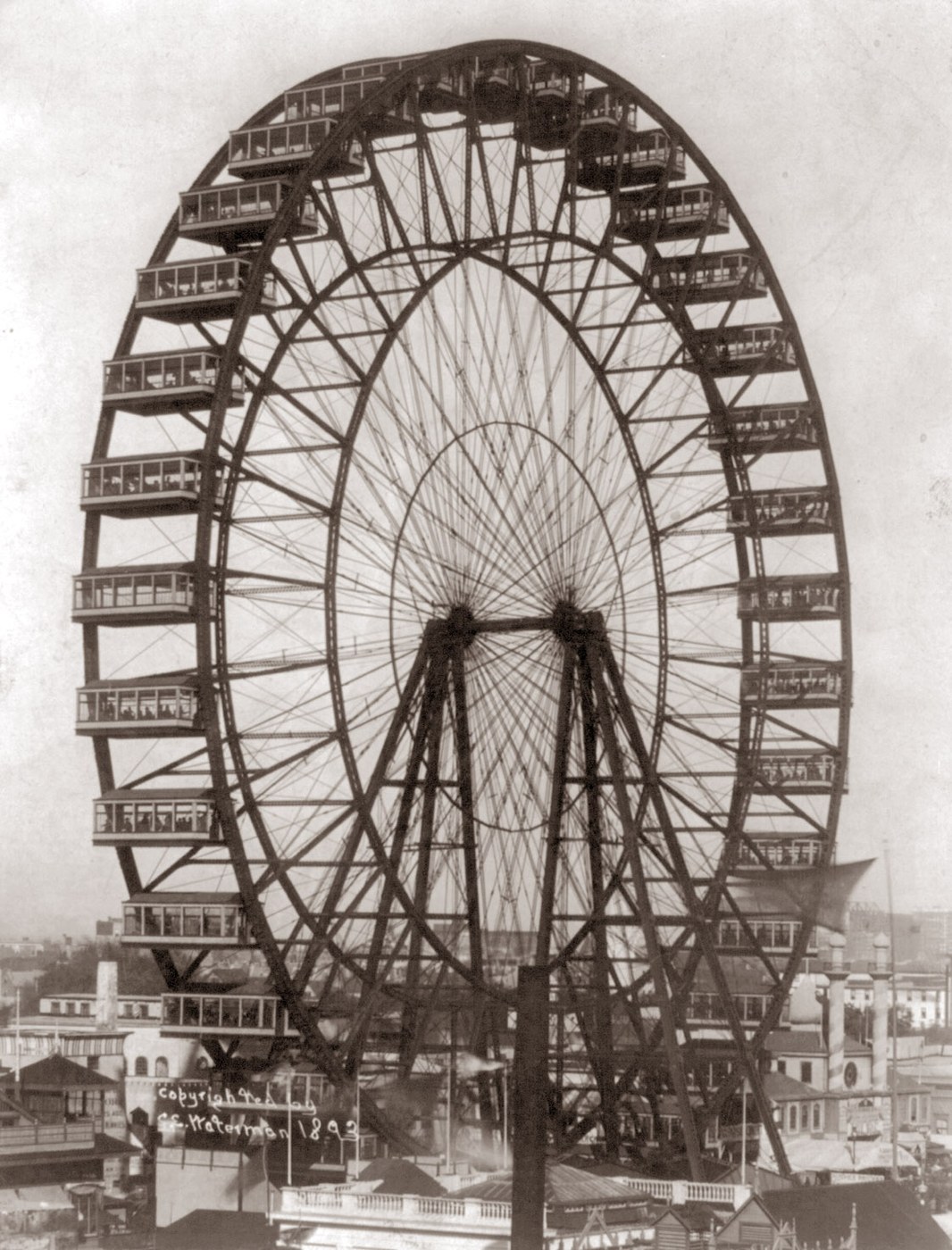
The 1893 World's Columbian Exposition wanted a centrepiece to rival the Eiffel Tower of 1889. George Washington Gale Ferris Jr, a Pittsburgh engineer whose firm inspected steel for bridges, proposed the wheel. The Exposition's engineers were openly sceptical and he had to fund much of the early work and testing himself.
The numbers: about 250 feet — 76 metres — in diameter, 36 enclosed cars, each rated at 60 passengers, so more than 2,000 people at once. Two 140-foot towers carried the axle. It ran through the fair and carried well over a million passengers without incident.
It was not the first big wheel — pleasure wheels turned by hand are much older, some documented in seventeenth-century Bulgaria and Turkey. What was new was the scale, and specifically the tension-spoke structure that made the scale possible. That idea came from bridge engineering, which is what Ferris actually did for a living.
It ended badly for its inventor. Ferris fought the Exposition over his share of the receipts, his business suffered, and he died in 1896 aged 37, of typhoid, reportedly close to bankrupt. The wheel was moved, ran again at the 1904 St Louis fair, and was demolished with dynamite in 1906.
What this build shows and does not: the tension-spoke principle and the free-hanging car are both genuine and demonstrated here. A real wheel adds wind loading, thermal expansion of a 76-metre rim, and fatigue in every joint over millions of cycles — the things that decide whether a structure lasts, none of which appear at bench scale.

CC0 퍼블릭 도메인
이 블루프린트는 CC0로 공개되었습니다. 어떤 목적으로든 자유롭게 복사, 수정, 배포 및 사용할 수 있습니다.
제품 구매를 통해 메이커를 지원하세요. 판매자가 설정한 메이커 커미션 을 받거나, 이 블루프린트의 새로운 반복을 만들어 연결로 포함시킬 수 있습니다.