예술
뷰티 및 웰니스
공예
문화 및 역사
엔터테인먼트
환경
음식 및 음료
역공학
과학
스포츠
기술
웨어러블
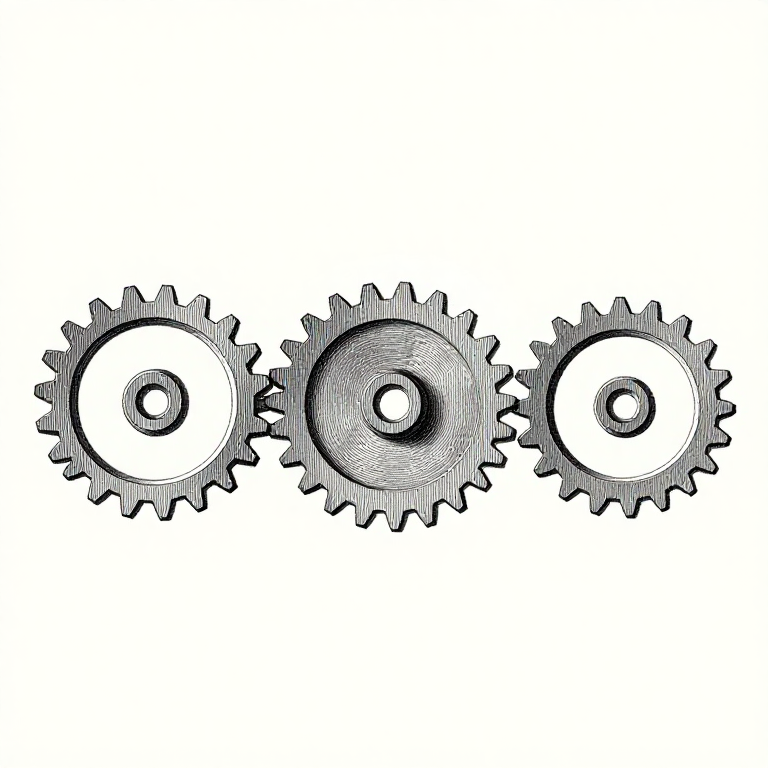


Gear Trains: Idlers, Compounding and Hitting a Given Ratio
One gear pair gives one ratio and there is a practical limit to how large it can be. Beyond about 6:1 the wheel becomes absurd beside its pinion, so ratio is built up in stages — and how the stages are arranged decides whether they multiply or cancel.
A line of gears each on its own shaft multiplies nothing: every gear between the first and the last appears once as driven and once as driver and drops straight out of the arithmetic. Those are idlers, and they earn their place by reversing direction and bridging distance, not by changing ratio. Pairing two gears on one shaft is what compounds.
This rung is the arithmetic of trains, what an idler is for, and the classic problem of hitting a ratio that is given to you rather than chosen — why a screwcutting lathe needs a 127 tooth gear, and how far an approximate ratio can be trusted.
중급
4 hours
안내
1
1
Simple, compound and reverted
Simple, compound and reverted
**A simple train** has one gear per shaft. The overall ratio is the last tooth count divided by the first, whatever is in between.
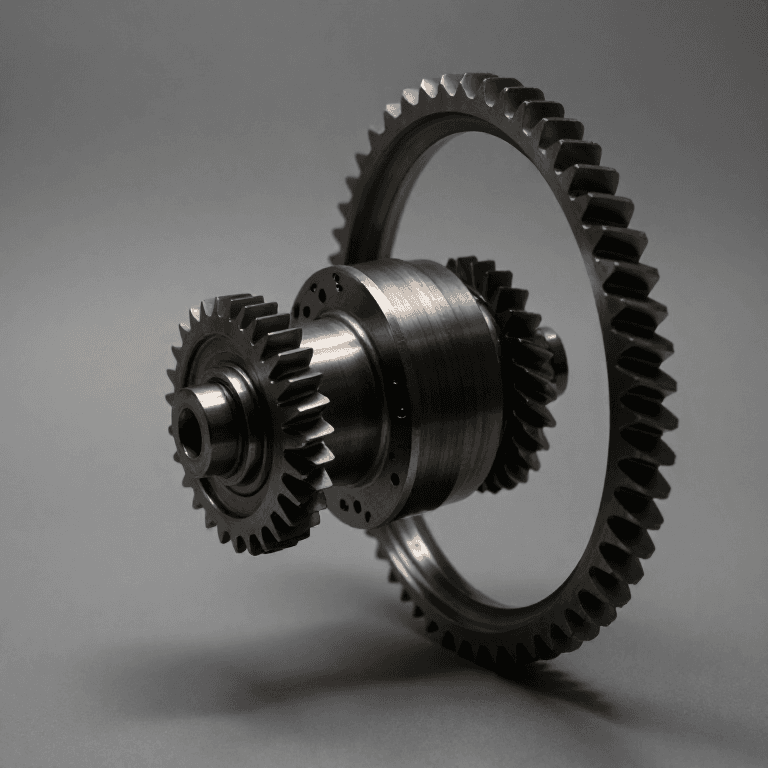
**A compound train** has two gears keyed to the same shaft. The pair turns together, so the ratio of the first mesh is carried into the second and the stages multiply. Every large reduction is a compound train.
**A reverted train** is a compound train whose input and output are on the same axis. It is the awkward one to design, because the centre distances of both stages must be equal — z₁ + z₂ = z₃ + z₄ at a common module — which constrains the tooth counts far more than the ratio does. Clocks and lathe headstocks are full of them.
**Per stage, keep the ratio sensible.** Spur and helical stages are usually held between about 1:1 and 6:1. Below 1:1 the pinion drives the wheel backwards and nothing is gained; above about 6:1 the wheel is large, heavy and expensive beside a pinion that is now the weak part, and a second stage costs less than the oversized wheel would.
**Split the ratio between stages, roughly evenly.** Two stages of 5:1 give 25:1 in a smaller box than 10:1 followed by 2.5:1, because the large wheel of the first arrangement is smaller. A common rule puts slightly more reduction in the first stage, where the torque is lowest.
이 단계의 재료:
 평기어 세트 (강, 20 이)4 개
 강철 축 30 mm2 개
 볼 베어링4 개
필요한 도구:
 디지털 캘리퍼스 6인치
2
2
Train arithmetic, idlers and change gears
Train arithmetic, idlers and change gears
Jupyter 노트북 불러오는 중…
필요한 도구:
 데스크톱 컴퓨터
3
3
Laying out a train that fits
Laying out a train that fits
**Start from the output.** The output torque and speed are given; the input is usually a motor with a catalogue of standard speeds. The ratio is fixed before anything is drawn.
**Choose the module from the most loaded pinion**, which is the last stage, where the torque is highest. A module chosen for the input stage will be too small at the output.
**Then the centre distances are no longer free.** Each stage's centres follow from m(z₁+z₂)/2, and the shafts must land where the housing can hold them. Adjusting a tooth count by one or two teeth to make a centre distance convenient is normal and costs nothing — and it is a good moment to make the counts coprime.
**Check the gears physically clear each other.** In a compound train the large wheel of one stage and the large wheel of the next are on adjacent shafts, and they can overlap in plan even though they never mesh. Draw the tip circles.
**Check the direction at the output.** Count the external meshes. Discovering after machining that the output turns the wrong way is an expensive idler.
**Leave room for bearings on both sides of every gear.** An overhung gear — one outboard of both its bearings — deflects under load and tips out of alignment, which is the subject of the mounting rung.
이 단계의 재료:
평기어 세트 (강, 20 이)4 개강철 축 30 mm2 개볼 베어링4 개필요한 도구:
디지털 캘리퍼스 6인치 자데스크톱 컴퓨터
4
4
Where trains go wrong
Where trains go wrong
**Tolerances add up along a train.** Each stage contributes its own backlash and its own transmission error, and at the output they sum. A four-stage train with a comfortable 0.08 mm of backlash per stage has, referred to the output, the sum of each stage's backlash divided by the ratio between it and the output — so the last stage dominates and the first barely matters. This is why a precision drive is built with the accurate stage last.
**Efficiency multiplies, it does not average.** A stage at 98% is excellent; four of them give 0.98⁴ = 92%. A worm stage at 60% in a four-stage train leaves 55% overall whatever the other stages do.
**The heat goes somewhere.** The lost 8% is watts in the oil, and a sealed box with no path to air will keep warming until the oil thins and the film fails.
**A common factor in the tooth counts wastes the train.** Two stages of 20:60 share every factor there is, so the same teeth meet for ever in both. Making one stage 20:61 costs nothing.
**An idler between two gears that already mesh correctly can still be wrong.** It must be the same module and pressure angle as both, and its own tooth count should share no factor with either, or it hunts in neither mesh.
이 단계의 재료:
평기어 세트 (강, 20 이)4 개 기어드 모터1 개
필요한 도구:
 다이얼 게이지데스크톱 컴퓨터
재료
4- 플레이스홀더
- 2 개플레이스홀더
- 플레이스홀더
- 플레이스홀더
관련 블루프린트
이 블루프린트들은 지식을 공유합니다 — 기술, 재료 또는 원리

CC0 퍼블릭 도메인
이 블루프린트는 CC0로 공개되었습니다. 어떤 목적으로든 자유롭게 복사, 수정, 배포 및 사용할 수 있습니다.
제품 구매를 통해 메이커를 지원하세요. 판매자가 설정한 메이커 커미션 을 받거나, 이 블루프린트의 새로운 반복을 만들어 연결로 포함시킬 수 있습니다.