
Generating Hydrogen Gas from Acid and Metal — The Lightest Element in the Universe
Hydrogen (H, element 1) is the simplest atom in existence — one proton, one electron — and the most abundant element in the universe, making up approximately 75% of all normal matter by mass. Every star, including our Sun, is powered by hydrogen fusion: four hydrogen nuclei fuse into one helium nucleus, releasing the energy that lights the cosmos. On Earth, hydrogen is the third most abundant element by atom count but is almost never found as free H₂ gas because it is so reactive and so light (density 0.09 g/L) that it escapes Earth's gravity.
Henry Cavendish first isolated hydrogen in 1766 by dissolving metals in acid, calling it 'inflammable air.' Antoine Lavoisier named it 'hydrogène' (water-former) in 1783 after proving that burning hydrogen produced water — the first demonstration that water is not an element but a compound of hydrogen and oxygen (H₂O). This discovery shattered the ancient Greek theory that water was a fundamental element and launched modern chemistry.
This blueprint teaches you to generate, collect, and test hydrogen gas using the classic acid-metal reaction that Cavendish used over 250 years ago. The same reaction still demonstrates fundamental chemistry: acid donates protons (H⁺) to a reactive metal, which gives up electrons; the H⁺ ions gain those electrons and combine as H₂ gas. Understanding hydrogen connects you to water chemistry, acids and bases, combustion, fuel cells, and the nuclear fusion that powers every star.
안내
Understand hydrogen's properties and place in the periodic table
Understand hydrogen's properties and place in the periodic table
Hydrogen (H, element 1) stands alone in the periodic table — it does not fit neatly into any group. It has one proton, one electron, electron configuration 1s¹, and atomic weight 1.008 — the lightest of all elements. Hydrogen can either lose its electron (forming H⁺, a bare proton — the basis of all acid chemistry) or gain one electron (forming H⁻, hydride — found in metal hydrides). This dual behavior is unique: no other element acts as both a nonmetal and a quasi-metal so readily.
Molecular hydrogen (H₂) is a colorless, odorless gas with a density of only 0.09 g/L — 14.4 times lighter than air. It is the lightest gas and the fastest-diffusing molecule. H₂ has a very wide flammable range in air (4–75% by volume) and burns with an almost invisible pale blue flame at approximately 2045 °C. The H–H bond energy is 436 kJ/mol — strong for a single bond, which is why H₂ is kinetically stable despite being thermodynamically reactive.
Understand the acid-metal reaction that produces hydrogen
Understand the acid-metal reaction that produces hydrogen
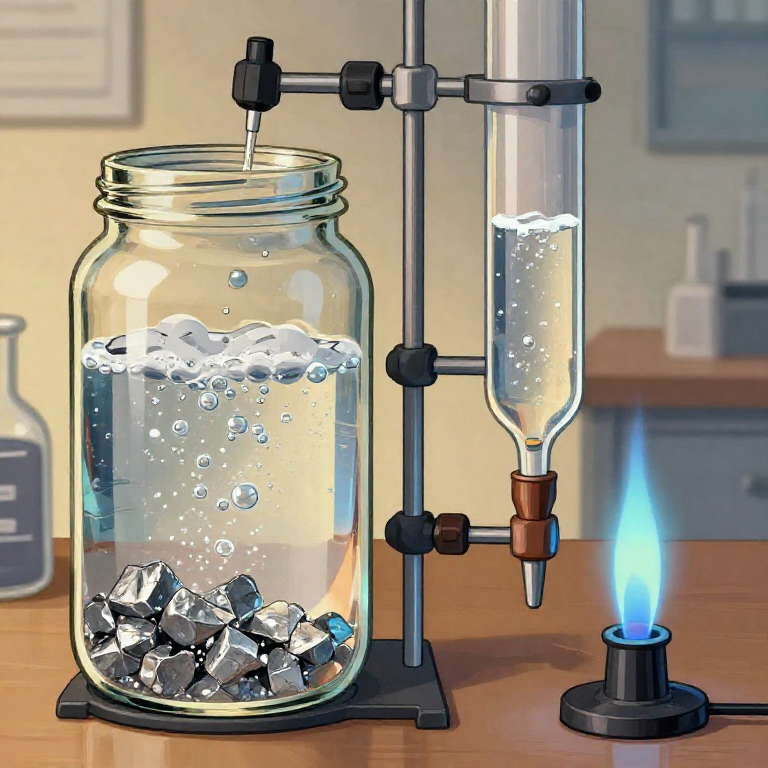
When a reactive metal is placed in an acid, the metal atoms lose electrons to hydrogen ions (H⁺) in the acid. Using zinc and hydrochloric acid as the example: Zn(s) + 2HCl(aq) → ZnCl₂(aq) + H₂(g)↑. The zinc dissolves, the solution warms (exothermic reaction), and hydrogen gas bubbles vigorously from the surface of the metal.
The reaction works with any metal more reactive than hydrogen in the activity series: zinc, iron, magnesium, and aluminum all work. Copper, silver, gold, and platinum are below hydrogen in the series and will NOT dissolve in hydrochloric acid — this is why gold survives in nature as a native metal while iron always occurs as an oxide ore. The activity series is, in effect, a ranking of how eagerly each metal donates electrons to H⁺ ions.
Prepare the apparatus for gas collection
Prepare the apparatus for gas collection
Set up a simple gas-collection apparatus outdoors or in a very well-ventilated area. Place a glass jar or bottle on a stable surface. You will add acid to metal inside this vessel and collect the gas that evolves. For the simplest collection method (downward displacement of water), fill a second glass jar completely with water, invert it in a basin of water so no air enters, and position the mouth of the reaction vessel near the inverted jar's mouth so rising H₂ bubbles displace the water.
SAFETY: Hydrogen gas is extremely flammable. Perform this experiment outdoors, away from flames, sparks, and heat sources. Wear chemical splash goggles and gloves. Have a water source nearby. Never seal a hydrogen-generating reaction in a closed container — pressure buildup can cause an explosion.
이 단계의 재료:
 유리병
유리병 깨끗한 물 (헹굼용)
필요한 도구:
 화학물질 비산 보안경
 긴 소매 가죽 장갑
Add zinc or iron to dilute hydrochloric acid
Add zinc or iron to dilute hydrochloric acid
Place several small pieces of zinc metal (or iron nails, or steel wool) into the glass jar. Wearing goggles and gloves, carefully pour dilute hydrochloric acid (10% HCl) into the jar to cover the metal pieces. Bubbles of hydrogen gas will immediately begin rising from the metal surface. The reaction is vigorous but controllable with dilute acid; more concentrated acid reacts faster and generates heat more quickly.
With zinc: Zn + 2HCl → ZnCl₂ + H₂↑. With iron: Fe + 2HCl → FeCl₂ + H₂↑ (slower, as iron is less reactive than zinc). The solution gradually turns colorless (zinc chloride) or pale green (ferrous chloride) as the metal dissolves. You can hear the gas bubbling — hydrogen produces a distinctive, rapid fizzing sound.
이 단계의 재료:
 염산
염산필요한 도구:
화학물질 비산 보안경긴 소매 가죽 장갑Collect hydrogen gas by water displacement
Collect hydrogen gas by water displacement
Position the inverted, water-filled collection jar over the reaction vessel so that rising hydrogen bubbles enter the jar's mouth and displace the water downward. Hydrogen is so much lighter than water that it rises rapidly into the inverted jar. As the jar fills with hydrogen, water drains out from the bottom. When the jar is mostly filled with gas (the water level has dropped to near the jar's mouth), carefully slide a flat cover (glass plate or card) under the mouth while keeping it inverted.
Wait at least 30 seconds before collecting gas to allow the initial air in the apparatus to be flushed out. Pure hydrogen is what you want — a mixture of hydrogen and air is explosive. The collected gas should be colorless and odorless (any smell comes from impurities in the acid or metal, not from the hydrogen itself).
Perform the squeaky pop test to confirm hydrogen
Perform the squeaky pop test to confirm hydrogen
The classic test for hydrogen gas: hold the inverted jar of collected gas near (but not directly over) a lit match or candle flame, and quickly remove the cover. If the jar contains hydrogen, it ignites with a characteristic sharp 'pop' or 'bark' sound. A soft pop indicates relatively pure hydrogen; a loud bark or explosion indicates a hydrogen-air mixture (more dangerous). Pure hydrogen burns with a nearly invisible pale blue flame.
The pop occurs because hydrogen and oxygen react explosively: 2H₂ + O₂ → 2H₂O + energy. The speed of this reaction at the air-hydrogen interface creates a pressure wave — the pop. This is the same reaction, on a vastly larger scale, that powered the Saturn V rocket (liquid hydrogen + liquid oxygen) and that operates in modern hydrogen fuel cells (the reaction runs electrochemically, producing electricity instead of explosion).
Observe hydrogen's extreme lightness
Observe hydrogen's extreme lightness
Fill a small, lightweight bag (a plastic produce bag or balloon) with hydrogen gas from the reaction by holding its opening over the gas source. Tie it off and release it. A hydrogen-filled balloon rises rapidly — hydrogen's density (0.09 g/L) is only 7% that of air (1.29 g/L), giving it greater lifting power per unit volume than helium (0.18 g/L). This property made hydrogen the gas of choice for early balloons and airships.
The first manned hydrogen balloon flight was by Jacques Charles in Paris, December 1, 1783 — just ten days after the first manned hot-air balloon flight. Hydrogen airships (culminating in the Hindenburg) were eventually abandoned after the 1937 disaster, replaced by helium — which is non-flammable but has only 92% of hydrogen's lifting capacity.
Understand hydrogen's connections to civilization
Understand hydrogen's connections to civilization
Hydrogen connects to every scale of existence. Cosmology: hydrogen comprises 75% of ordinary matter in the universe. The first atoms to form after the Big Bang were hydrogen. Every star begins as a collapsing cloud of hydrogen. Water: two hydrogen atoms bonded to one oxygen atom create the molecule (H₂O) that defines life on Earth. Water's unique properties — high heat capacity, surface tension, universal solvent, ice floats — all arise from hydrogen bonding between H₂O molecules. Acids and bases: all acid chemistry is hydrogen chemistry. An acid is any substance that donates H⁺ (a proton). pH literally measures hydrogen ion concentration: pH = −log[H⁺]. Energy: the Haber-Bosch process (N₂ + 3H₂ → 2NH₃) consumes ~2% of world energy. Hydrogen fuel cells convert H₂ + O₂ → H₂O + electricity with 60% efficiency. Organic chemistry: every organic molecule contains hydrogen bonded to carbon. Hydrocarbons (CH₄, C₈H₁₈, etc.) store solar energy captured by ancient photosynthesis.
Hydrogen is where chemistry begins — element 1, one proton, one electron. Every other element was forged from hydrogen in the cores of stars. Understanding hydrogen is understanding the foundation of matter itself.
필요 도구
2- 플레이스홀더
- 플레이스홀더
연결된 블루프린트 재료

이 블루프린트로 만드는 것
CC0 퍼블릭 도메인
이 블루프린트는 CC0로 공개되었습니다. 어떤 목적으로든 자유롭게 복사, 수정, 배포 및 사용할 수 있습니다.
제품 구매를 통해 메이커를 지원하세요. 판매자가 설정한 메이커 커미션 을 받거나, 이 블루프린트의 새로운 반복을 만들어 연결로 포함시킬 수 있습니다.