

Greek Fire — The Byzantine Superweapon Whose Secret Died with an Empire
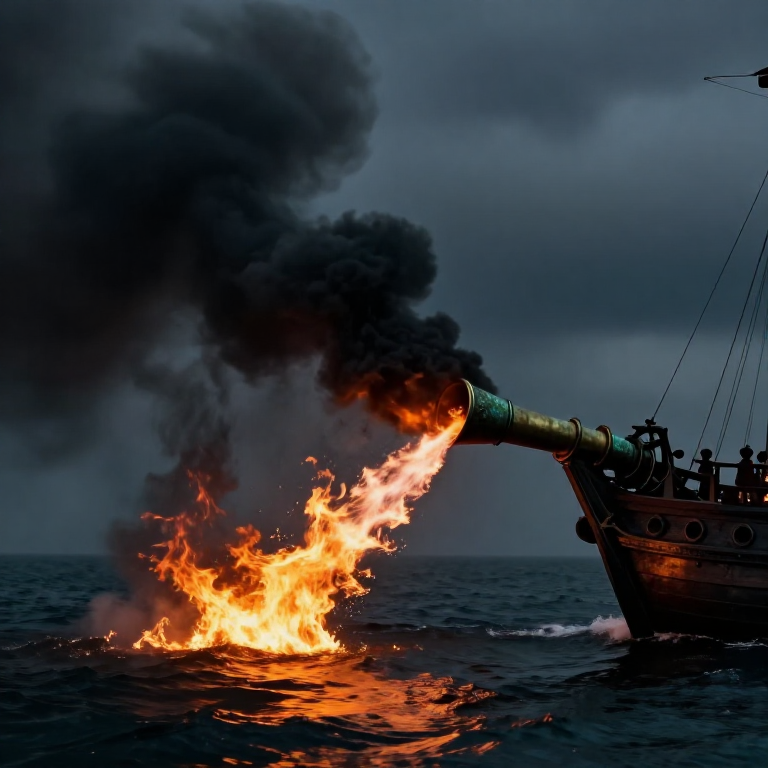
Greek fire (Greek: Ὑγρὸν Πῦρ, 'liquid fire') was the most devastating weapon of the medieval world. First deployed by the Byzantine Empire against the Arab fleet at the Siege of Constantinople in 672 AD, it was a liquid incendiary compound that burned on water, could not be extinguished with water (which reportedly made it burn more fiercely), and was projected from bronze siphon tubes mounted on the prows of Byzantine warships — the world's first flamethrower.
The formula was a state secret of the Byzantine Empire, known only to the Kallinikos family who invented it and the emperor's inner circle. Byzantine emperors warned their successors never to reveal the formula, even under torture. When Constantinople fell to the Ottoman Turks in 1453, the secret died with the empire — no confirmed recipe has ever been found, making Greek fire one of history's great lost technologies.
Modern historians and chemists have proposed reconstructions based on contemporary descriptions: the flame was liquid, sticky, burned on water, and produced thick smoke. The leading candidate ingredients are naphtha (crude petroleum), quicklime (which reacts exothermically with water, explaining the water-burning effect), sulfur, and pine resin (for adhesion and thickening). This blueprint presents the best-understood reconstruction — but the true formula remains unknown.
안내
The historical evidence — what witnesses described
The historical evidence — what witnesses described
Contemporary accounts from both Byzantine and Arab sources describe Greek fire consistently: a liquid that was projected through bronze tubes ('siphons'), burned on the surface of water, clung to ships and men like napalm, and produced dense black smoke with a thunderous noise on ignition. The Arab historian Al-Masudi wrote that it 'burns on water and can only be extinguished with vinegar, sand, or old urine' — suggesting that water actually fed the reaction.
The projection mechanism was a bronze tube mounted on a swivelling platform at the bow of a dromon (Byzantine warship). The liquid was heated in a sealed bronze tank and forced through the tube under pressure — either from a hand-operated pump or from the thermal expansion of the liquid itself. The crew ignited the stream at the nozzle, producing a continuous jet of burning liquid that could reach 10-15 meters. The psychological effect was as devastating as the physical — enemy crews abandoned ship rather than face the unstoppable flame.
Candidate ingredient — naphtha (crude petroleum)
Candidate ingredient — naphtha (crude petroleum)
The primary fuel was almost certainly naphtha — light crude petroleum that seeps naturally to the surface in several locations near the Byzantine Empire, particularly the Crimean Peninsula (modern Ukraine), the Caucasus (modern Azerbaijan), and Mesopotamia (modern Iraq). Natural petroleum seeps were well known in the ancient world — the Oracle at Delphi sat above one, and Mesopotamian builders used bitumen as mortar for millennia.
Naphtha is a volatile, flammable liquid that burns with a hot, sooty flame and is lighter than water — it floats on the surface and continues burning. This matches the descriptions of Greek fire burning on water. However, naphtha alone can be extinguished with water by smothering — the accounts insist that water made Greek fire burn fiercer, which requires an additional reactive component.
Candidate ingredient — quicklime (calcium oxide)
Candidate ingredient — quicklime (calcium oxide)
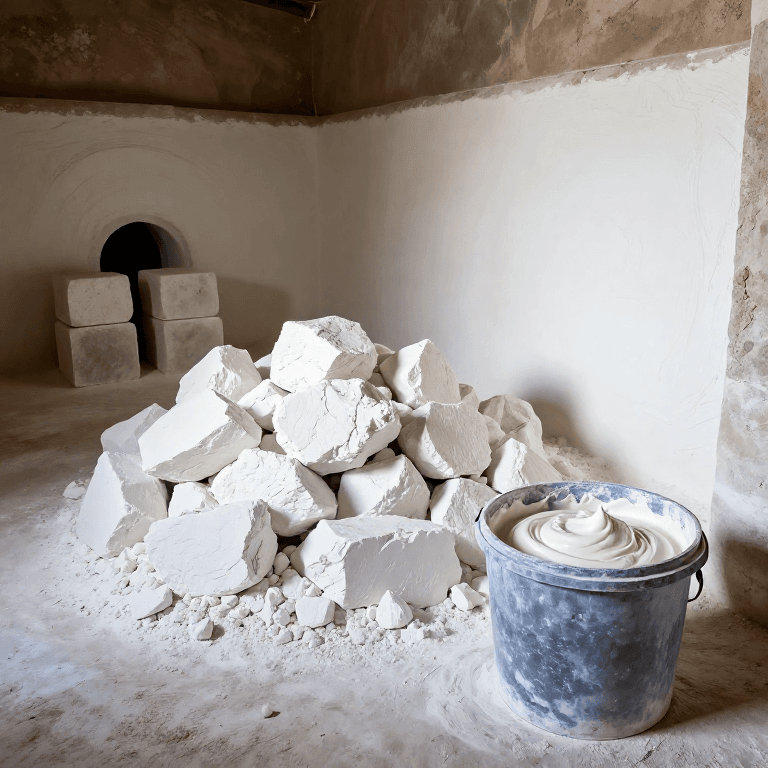
Quicklime (CaO) reacts violently with water in a strongly exothermic reaction: CaO + H₂O → Ca(OH)₂ + heat (65 kJ/mol). This reaction generates temperatures above 300°C — hot enough to ignite naphtha on contact with water. Adding powdered quicklime to the naphtha-based mixture would explain the reports of Greek fire burning fiercer when doused with water: every bucket of water thrown on the flames would react with the quicklime, generating intense heat that reignited the naphtha.
This chemistry also explains why the recommended extinguishers — vinegar (acid, which reacts differently with quicklime), sand (smothering), and old urine (which contains ammonia salts that form a cooling endothermic reaction) — would be more effective than water. The quicklime theory is the strongest candidate for explaining Greek fire's most distinctive property.
Candidate ingredients — sulfur and pine resin
Candidate ingredients — sulfur and pine resin
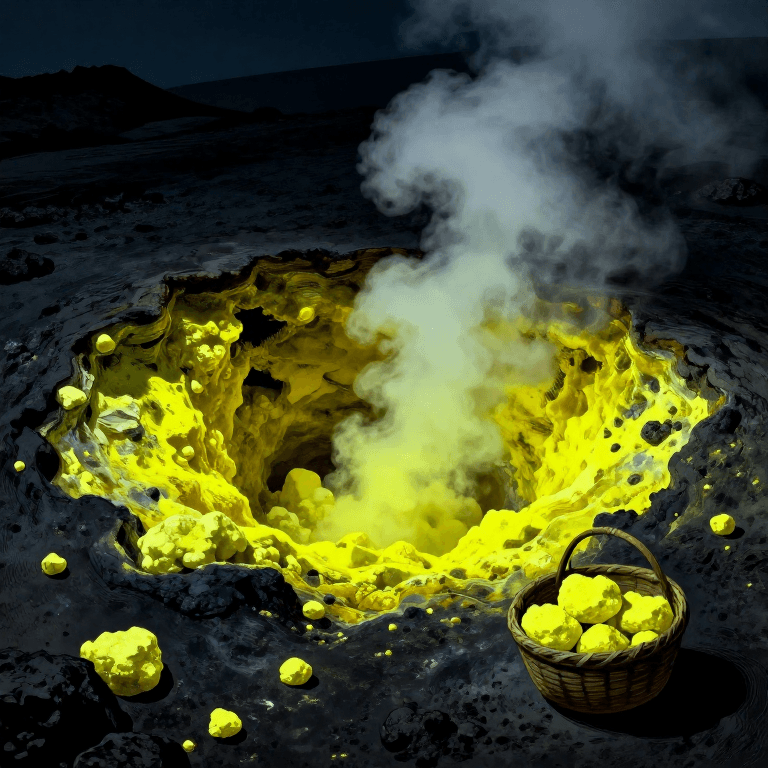
Sulfur was a common incendiary additive in the ancient world — it ignites easily, burns at high temperature (445°C), and produces choking sulfur dioxide gas (SO₂). Adding powdered sulfur to the naphtha would lower its ignition point and add toxic smoke to the weapon's effects. Sulfur was readily available from volcanic deposits across the Mediterranean.
Pine resin (from Pinus species abundant in the Byzantine Mediterranean) would serve as a thickening agent — converting the thin, runny naphtha into a viscous, sticky mixture that clung to surfaces rather than running off. Modern napalm uses a similar principle: gasoline thickened with naphthenic acid soap becomes a gel that adheres to targets. Pine resin also burns readily, contributing additional fuel and producing the thick black smoke consistently described in accounts of Greek fire.
The siphon delivery system
The siphon delivery system
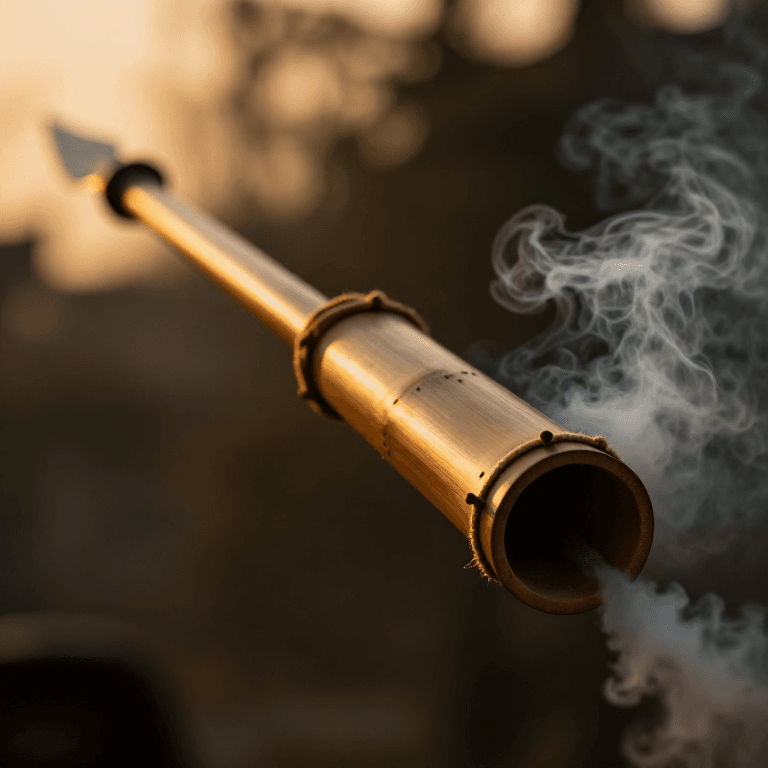
The delivery system was as innovative as the fuel. Byzantine dromones carried a sealed bronze tank connected to a hand-operated piston pump (similar to a large syringe). The tank was heated over a fire to reduce the fuel's viscosity and build internal pressure. When the valve was opened, the pressurised liquid squirted through a bronze nozzle where it was ignited by a flame at the tip — creating a continuous stream of burning liquid.
The operator could sweep the nozzle across an arc, spraying fire across an enemy ship's deck, rigging, and crew. The siphon could also be mounted in the bow of a fireboat that was sailed directly into the enemy fleet — a suicide weapon that could destroy multiple ships. Hand-held versions ('cheirosiphon', literally 'hand-siphon') were developed for infantry use — the medieval equivalent of a portable flamethrower, documented in siege warfare as late as the 12th century.
Why the secret was lost — and why it matters
Why the secret was lost — and why it matters
The loss of Greek fire's formula illustrates a fundamental problem with trade secrets versus open knowledge. The Byzantines kept the formula secret for nearly 800 years — and when the empire fell, the knowledge died with it. No written formula survives. No workshop manual. No apprentice's notes. An entire branch of advanced chemistry vanished because it was deliberately restricted to a handful of people.
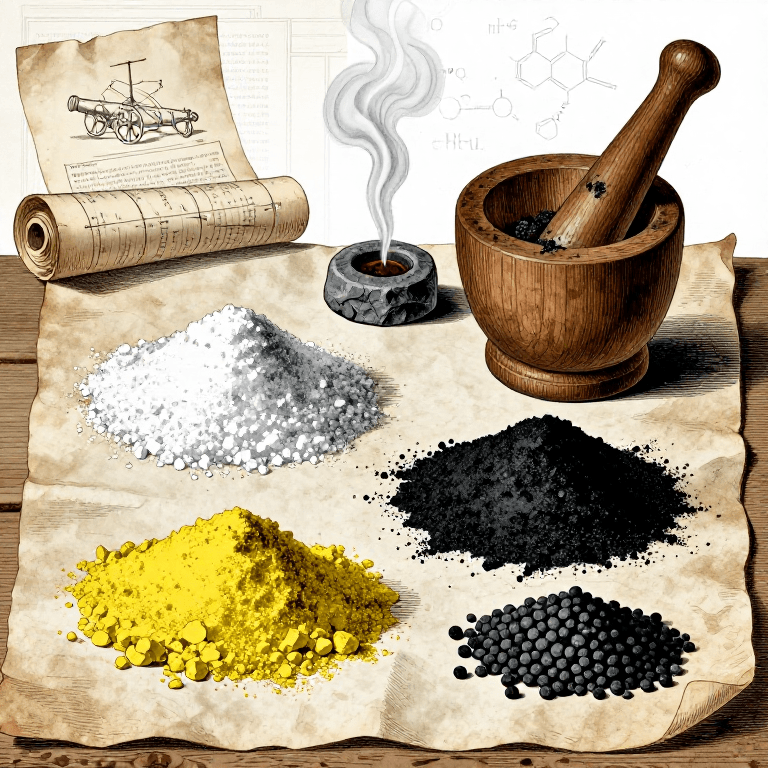
Compare this to Chinese gunpowder: documented in the Wujing Zongyao military manual (1044 AD), studied by scholars, replicated across Asia and eventually the world. Gunpowder survived because it was written down and shared. Greek fire died because it was hoarded. The lesson for innovation is clear — and it is the foundational principle of Youblob: knowledge that is open compounds forever; knowledge that is secret dies with its keepers.
연결된 블루프린트 재료
관련 블루프린트
이 블루프린트들은 지식을 공유합니다 — 기술, 재료 또는 원리


CC0 퍼블릭 도메인
이 블루프린트는 CC0로 공개되었습니다. 어떤 목적으로든 자유롭게 복사, 수정, 배포 및 사용할 수 있습니다.
제품 구매를 통해 메이커를 지원하세요. 판매자가 설정한 메이커 커미션 을 받거나, 이 블루프린트의 새로운 반복을 만들어 연결로 포함시킬 수 있습니다.