

Reel Lawn Mower
Before the lawn mower, grass was cut with a scythe — a swinging blade that took real skill to keep even, and left a rough, wavy finish only a strong, practised hand could manage. A tidy lawn was a luxury of the rich, kept by teams of scythe-men.
The reel mower turns grass-cutting into a pair of scissors you push. A cylinder of curved blades spins fast, geared to the wheels, and sweeps each blade past a fixed bottom knife. The grass is caught between the moving blade and the still one and sheared — a clean scissor cut, not a chop — at hundreds of cuts a second.
Because the wheels drive the reel, pushing the mower is what powers the cut, and because the blades are set in a spiral, one is always shearing — so the cut is smooth and continuous, giving the even, close-clipped lawn a scythe never could.
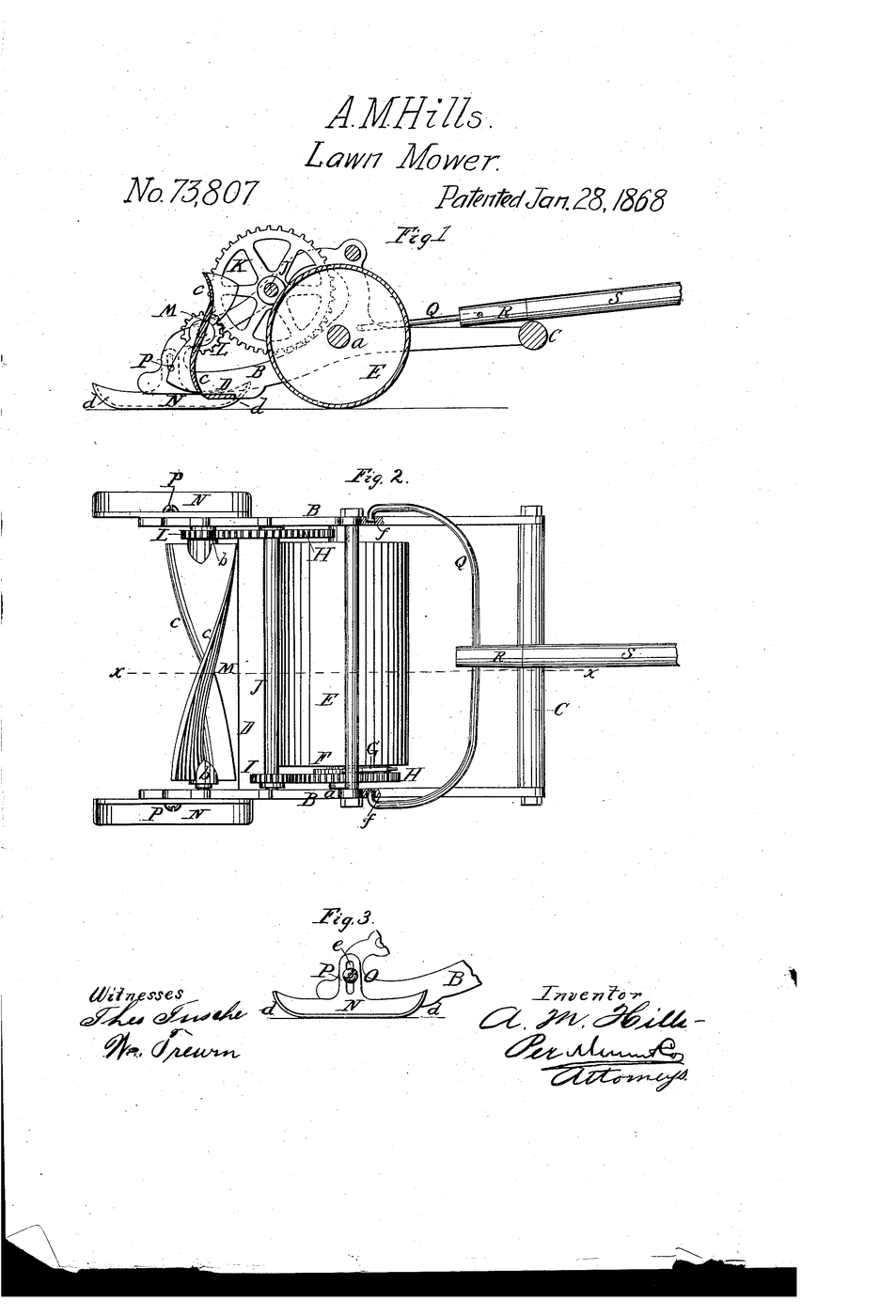
US Patent 73,807, "Improvement in Lawn-Mowers", granted 28 January 1868 to Amariah M. Hills of Hockanum, Connecticut — the first US lawn-mower patent (the reel mower itself was invented by Edwin Budding in England, 1830).
안내
Read the claim: a spinning reel shears against a fixed knife
Read the claim: a spinning reel shears against a fixed knife
Hills claims a revolving cylinder of blades geared to the wheels that cuts grass by shearing it against a fixed bottom knife — a scissor, not a chop. Note the two edges.
Make the fixed bottom knife
Make the fixed bottom knife
Fix a straight strip of aluminium along the base of a frame, its edge horizontal just above the ground. This still edge is one half of the scissors.
이 단계의 재료:
 알루미늄 판1 장
필요한 도구:
 공예용 칼
공예용 칼Build the blade reel
Build the blade reel
Glue several thin blades along a dowel, each set at a slight spiral so they don't all strike at once. This cylinder is the moving edge.
이 단계의 재료:
 바스우드 판1 장
 목재 다월봉1 개
필요한 도구:
 실톱(코핑 소)
Mount the reel and add wheels
Mount the reel and add wheels
Hang the reel in the frame so its blades sweep just past the fixed knife, and fit a wheel on each side.
이 단계의 재료:
 캐스터 바퀴 세트1 세트
Gear the reel to the wheels
Gear the reel to the wheels
Loop a wire or band from a wheel to the reel spindle so the wheel spins the reel several times faster than it rolls. Now pushing drives the cut.
이 단계의 재료:
 아연 도금 강선1 미터
Push it and watch the reel whirl
Push it and watch the reel whirl
Roll the mower forward. The reel spins fast from a slow push — the gearing multiplies wheel turns into many blade passes.
Cut paper 'grass'
Cut paper 'grass'
Stand strips of paper up in a row and mow over them. Each is sheared between the moving blade and the fixed knife — a clean cut, not a tear.
See why the gap matters
See why the gap matters
Open the reel-to-knife gap wide: the paper folds over uncut. Close it to a whisker: it shears cleanly. A scissor only cuts when its edges nearly touch.
Feel the spiral do a continuous cut
Feel the spiral do a continuous cut
Because the blades are spiralled, one is always crossing the knife — the cut is smooth and steady, not a series of jolts. Straight blades would all bang at once.
Mow real grass
Mow real grass
Run it over a tuft of real grass. It clips the tops evenly, throwing the cuttings forward — a close, level finish.
Set the cutting height
Set the cutting height
Raise or lower the whole reel-and-knife relative to the wheels. Higher leaves the grass long, lower cuts it short — the mower's height adjustment.
Compare with a scythe swing
Compare with a scythe swing
Try cutting the same grass by swinging a ruler like a scythe. It is uneven and needs skill and force. The mower gives anyone a level lawn by just walking. Note why that changed the suburbs.
History & Context — the machine that made the lawn ordinary
History & Context — the machine that made the lawn ordinary
The patent. US 73,807, "Improvement in Lawn-Mowers", granted 28 January 1868 to Amariah M. Hills of Hockanum, Connecticut. This is the first US lawn-mower patent, and Hills went on to found the Archimedean Lawn Mower Company. The reel mower itself, though, was English: Edwin Beard Budding patented it in 1830, having adapted the rotary shearing cylinder from a machine that trimmed the nap on woollen cloth. Hills' patent brought the type to American manufacture and improved the gearing and adjustment.
The physics is a rotary scissors. A scissor cuts because two edges pass each other with almost no gap, trapping and shearing whatever is between them (step 8). The reel mower makes one edge a fast-spinning cylinder of curved blades and the other a fixed bottom knife (the "bed knife"); each blade sweeping past the knife is one snip, and with the wheels geared to spin the reel several times per revolution, a walking-pace push delivers hundreds of clean snips a second. Setting the blades in a helix means only a small part of one blade meets the knife at any instant, so the cut is continuous and the effort smooth (step 9) rather than a hammering of simultaneous blows.
Why it changed the world outside. Before the mower, a smooth green lawn meant either grazing animals or an army of scythe-men, so it signalled wealth. The reel mower let one ordinary person keep a neat lawn in an hour — and with it came the suburban front lawn, the public park, and the modern sports field. Cricket, tennis, golf and football all depend on a closely-mown, level turf that simply could not be produced at scale by hand; the smooth pitch is a product of this machine. Your paper-shearing model is the whole invention: two edges, nearly touching, driven by the wheels you push.
이 블루프린트로 만드는 것

CC0 퍼블릭 도메인
이 블루프린트는 CC0로 공개되었습니다. 어떤 목적으로든 자유롭게 복사, 수정, 배포 및 사용할 수 있습니다.
제품 구매를 통해 메이커를 지원하세요. 판매자가 설정한 메이커 커미션 을 받거나, 이 블루프린트의 새로운 반복을 만들어 연결로 포함시킬 수 있습니다.