

Solar Water Heater
Before this, a hot bath meant burning something. You lit a stove, waited, and paid for coal or wood every single time. Meanwhile a black tank left in the yard got genuinely hot on a summer afternoon and cooled off again by evening — free heat that nobody could use on demand.
Kemp's patent turns that observation into plumbing. Put the tanks inside a glazed box so the heat cannot escape, and — this is the part that makes it a system rather than a bucket — connect several tanks in series so cold water entering at one end has to pass through every tank before it reaches the tap.
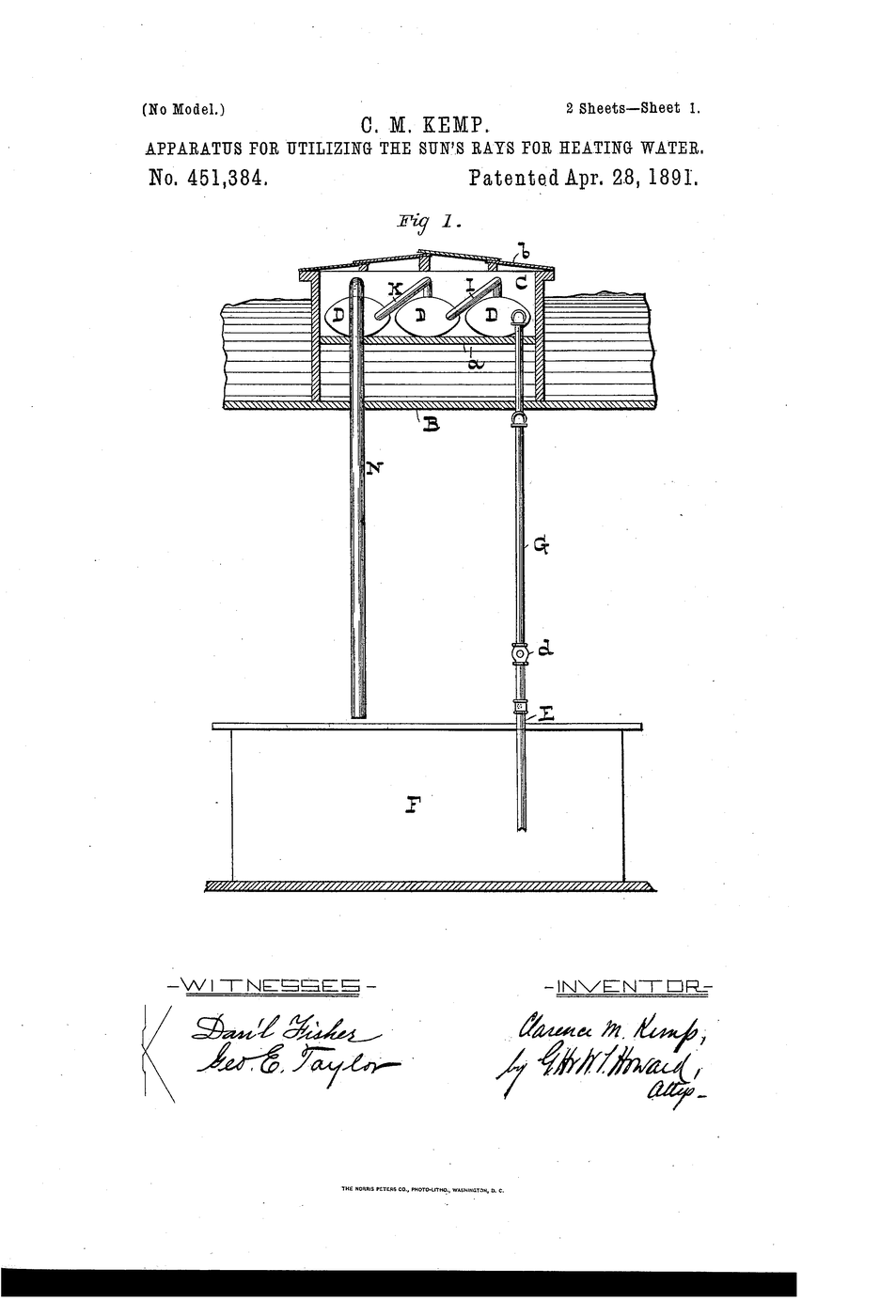
His own summary: the invention consists "in exposing tanks containing water within a glass-covered box to the heat-rays of the sun and in providing the said tanks with suitable pipes whereby water is made to pass from one tank to another and be finally discharged in a heated condition".
US Patent 451,384, "Apparatus for utilizing the sun's rays for heating water", granted 28 April 1891 to Clarence M. Kemp of Baltimore, Maryland — sold as the Climax.
안내
Read Kemp's one-sentence summary
Read Kemp's one-sentence summary
Three elements: tanks, a glass-covered box, and pipes carrying water from one tank to another. Test them one at a time.
Fill three identical bottles with 200 ml of water
Fill three identical bottles with 200 ml of water
Use three identical containers, each with 200 ml at the same starting temperature. Record that temperature.
이 단계의 재료:
 유리병3 개
필요한 도구:
 조리용 온도계
Paint one matt black
Paint one matt black
Paint the outside of one container matt black. Leave the second bare and the third bare — the third is for the box test.
이 단계의 재료:
 아크릴 물감 세트1 세트
Put the black and bare bottles in the sun for 30 minutes
Put the black and bare bottles in the sun for 30 minutes
Same place, same sun, same 30 minutes. Measure both. Black absorbs more. Record the gap.
Build a shallow box and line it
Build a shallow box and line it
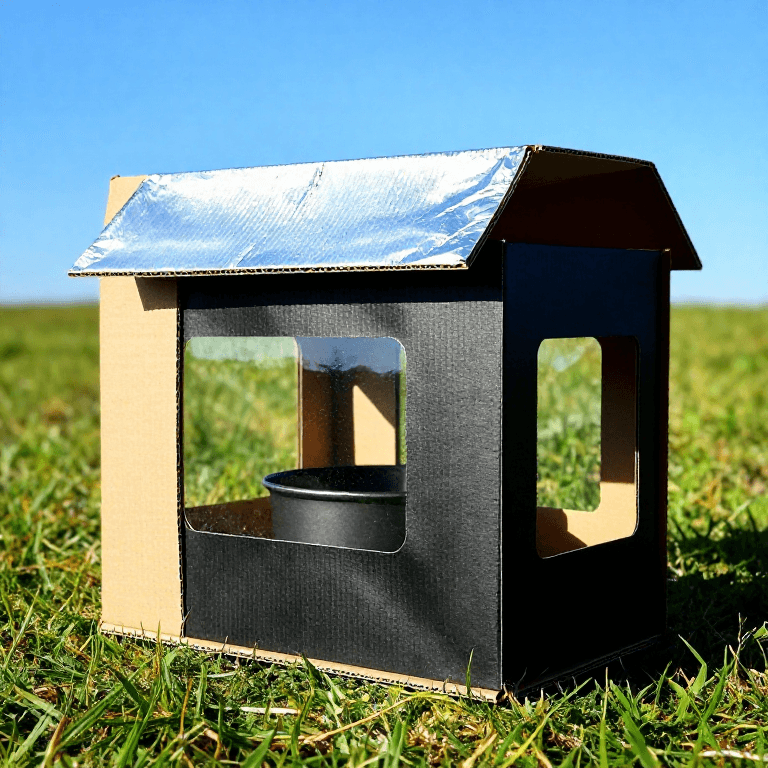
Make a plywood tray a little larger than the bottles and line the inside matt black. This is Kemp's box "secured on the roof".
이 단계의 재료:
 발트 자작나무 합판1 장
Fit a float glass lid
Fit a float glass lid
Lay a float glass sheet over the box as the "glazed cover". Glass lets sunlight in and holds warmed air in.
이 단계의 재료:
 판유리 (플로트 유리)1 장
Run the black bottle inside the glazed box
Run the black bottle inside the glazed box
Same sun, same 30 minutes, black bottle now under glass. Measure. Compare against step 4 — the glazing is worth a large share of the gain.
Lift the glass and watch the temperature stall
Lift the glass and watch the temperature stall
Take the lid off and keep measuring every five minutes. The rise slows immediately — warm air is carrying the heat straight off.
Plumb three small tanks in series
Plumb three small tanks in series
Join three containers with copper pipe so water must flow through all three in turn. This is the claim that makes it a heater rather than a hot tank.
이 단계의 재료:
 동관1 개
동관1 개Measure the temperature after each tank
Measure the temperature after each tank
Run water slowly through and measure at each junction. The temperature climbs in steps — each tank adds to what the last one did.
Double the flow rate and measure again
Double the flow rate and measure again
Run twice as fast. The outlet is cooler. Slow flow, hot water; fast flow, warm water. The collector delivers power, not temperature.
Present a wide face to the sun
Present a wide face to the sun
Turn a tank so its widest side faces the sun, then edge-on, measuring each. Kemp made his tanks elliptical and laid them with the wide axis horizontal "to increase the surface exposed to the sun".
Leave it out until after sunset
Leave it out until after sunset
Measure again an hour after sundown. It has gone cold. The Climax had no insulated store, and that single fact shaped the whole later industry.
History & Context — the first solar water heater you could buy
History & Context — the first solar water heater you could buy
The patent. US 451,384, "Apparatus for utilizing the sun's rays for heating water", granted 28 April 1891 to Clarence M. Kemp of Baltimore, Maryland. Kemp sold it as the Climax, and it is generally regarded as the first commercially marketed solar water heater. He states the purpose without any grandeur: "to utilize the sun's rays to heat water for bathing and other domestic purposes".
The drawings are worth reading as a system, not a device. Figure 1 shows the box on a house roof, piped down to a bath-tub, with a cock controlling flow into the first tank. This is not a laboratory demonstration of solar heating — it is a plumbing installation, drawn into an actual house, with the tap at the end. That is what separates Kemp from a century of earlier hot-box experiments: he treated sunshine as a utility connection.
Three design decisions, all still in use. First, glazing: the tanks sit "within a glass-covered box", which admits sunlight and suppresses the convection that otherwise strips heat off a hot surface — step 8 shows how much that is worth. Second, series flow: pipes carry water "from one tank to another" so each tank raises the temperature further, which is why the outlet is much hotter than any single tank would be. Third, shape: the tanks are "preferably elliptical in cross-section" laid with the larger diameter horizontal, purely "to increase the surface exposed to the sun". Kemp is optimising collector area per unit of stored water, which is precisely what a modern flat-plate panel does.
The honest weakness is the one step 13 finds. The Climax stores its water in the collector, so the store is also the thing radiating to the night sky. It heats beautifully by day and is cold by morning — fine in southern California, where it sold well, and much less useful in a cold climate or for an early bath. The fix was to separate collecting from storing: put an insulated tank indoors and circulate water through an outdoor collector, which is what the later Day and Night system and every modern installation do. Kemp's patent contains the collector but not the store, and knowing which half is missing is the useful part of reading it.
Why it matters now. Domestic hot water is a large share of household energy, and it is a low-temperature demand — which is exactly what a cheap collector supplies well. Solar water heating remains, per unit cost, one of the most effective solar technologies there is, and the arrangement in this 1891 drawing is recognisably the same machine.
관련 블루프린트
이 블루프린트들은 지식을 공유합니다 — 기술, 재료 또는 원리
CC0 퍼블릭 도메인
이 블루프린트는 CC0로 공개되었습니다. 어떤 목적으로든 자유롭게 복사, 수정, 배포 및 사용할 수 있습니다.
제품 구매를 통해 메이커를 지원하세요. 판매자가 설정한 메이커 커미션 을 받거나, 이 블루프린트의 새로운 반복을 만들어 연결로 포함시킬 수 있습니다.