예술
뷰티 및 웰니스
공예
문화 및 역사
엔터테인먼트
환경
음식 및 음료
역공학
과학
스포츠
기술
웨어러블
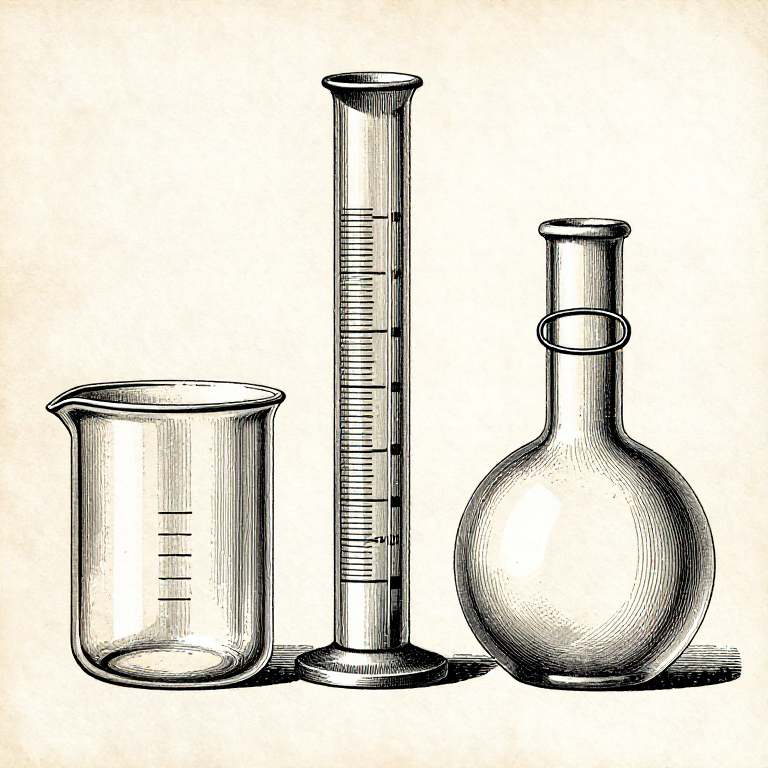


Making Up a Solution: Which Glassware Actually Measures, and Which Only Looks Like It
The graduations printed on a beaker are decoration. They are there so you can see roughly how full it is, and they are commonly 5% out — which is a hundred times worse than the flask standing next to it.
Glassware divides into two families and the difference is enormous. VOLUMETRIC glassware — volumetric flasks, bulb pipettes, burettes — is made and tested to deliver one stated volume accurately. Everything else is a container with marks on it.
Which you reach for is a decision about what the solution is FOR. Rinsing something out needs a beaker; a solution whose concentration will appear in a result needs a volumetric flask, and using the wrong one quietly poisons every number downstream.
초급
2 hours
안내
1
1
Weigh the solid, and dissolve it somewhere else first
Weigh the solid, and dissolve it somewhere else first
Weigh the solid on a precision balance, into a weighing container rather than onto the pan, and write the ACTUAL mass down — not the mass you intended. The difference between 5.00 g and 5.03 g is the difference between a calculated concentration and a guessed one.
Dissolve it in a BEAKER with a smaller volume of solvent than the final target, not in the volumetric flask. Solids dissolve slowly, need stirring, and sometimes need warming, and a volumetric flask has a narrow neck that makes all three awkward.
Make sure it is completely dissolved before going any further. Undissolved solid transferred into the flask is solid that is not in your solution, and the concentration you calculate will be higher than the one you have.
이 단계의 재료:
 염화나트륨(소금)1 개
 증류수1 리터
필요한 도구:
 정밀 저울
정밀 저울 유리 비커
유리 비커 뒤집개
뒤집개 젓개
젓개2
2
Transfer, rinse, and rinse again
Transfer, rinse, and rinse again
Pour the dissolved solution into the volumetric flask through a funnel, then rinse the beaker with a little solvent and pour that in too. Then do it again. Rinse the stirring rod and the funnel into the flask as well.
Whatever stays behind in the beaker is solute missing from your solution. A beaker that looks empty holds a film worth a percent or more of a small quantity, and three small rinses recover nearly all of it.
A wash bottle makes this easy and precise: a thin jet reaches the walls and the rod without adding much volume. The rinsings go into the flask, never into the sink — they are part of the measurement.
이 단계의 재료:
증류수1 리터필요한 도구:
 메스플라스크
 자루 달린 유리 깔때기
 세척병유리 비커
3
3
Make up to the mark — and what the mark means
Make up to the mark — and what the mark means
Jupyter 노트북 불러오는 중…
이 단계의 재료:
증류수1 리터필요한 도구:
메스플라스크 메스실린더정밀 저울
 데스크톱 컴퓨터
4
4
Invert to mix, then label
Invert to mix, then label
Stopper the flask and invert it completely, twenty times or so, letting the bubble travel the full length each time. Swirling does not mix a volumetric flask: the dense solution sits in the bulb and the neck stays nearly pure solvent.
This matters more than it sounds. An unmixed flask sampled from the neck gives a concentration far below the real one, and it is a mistake that produces beautifully reproducible wrong answers — the systematic error the measurement batch warns about.
Then label it: substance, concentration, solvent, date, initials. And do not STORE solutions in volumetric flasks; transfer to a proper bottle. A volumetric flask is a measuring instrument, and leaving solution to dry in the neck around the graduation is how one stops being accurate.
이 단계의 재료:
 접착 라벨1 개
필요한 도구:
메스플라스크 유성 매직
유성 매직관련 블루프린트
이 블루프린트들은 지식을 공유합니다 — 기술, 재료 또는 원리


CC0 퍼블릭 도메인
이 블루프린트는 CC0로 공개되었습니다. 어떤 목적으로든 자유롭게 복사, 수정, 배포 및 사용할 수 있습니다.
제품 구매를 통해 메이커를 지원하세요. 판매자가 설정한 메이커 커미션 을 받거나, 이 블루프린트의 새로운 반복을 만들어 연결로 포함시킬 수 있습니다.