예술
뷰티 및 웰니스
공예
문화 및 역사
엔터테인먼트
환경
음식 및 음료
역공학
과학
스포츠
기술
웨어러블
English


Carrara Marble Extraction — From Quarry to Squared Block
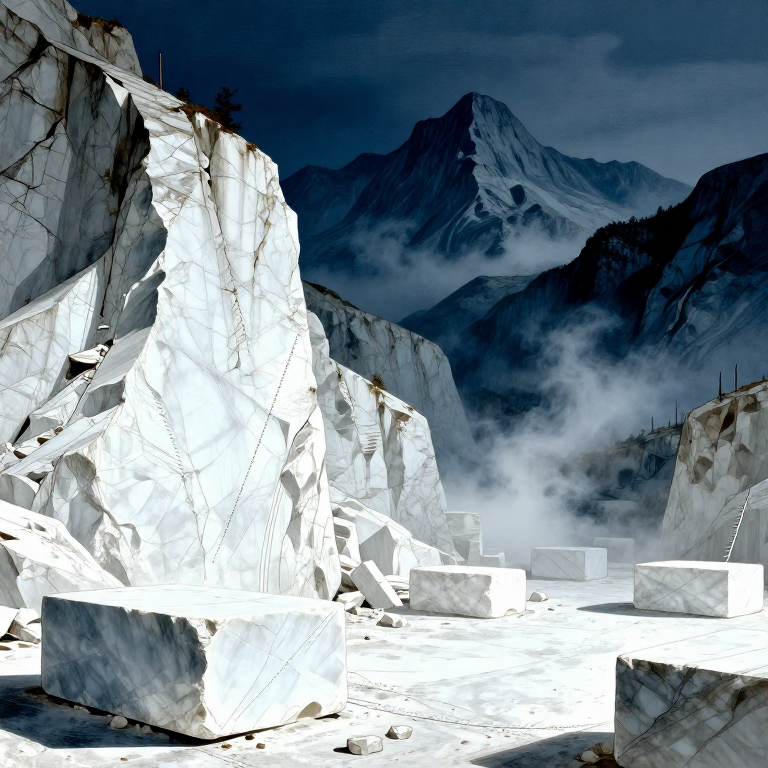
Complete guide to extracting white Carrara marble from the Apuan Alps in Tuscany — the world's most prized marble, used since Roman times for sculpture, architecture, and art. Carrara marble is 99% calcium carbonate (CaCO₃), formed approximately 200 million years ago.
고급
8-12 hours
안내
1
1
Understanding the geology of Carrara marble
Understanding the geology of Carrara marble
Carrara marble formed approximately 200 million years ago, during the Jurassic period, from the metamorphosis of calcareous sediments deposited on the floor of an ancient sea. Temperatures exceeding 200 degrees Celsius and pressures of thousands of atmospheres transformed limestone (CaCO3) into crystalline marble. Carrara marble is composed of 99% pure calcite, which gives it its characteristic white color. The Apuan Alps contain over 300 active quarries, and the area produces approximately 800,000 tonnes of marble annually. The main varieties are Statuario (the purest, almost transparent), Bianco ordinario, Venato (with gray veining), and Arabescato (with pronounced patterns).
2
2
Reading the mountain and identifying quality veins
Reading the mountain and identifying quality veins
Identifying quality marble veins requires experience and geological knowledge. Observe exposed rock faces, looking for uniform white marble layers without inclusions of dark minerals such as pyrite or graphite. The best veins run in continuous layers more than 3 meters thick. Look for marble with fine grain and small crystals (less than 0.2 mm), indicating complete metamorphism. The color should be uniformly white, without yellowish stains caused by iron oxides. An experienced quarryman strikes the wall with a geological hammer: a clear, ringing sound indicates compact, healthy marble, while a dull sound reveals internal fractures or inclusions.
필요한 도구:
 Geological Hammer
 Hand Lens 10x
 Geological Survey Map
3
3
Preparing the extraction plan and quarry safety
Preparing the extraction plan and quarry safety
Before starting extraction, a detailed plan is prepared that takes into account the direction of the veining, the slope of the quarry face, and natural fractures. In Italy, quarries are regulated by Legislative Decree 624/1996 and the regional extractive activities plan. Every quarry must have a responsible director (a registered mining engineer). The stability of the quarry face is checked, rockfall nets are positioned on the upper walls, and work areas are demarcated. All personnel wear protective hard hats, steel-toe safety boots, safety goggles, and ear protection, since noise in the quarry regularly exceeds 85 decibels.
이 단계의 재료:
 Safety Netting for Rockfall50 미터
 Barrier Tape100 미터
필요한 도구:
 Hard Hat with Chin Strap
 Steel-Toe Safety Boots
 Safety Goggles
 Ear Protection Muffs
4
4
Drilling guide holes for the diamond wire
Drilling guide holes for the diamond wire
To create the path for the diamond wire, through-holes are drilled into the rock. A track-mounted pneumatic drill rig is used to drill holes 80-100 mm in diameter. The holes are drilled in an L or U configuration, connecting the base of the block to the rear side to allow the wire to pass through. Drilling uses tungsten carbide bits cooled with water. A single 10-meter hole requires approximately 2-3 hours of work. Cooling water is continuously pumped into the hole to prevent the bit from overheating and to evacuate drilling debris.
이 단계의 재료:
 Tungsten Carbide Drill Bit 90mm3 개
 Drilling Water Supply Hose30 미터
필요한 도구:
 Track-Mounted Pneumatic Drill Rig
 Industrial Air Compressor
 Water Pump
5
5
Threading and tensioning the diamond wire
Threading and tensioning the diamond wire
The diamond wire consists of a 5 mm diameter steel cable on which diamond beads are mounted at 25-30 mm intervals. Each bead contains synthetic diamonds in a sintered metal matrix. The wire is threaded through the previously drilled guide holes, forming a closed loop. The wire is connected to the cutting machine (wire block cutter), which consists of a motorized flywheel mounted on rails. The machine tensions the wire and runs it at speeds of 20-30 meters per second. A good quality diamond wire cuts approximately 8-12 square meters of marble before wearing out.
이 단계의 재료:
 Diamond Wire 11mm Diameter40 미터
 Wire Joining Crimp Sleeves4 개
필요한 도구:
 Diamond Wire Cutting Machine
 Wire Crimping Tool
6
6
Performing the cut with the diamond wire
Performing the cut with the diamond wire
The block-cutting machine is started and the diamond wire begins rotating through the marble. The cutting speed in Carrara marble is approximately 2-4 square meters per hour, depending on the hardness and the presence of veining. Water is continuously injected at the cutting point to cool the wire, reduce dust, and extend the life of the diamond beads. The operator monitors the wire tension and feed rate, adjusting the machine in real time. A vertical cut of 6 meters high and 10 meters long requires approximately 15-20 hours of continuous work. Three cuts are made: rear, right side, and left side, leaving the block connected to the mountain only at the base.
이 단계의 재료:
 Cooling Water5000 리터
필요한 도구:
Diamond Wire Cutting Machine Water Supply System
 Wire Tension Monitoring Gauge
7
7
Cutting the base of the block
Cutting the base of the block
The base cut is the most critical of the entire operation. A series of horizontal holes are drilled at the base of the block, spaced approximately 25-30 cm apart. Steel wedges (also called wedge charges) driven hydraulically or flat hydraulic cushions are inserted into these holes. The hydraulic cushions are slowly inflated to a pressure of 300-400 bar, generating sufficient separation force to detach the block along the base plane. Alternatively, the diamond wire can also be used for the horizontal cut by threading it through a horizontal hole drilled beneath the block. This cut requires extreme precision because an error can cause the entire block to fracture irregularly.
이 단계의 재료:
 Hydraulic Flat Cushion8 개
필요한 도구:
 Hydraulic Pump Unit 400 BarTrack-Mounted Pneumatic Drill Rig
 Steel Wedge Set
8
8
Tipping the block from the wall
Tipping the block from the wall
Once all cuts are completed, the block is separated from the mountain wall. A tracked excavator or a steel cable connected to a winch is used to gently pull the block forward. The block, which can weigh from 20 to 300 tonnes, tips onto the quarry floor which has been previously prepared with a layer of soft debris (called ravaneto) to cushion the fall. The tipping is the most dangerous moment: all personnel must be at a safe distance (minimum 50 meters). The quarry director coordinates the operation with coded sound signals.
이 단계의 재료:
 Crushed Marble Debris Cushion10 cubic meter
 Steel Cable 40mm30 미터
필요한 도구:
 Tracked Excavator
 Hydraulic Winch
 Warning Horn
9
9
Inspecting and classifying the block
Inspecting and classifying the block
After tipping, the block is visually and instrumentally inspected to assess its commercial quality. The exposed surfaces are examined to identify fractures, inclusions, iron oxide stains, gray veins, or pyrite inclusions. The marble is classified according to the traditional Carrara system: Statuario (pure white, fine crystals, light transparency, the most prized), Bianco C (good whiteness with minimal veining), Bianco CD (light veining), Venato (decorative gray veining), Arabescato (pronounced veining and complex patterns), and Bardiglio (uniform dark gray). A block of superior quality Statuario can be worth over 10,000 euros per cubic meter.
필요한 도구:
 LED Inspection FlashlightHand Lens 10x
 Marble Classification Chart
 Measuring Tape 10m
10
10
Squaring the block with the chain cutter
Squaring the block with the chain cutter
The rough tipped block has irregular surfaces and must be squared into regular shapes for transport and sale. A track-mounted quarry chain cutter (called a block-cutting arm) is used, with a 3-4 meter bar fitted with tungsten carbide teeth. The machine cuts the marble into regular blocks with standard dimensions: typically 2.0 x 1.5 x 1.0 meters for a weight of approximately 8 tonnes. Each squaring cut requires continuous water cooling. The squared blocks are marked with the quarry number, extraction date, and quality classification, painted directly on the surface with industrial marking paint.
이 단계의 재료:
 Chain Cutter Teeth (Tungsten Carbide)20 개
 Industrial Marking Paint2 can
필요한 도구:
 Track-Mounted Chain Saw Quarry CutterWater Supply SystemMeasuring Tape 10m
 Spirit Level 1.5m
11
11
Loading and transporting the blocks
Loading and transporting the blocks
The squared blocks are loaded onto low-bed quarry trucks with a payload of 30-40 tonnes, using wheel loaders or excavators fitted with marble clamps. The quarry roads in the Apuan Alps are narrow and steep, with gradients up to 18% and 180-degree hairpin bends. Trucks descend at a maximum speed of 15 km/h, using drum brakes and hydraulic retarders. Historically, blocks were lowered to the valley by lizzatura: they were dragged on wooden sleds along steep tracks greased with soap, with lizzatori controlling the descent using beech poles as brakes. Lizzatura was used from the Middle Ages until the 1960s.
이 단계의 재료:
 Rubber Blocking Pad8 개
 Ratchet Strap Heavy Duty4 개
필요한 도구:
 Low-Bed Quarry Truck
 Wheel Loader with Marble Clamp
12
12
Managing waste and environmental recovery
Managing waste and environmental recovery
Marble extraction produces a significant amount of waste: approximately 70-80% of extracted material becomes debris. The ravaneti (debris accumulations) are visible as white cascades on the mountains above Carrara. Marble dust (pure calcium carbonate) is recovered and used in the paper industry as mineral filler, in toothpaste production, as an acidity corrector for agricultural soils, and as raw material for paints and plasters. Medium-sized waste blocks are sold for paving, road foundations, and production of decorative aggregates. Disused quarries must be rehabilitated according to Tuscan regional law, with wall reshaping, revegetation, and stabilization of the ravaneti.
13
13
Final quality control at the depot
Final quality control at the depot
At the downstream depot (the main one is located at the port of Marina di Carrara), each block is precisely measured: length, width, and height in centimeters. The volume is calculated and the block is weighed on an industrial scale. Carrara marble has a density of 2.69-2.71 g/cm3. Final quality tests are performed: water absorption (must be less than 0.5% for Statuario), compressive strength (typically 120-140 MPa for white Carrara), and polishability (a sample is polished to verify it achieves a specular gloss level). The block receives its final documentation with a certificate of origin, chemical analysis, and definitive commercial classification, ready for sale to sculptors, architects, and industries worldwide.
이 단계의 재료:
 Sample Polishing Pad Set1 세트
필요한 도구:
 Industrial Platform ScaleMeasuring Tape 10m
 Gloss Meter
 Water Absorption Testing Kit
재료
16- 플레이스홀더
- 100 미터플레이스홀더
- 플레이스홀더
- 플레이스홀더
- 플레이스홀더
- 플레이스홀더
- 5000 리터플레이스홀더
- 플레이스홀더
- 10 cubic meter플레이스홀더
- 30 미터플레이스홀더
- 플레이스홀더
- 플레이스홀더
- 플레이스홀더
- 플레이스홀더
- 플레이스홀더
- 5000 리터플레이스홀더
필요 도구
29- 플레이스홀더
- 플레이스홀더
- 플레이스홀더
- 플레이스홀더
- 플레이스홀더
- 플레이스홀더
- 플레이스홀더
- 플레이스홀더
- 플레이스홀더
- 플레이스홀더
- 플레이스홀더
- 플레이스홀더
- 플레이스홀더
- 플레이스홀더
- 플레이스홀더
- 플레이스홀더
- 플레이스홀더
- 플레이스홀더
CC0 퍼블릭 도메인
이 블루프린트는 CC0로 공개되었습니다. 어떤 목적으로든 자유롭게 복사, 수정, 배포 및 사용할 수 있습니다.
제품 구매를 통해 메이커를 지원하세요. 판매자가 설정한 메이커 커미션 을 받거나, 이 블루프린트의 새로운 반복을 만들어 연결로 포함시킬 수 있습니다.