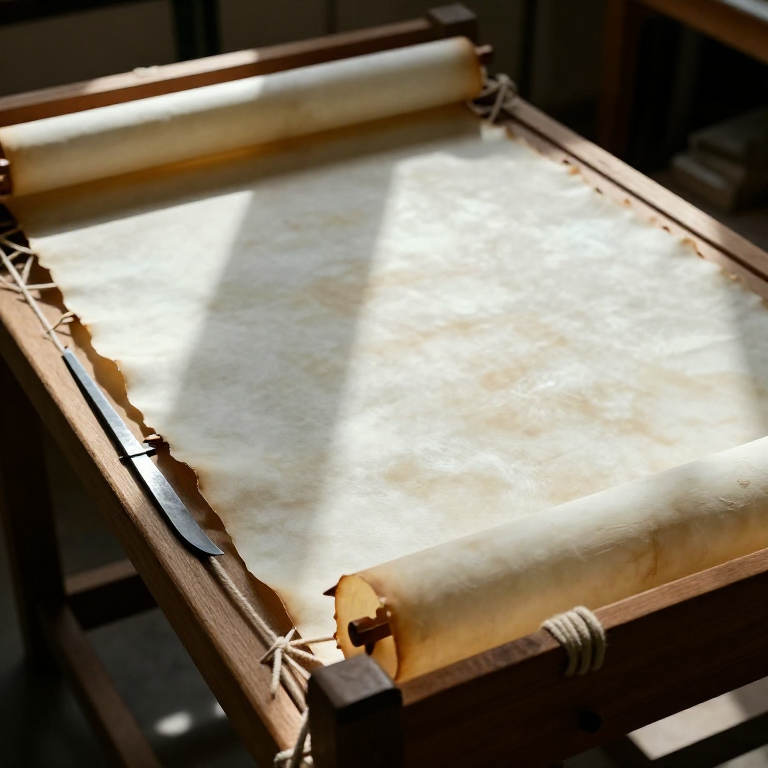


Making Parchment from Calfskin — Medieval Writing Surface
안내
Soak the Skin in Lime
Soak the Skin in Lime
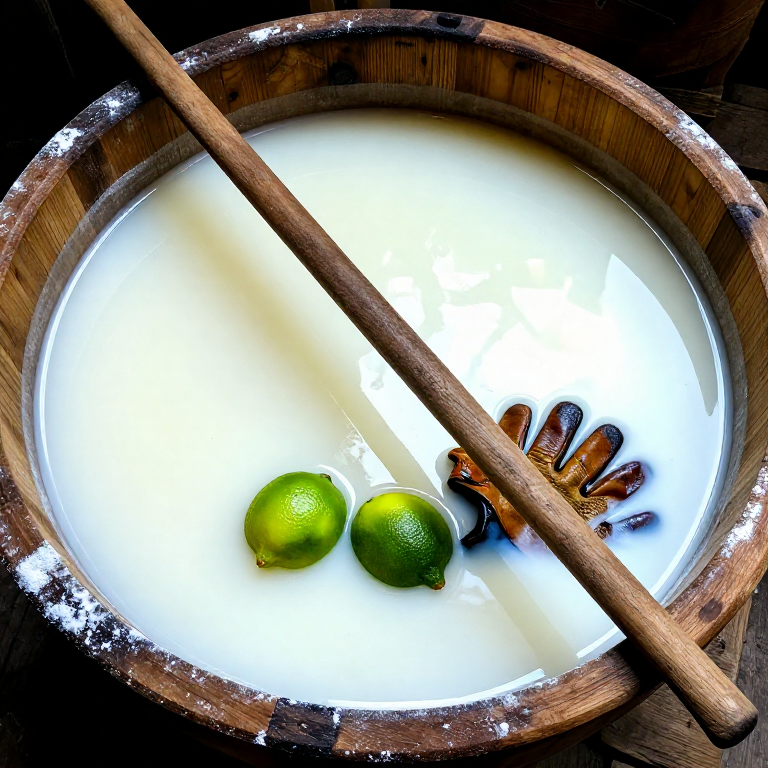
Submerge the fresh skin in a trough of cold water for 24 hours to clean it. Prepare a lime bath by dissolving 2 to 3 kg of slaked lime (calcium hydroxide) in enough water to cover the skin. Immerse the skin in the lime bath and leave it for 8 to 14 days, stirring daily. The strong alkaline solution (pH approximately 12-13) dissolves the hair roots and epidermis, loosens the grain layer, and swells the collagen fibres in the dermis. The lime also partially breaks down the fat between the collagen fibres, making them easier to separate during scraping. After 8 to 14 days, the hair should pull away easily when tested. Wear gloves at all times when handling lime-soaked skins, as calcium hydroxide causes severe chemical burns to exposed skin.
이 단계의 재료:
 소석회(수산화칼슘)2-3kg 개
 물trough full 개
필요한 도구:
 대형 침지 용기
 가죽 장갑
가죽 장갑Dehair and Rinse
Dehair and Rinse
Remove the skin from the lime bath and drape it hair-side up over a convex beam (a rounded wooden log on a stand). Using a blunt curved knife (unhailing knife), scrape the hair, epidermis, and loosened grain from the surface. Work from the centre toward the edges with firm, even strokes. The hair and degraded epidermis should come away in sheets, revealing the smooth, swollen dermal layer beneath. Turn the skin over and scrape the flesh side to remove any remaining fat and subcutaneous tissue. Rinse the dehaired skin in multiple changes of clean water over 24 to 48 hours to remove the lime. Any residual lime in the parchment will cause it to yellow and become brittle over time, so thorough rinsing is essential.
이 단계의 재료:
물multiple changes 개필요한 도구:
 굽은 깎는 칼가죽 장갑
Stretch on the Frame
Stretch on the Frame
Thread cords or leather thongs through small holes pierced around the perimeter of the wet skin (or wrap the edges around smooth pebbles and tie the cords around them to avoid piercing the usable area). Attach these cords to the wooden pegs of the stretching frame (herse). Tighten the pegs to stretch the skin taut and even, pulling from all sides simultaneously. The tension must be high — as the skin dries under tension, the collagen fibres realign from their natural random three-dimensional network into a flat, sheet-like arrangement, which is what gives parchment its distinctive smooth, opaque, paper-like quality rather than the translucent flexibility of leather. Adjust the tension as the skin begins to dry by tightening the pegs — the skin will attempt to shrink as it loses moisture.
Scrape to Final Thickness
Scrape to Final Thickness
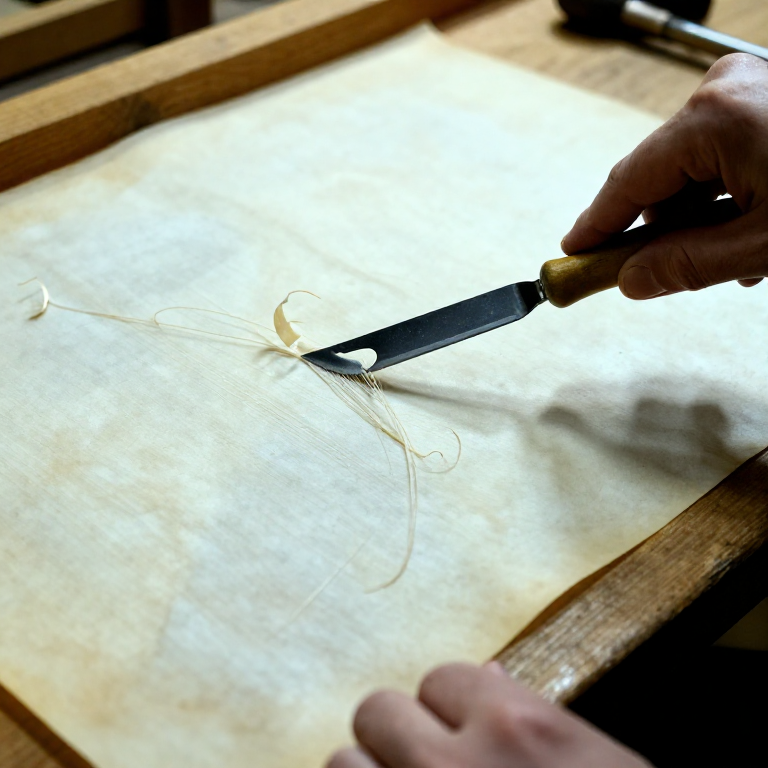
While the skin is still damp and stretched on the frame, scrape both surfaces with a lunellum (a sharp, crescent-shaped blade) to thin the parchment to its final thickness — typically 0.1 to 0.3 mm for a fine writing surface. Work evenly across the entire surface, removing thin shavings with each pass. The grain side (outer, hair side) will be smoother and slightly darker; the flesh side will be lighter and slightly rougher. For the finest vellum (uterine vellum used for luxury manuscripts), the parchment is scraped almost translucently thin. Check for uniform thickness by holding the sheet up to the light — thick spots will appear darker. Re-dampen dry areas with a sponge to keep the surface workable during scraping.
필요한 도구:
굽은 깎는 칼Finish and Prepare for Writing
Finish and Prepare for Writing
Allow the parchment to dry completely on the frame — this takes 2 to 4 days depending on humidity and thickness. Once dry, dust both surfaces with finely ground pumice stone and rub gently in circular motions to smooth the surface and raise a very slight tooth that holds ink without feathering. The pumice also removes any residual grease that would cause ink to bead up. Cut the parchment from the frame by slicing just inside the peg holes. Trim to the desired size with a sharp knife and straightedge. The finished parchment should be opaque, smooth, flexible (not brittle), and uniformly white or cream-coloured. It is ready for writing with iron gall ink applied with a quill pen. Parchment is extraordinarily durable — medieval manuscripts on vellum have survived for over a thousand years in good condition, outlasting any paper by centuries.
이 단계의 재료:
 경석1 piece 개
필요한 도구:
 커터칼
커터칼재료
4- 2-3kg 개플레이스홀더
- trough full 개플레이스홀더
- 1 piece 개플레이스홀더
- 1 whole skin 개플레이스홀더
이 블루프린트로 만드는 것
CC0 퍼블릭 도메인
이 블루프린트는 CC0로 공개되었습니다. 어떤 목적으로든 자유롭게 복사, 수정, 배포 및 사용할 수 있습니다.
제품 구매를 통해 메이커를 지원하세요. 판매자가 설정한 메이커 커미션 을 받거나, 이 블루프린트의 새로운 반복을 만들어 연결로 포함시킬 수 있습니다.