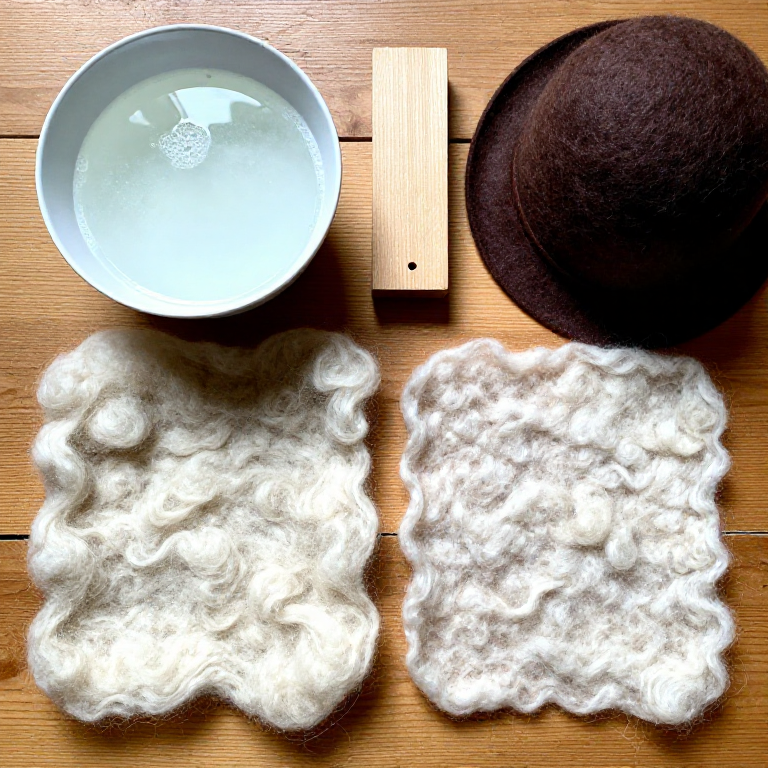


Fulling Wool Felt for Hats — Medieval Felting
안내
Lay Out the Wool Fibres
Lay Out the Wool Fibres
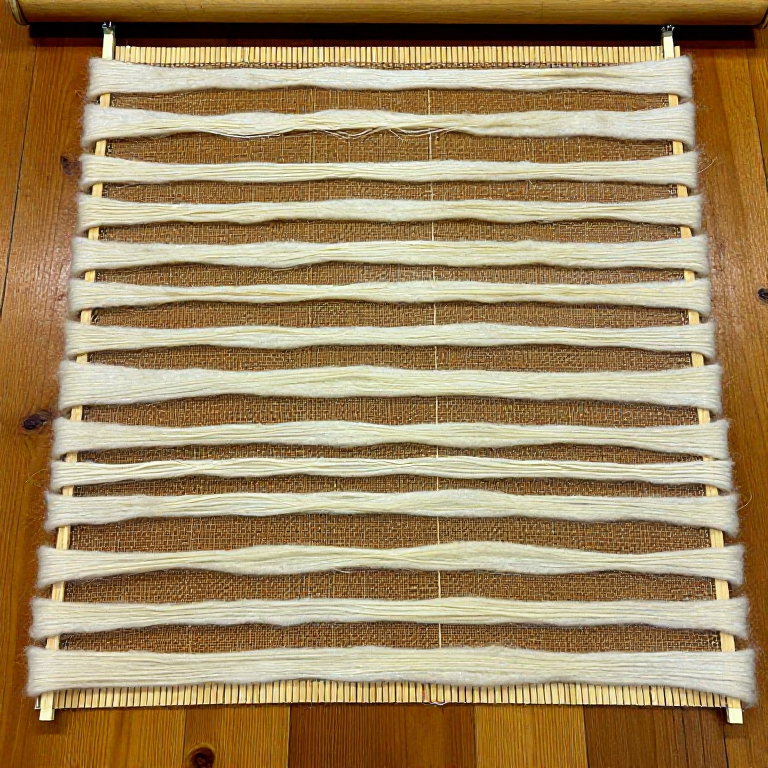
Pull thin, even wisps of carded wool from the batt and lay them on a bamboo rolling mat or sheet of bubble wrap. Create a first layer with all fibres running in the same direction (horizontal), covering the desired area with an even thickness and no thin spots or gaps. Add a second layer with fibres running perpendicular (vertical) to the first. Add a third layer with fibres running horizontal again. Three layers is the minimum for a strong felt — more layers produce thicker, firmer felt. The finished felt will shrink by approximately 30 to 40 percent in each direction during the felting process, so lay out an area correspondingly larger than the desired final size. For a hat, the layup should be approximately 50 to 60 cm square to produce a piece large enough to stretch over a hat block.
이 단계의 재료:
 기모 모직200-300 grams 개
 물several litres 개
 올리브 포마스유30-50 grams dissolved in water 개
 식초 종초50 ml ml
필요한 도구:
 뽁뽁이물
뽁뽁이물 물기 닦는 수건
 모자 골 — 나무, 챙용
Wet and Agitate the Fibres
Wet and Agitate the Fibres
Sprinkle hot soapy water (60-70 degrees Celsius) over the layered wool using a spray bottle or by drizzling from a cup. Press gently to saturate all layers without disturbing the fibre arrangement. The soap and hot water serve two functions: the alkaline soap opens the microscopic barbed scales on each wool fibre, and the heat softens the keratin protein. Begin agitating the wet wool by pressing gently with flat palms in a circular motion. Start with very light pressure — heavy pressure at this stage will shift the fibres out of position. After 5 to 10 minutes of gentle rubbing, the fibres will begin to entangle. Test by pinching the surface: if the fibres lift as a sheet rather than pulling apart individually, the initial felting (prefelt stage) has begun.
Full the Felt by Rolling
Full the Felt by Rolling
Once the fibres hold together as a prefelt, increase the agitation to tighten the felt. Roll the felt sheet tightly inside the bamboo mat or bubble wrap and roll it back and forth vigorously (200 to 300 rolls). Open, rotate the felt 90 degrees, re-roll, and repeat from a different direction to shrink evenly in all dimensions. This rolling process is called fulling — the same term used for the Roman and medieval cloth-finishing process. The felt will shrink significantly and become progressively denser and firmer. Continue fulling until the felt has shrunk by approximately 30 to 40 percent and is dense enough that individual fibres cannot be easily pulled from the surface. The felt should feel uniform in thickness with no thin spots.
Shape Over a Hat Block (Optional)
Shape Over a Hat Block (Optional)
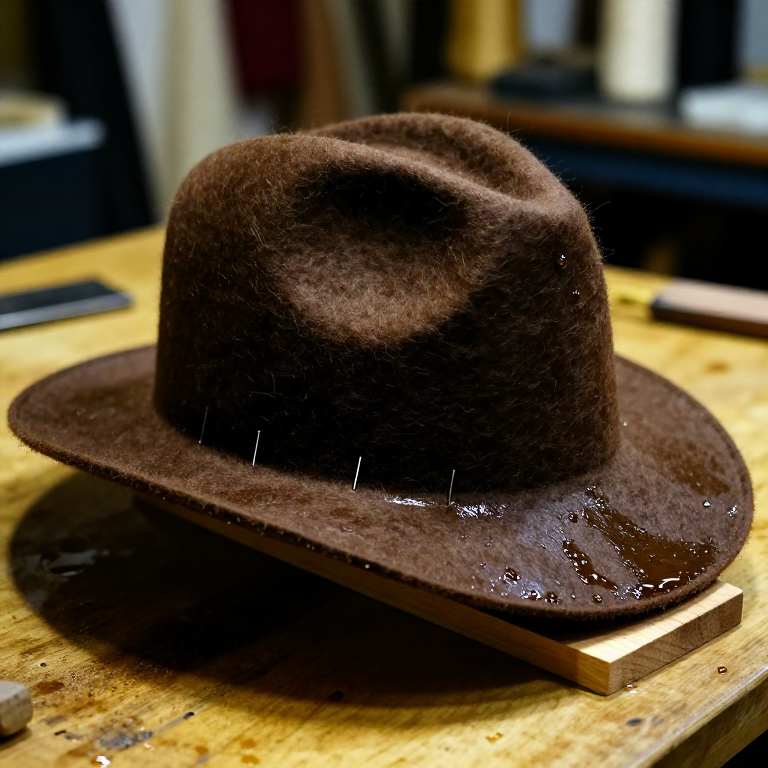
While the felt is still wet and warm (and therefore pliable), it can be shaped over a hat block, bowl, or other form. Stretch the felt over the block, pulling it smooth and even. Wool felt has remarkable stretch and memory when wet — it can be pulled and shaped significantly, and will hold the shape once dried. For a simple medieval cap (coif), stretch the wet felt over a head-sized bowl or wooden block, smooth out any wrinkles, and pin the edges in place. Allow the felt to dry completely on the block — at least 24 hours in warm, dry conditions. The dried felt will hold the three-dimensional shape permanently. If the felt is too thick in places, it can be shaved thinner with a sharp razor while damp.
Rinse, Dry, and Finish
Rinse, Dry, and Finish
Rinse the felted piece thoroughly in cool water to remove all soap residue — residual soap can attract moths and cause the felt to deteriorate. A final rinse in water with a splash of vinegar (approximately 5 percent solution) helps neutralise any remaining alkalinity and closes the wool fibre scales, producing a smoother surface. Squeeze out excess water gently (do not wring) and allow to dry completely. Once dry, the felt can be trimmed to final shape with sharp scissors, steam-pressed with an iron for a smoother finish, or brushed with a stiff brush to raise a slight nap. Medieval felt was used for hats, cap linings, shoe insoles, armour padding (worn under mail), horse blankets, and tent panels. It is naturally water-resistant, insulating, and remarkably durable — archaeological felt from medieval sites often survives in good condition despite centuries of burial.
재료
4- 200-300 grams 개플레이스홀더
- several litres 개플레이스홀더
- 30-50 grams dissolved in water 개플레이스홀더
- 50 ml ml플레이스홀더
CC0 퍼블릭 도메인
이 블루프린트는 CC0로 공개되었습니다. 어떤 목적으로든 자유롭게 복사, 수정, 배포 및 사용할 수 있습니다.
제품 구매를 통해 메이커를 지원하세요. 판매자가 설정한 메이커 커미션 을 받거나, 이 블루프린트의 새로운 반복을 만들어 연결로 포함시킬 수 있습니다.