

Monotype Casting
The Linotype casts a whole line as one solid slug. Correct a single letter and you recast the entire line. Tolbert Lanston's machine took the opposite approach: cast every character as a separate piece of type, then assemble them into justified lines.
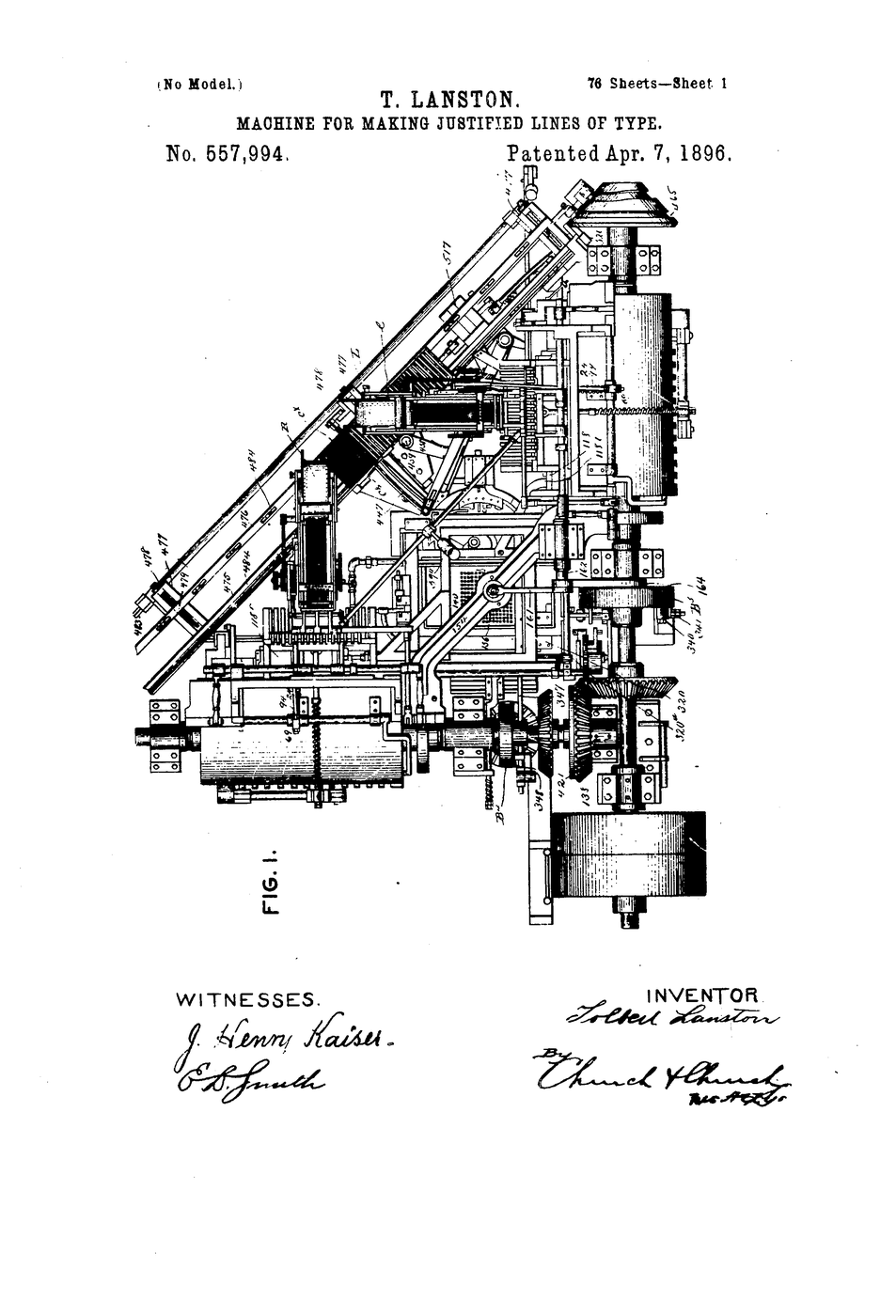
US 557,994, “Machine for making justified lines of type”, granted 7 April 1896. Its classification, B41B7/04, is precise: mechanical composition in which the type is cast or moulded from matrices. The patent runs to 76 sheets of drawings.
Separate types mean a compositor can pull one wrong letter with tweezers. It also means the hard problem moves to justification — deciding, before casting begins, exactly how much extra width each space in a line must carry. This blueprint builds the mould-and-matrix geometry and solves the justification arithmetic by hand, without melting any metal.
안내
Understand the difference from Linotype
Understand the difference from Linotype
Linotype casts a line as one slug. Monotype casts single characters. Write down one advantage and one disadvantage of each before building.
Safety substitution — no molten type metal
Safety substitution — no molten type metal
Real type metal is a lead–antimony–tin alloy. Lead is a cumulative poison and casting it is not a classroom activity. This blueprint casts plaster of Paris instead. The mould geometry, the matrix, and the justification arithmetic are identical; only the material changes.
Cut a matrix
Cut a matrix
Carve a single letter, in reverse, into the rubber sheet about 3 mm deep. This is your matrix — the female form the type is cast against.
이 단계의 재료:
 천연 고무 시트1 개
필요한 도구:
 공예용 칼
공예용 칼Build an adjustable mould
Build an adjustable mould
Make a small open box from card, one wall movable. The matrix forms the base. The movable wall is the point — Monotype's mould changes width for every character.
이 단계의 재료:
 골판지 시트1 장
 목공용 접착제3 ml
필요한 도구:
공예용 칼 자
자Set the mould to one character width
Set the mould to one character width
Set the movable wall to 8 mm. Record the setting.
필요한 도구:
자Cast the first type
Cast the first type
Mix plaster to a pourable cream and fill the mould. Level the top.
이 단계의 재료:
 소석고(플라스터 오브 파리)50 g
필요한 도구:
 디지털 주방 저울
Let it set and release
Let it set and release
Wait 15 minutes, then flex the rubber matrix away. You have a single piece of type with a raised reversed letter.
필요한 도구:
 스톱워치
스톱워치Cast three more at different widths
Cast three more at different widths
Reset the movable wall to 6 mm, 10 mm and 12 mm and cast three more. Real type is proportional — an 'i' is not as wide as an 'm'.
이 단계의 재료:
소석고(플라스터 오브 파리)150 g필요한 도구:
자Dress the castings
Dress the castings
Sand each casting flat on its back and sides so all four stand at identical height.
필요한 도구:
 사포
사포Measure the set widths
Measure the set widths
Measure each type body. Record the four widths. These are your character set widths.
필요한 도구:
자Do the justification arithmetic
Do the justification arithmetic
Choose a line length of 120 mm. Add up your character widths for a short sentence. Subtract from 120. Divide the remainder by the number of spaces. That quotient is what every space must be widened by — and Monotype had to know it before it cast the first character of the line.
필요한 도구:
자Cast spaces to your computed width
Cast spaces to your computed width
Set the mould to the width you calculated and cast the spaces.
이 단계의 재료:
소석고(플라스터 오브 파리)50 g필요한 도구:
자Compose and measure the line
Compose and measure the line
Assemble types and spaces in a card channel. Measure the finished line. It should reach 120 mm within a millimetre.
이 단계의 재료:
골판지 시트1 장필요한 도구:
자Correct one character
Correct one character
Pull a single type out and replace it. Note that this took seconds. On a Linotype it means recasting the whole line — the entire argument for Monotype in one action.
Ink and pull a proof
Ink and pull a proof
Roll ink over the assembled line and press paper onto it.
이 단계의 재료:
 판화 잉크2 ml
 종이1 장
종이1 장필요한 도구:
 고무 잉크 롤러
History & Context
History & Context
US 557,994, “Machine for making justified lines of type”, Tolbert Lanston, granted 7 April 1896. Patent protection ran 17 years from grant and expired in 1913.
Lanston, of Washington D.C., applied in 1885 for a typesetting system that produced its printing surface by cold-stamping rather than casting, and demonstrated a prototype in 1887. The hot-metal machine of this 1896 patent is the mature form. Sources disagree over whether to date the Monotype to 1885, 1887 or 1896 because they are describing three different things — the application, the prototype, and the casting machine.
A note on the record. Google Patents shows the filing date for US 557,994 as identical to the grant date. That is a cataloguing artefact, as with Hawes's envelope machine in this same batch; cite the grant date only.
How the real machine split the job in two. Monotype used two separate units — a keyboard that punched a paper ribbon, and a caster that read it. The operator typed; the ribbon was carried to the caster; the caster read the ribbon backwards, which is why the justification had to be computed and recorded at the end of each line as it was keyed. This is a genuine ancestor of stored-program control: an operator producing a physical instruction tape consumed later by a separate machine, in the same family as Jacquard's cards and Hollerith's punched strips.
Monotype outlived Linotype in fine bookwork precisely because of single types — corrections were cheap and the typographic quality was higher. Both were finished by phototypesetting and then by digital composition.
재료
6- 1 개플레이스홀더
- 1 장플레이스홀더
- 3 ml플레이스홀더
- 250 g플레이스홀더
- 2 ml플레이스홀더
- 1 장플레이스홀더


관련 블루프린트
이 블루프린트들은 지식을 공유합니다 — 기술, 재료 또는 원리


CC0 퍼블릭 도메인
이 블루프린트는 CC0로 공개되었습니다. 어떤 목적으로든 자유롭게 복사, 수정, 배포 및 사용할 수 있습니다.
제품 구매를 통해 메이커를 지원하세요. 판매자가 설정한 메이커 커미션 을 받거나, 이 블루프린트의 새로운 반복을 만들어 연결로 포함시킬 수 있습니다.