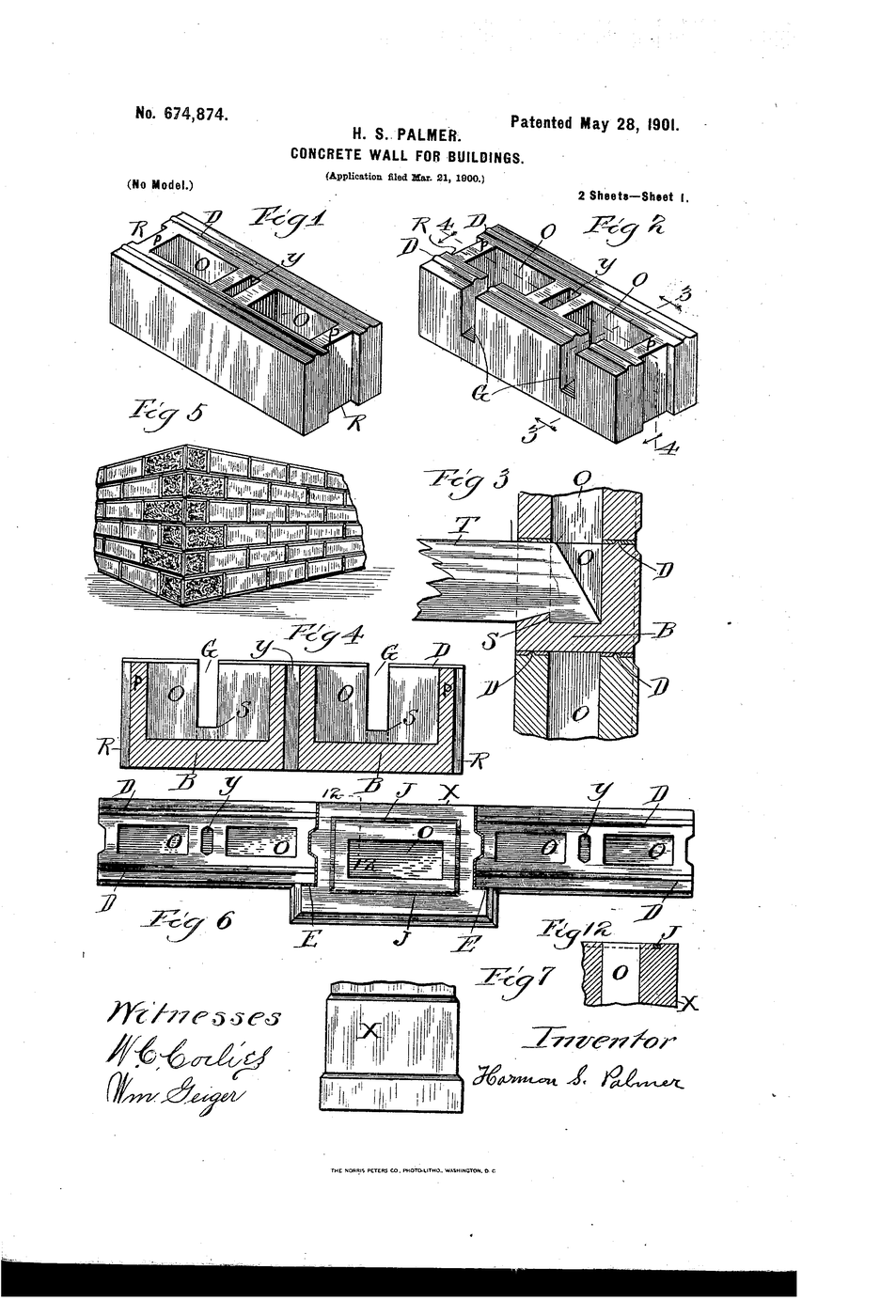


Concrete Block
Concrete is a wonderful wall material — strong, fireproof, cheap ingredients — but pouring a whole wall in place is slow and demands a mould (formwork) built for every job. What builders wanted was a concrete brick: a standard unit made in a factory or on site, cured, and then laid like masonry by any bricklayer.
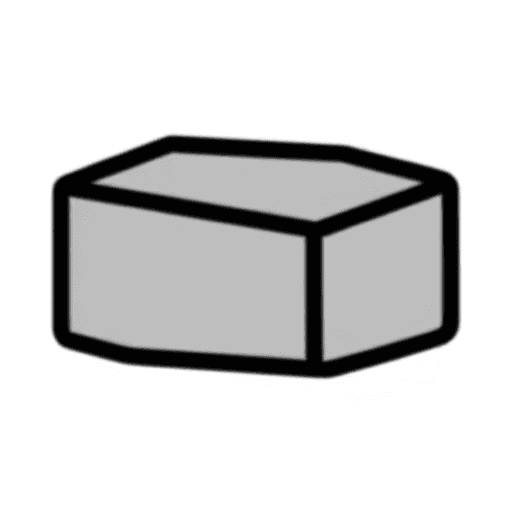
Palmer's patent is the HOLLOW concrete block and the wall built from it. Each block is cast with voids down the middle; the blocks interlock and are laid up in courses, with corner blocks, mortared expansion joints, and aligned cavities that can be threaded with steel and grout to reinforce the wall.
The hollow core is the clever part: it uses far less concrete, makes the block light enough to lift by hand, and leaves an air cavity that keeps the wall drier and warmer.
US Patent 674,874, "Concrete wall for buildings", filed 1900 and granted 28 May 1901 to Harmon S. Palmer of Chicago, Illinois. (Palmer is also remembered for the cast-iron machine he built to mass-produce these blocks — a separate patent.)
안내
Read the two ideas: hollow, and stackable
Read the two ideas: hollow, and stackable
Palmer's patent covers a hollow concrete block and the wall built from it — interlocking units, corner blocks, and cavities that take steel. Note both: the hollow core AND laying it up like masonry.
Mix a stiff, nearly dry concrete
Mix a stiff, nearly dry concrete
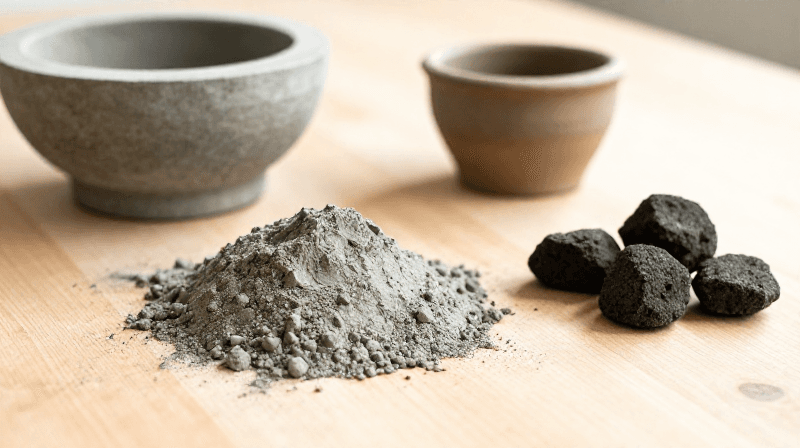
Mix cement, sand and gravel with just enough water to hold together when squeezed — a dry, crumbly mix, not a pourable one. Dry mix is what lets a block hold its shape the instant it is moulded.
이 단계의 재료:
 포틀랜드 시멘트500 g
 고운 모래1 kg
 자갈1 kg
Build a rectangular mould box
Build a rectangular mould box
Make an open box the size of a block from wood. This is the outer mould that shapes the block's faces.
이 단계의 재료:
 발트 자작나무 합판1 장
필요한 도구:
 쇠톱(핵소)
Cast a SOLID block first and weigh it
Cast a SOLID block first and weigh it
Tamp the dry mix into the plain box, then turn it out and let it set. Weigh it. A solid block is heavy and uses a lot of concrete. Record both.
필요한 도구:
 접시 저울
접시 저울Add removable cores to the mould
Add removable cores to the mould
Stand two smooth blocks or tubes in the mould as cores, coated so they release. They will leave hollow voids down the block.
Tamp the mix around the cores
Tamp the mix around the cores
Pack the dry mix firmly around the cores, tamping to fill the corners. A stiff mix stays put around the voids where a wet one would slump in.
Pull the cores while the block is green
Pull the cores while the block is green
Gently withdraw the cores straight up before the concrete sets hard. The voids stay open because the dry, tamped mix holds its shape. Then open the box.
Cure it damp, then weigh it
Cure it damp, then weigh it
Keep the hollow block damp for a few days to cure, then weigh it. It is far lighter than the solid block (step 4) — compute how much concrete the hollow saved.
Crush-test hollow versus solid
Crush-test hollow versus solid
Load both blocks on their bedding faces until they crack. The hollow block carries plenty of load through its webs and shells — you keep most of the strength for a fraction of the material.
필요한 도구:
 힘 측정기(스프링 저울)
Lay a small wall with mortar
Lay a small wall with mortar
Cast several blocks and lay them up in courses with a little mortar, breaking the joints like brick. A concrete wall, built by stacking — no formwork.
Line up the hollows into a cavity
Line up the hollows into a cavity
Note the voids stack into continuous vertical cavities through the wall. That air gap slows heat and keeps damp from crossing — and can be filled with insulation or steel and concrete for strength.
Reinforce the wall through the cavities
Reinforce the wall through the cavities
Line the hollow cores up into vertical channels, drop a steel wire down them and fill with mortar. The wall is now reinforced — Palmer's patent claims exactly this: blocks whose voids take steel and grout to strengthen the wall.
이 단계의 재료:
 아연 도금 강선1 미터
History & Context — the block that built Main Street
History & Context — the block that built Main Street
The patent. US 674,874, "Concrete wall for buildings", filed 21 March 1900 and granted 28 May 1901 to Harmon S. Palmer of Chicago, Illinois. The Google Patents date reads 1900 — that is the filing date; the sheet says "Patented May 28, 1901." Its seven claims cover the hollow concrete blocks and the wall assembled from them — corner blocks, mortared expansion joints, and voids that take reinforcement — not the machine that makes them.
The concrete block is really a manufacturing idea. Poured-in-place concrete needs a purpose-built mould for every wall and skilled crews; Palmer's insight was to turn concrete into a masonry unit — a standard hollow block, cured, then laid by any bricklayer using ordinary skills. Palmer is remembered as the father of the concrete block: alongside this wall patent he built a cast-iron machine (patented separately) that tamped a nearly dry mix around removable cores and turned out block after block. That dry, tamped mix is the key — it holds its shape the instant the mould is stripped (steps 6-7), and the hollow core is what you added in step 5.
Why hollow matters so much. The voids do three jobs at once. They cut the concrete used — and therefore the cost and, above all, the weight — so the block is light enough for one worker to lift and lay (step 8), while the remaining webs and shells keep most of the strength (step 9). They create an air cavity in the wall that resists heat flow and helps keep the inside dry (step 11). And they leave a channel that can be filled with insulation, or with steel and grout to make a reinforced concrete-masonry wall. That is why the hollow concrete block — the humble grey "cinder block" — became the default wall of factories, schools, shops and homes across America and much of the world in the twentieth century.
Where it sits. The concrete block completes a family: Portland cement makes the concrete, Ransome's bond and Freyssinet's prestressing make cast concrete span, and Palmer's hollow block turns concrete into a stackable unit for walls. It industrialised masonry itself — a wall you assemble from identical mass-produced pieces rather than build wet in place — and the humble grey hollow block you moulded here, cores and all, is still on every building site today.
이 블루프린트로 만드는 것
관련 블루프린트
이 블루프린트들은 지식을 공유합니다 — 기술, 재료 또는 원리


CC0 퍼블릭 도메인
이 블루프린트는 CC0로 공개되었습니다. 어떤 목적으로든 자유롭게 복사, 수정, 배포 및 사용할 수 있습니다.
제품 구매를 통해 메이커를 지원하세요. 판매자가 설정한 메이커 커미션 을 받거나, 이 블루프린트의 새로운 반복을 만들어 연결로 포함시킬 수 있습니다.