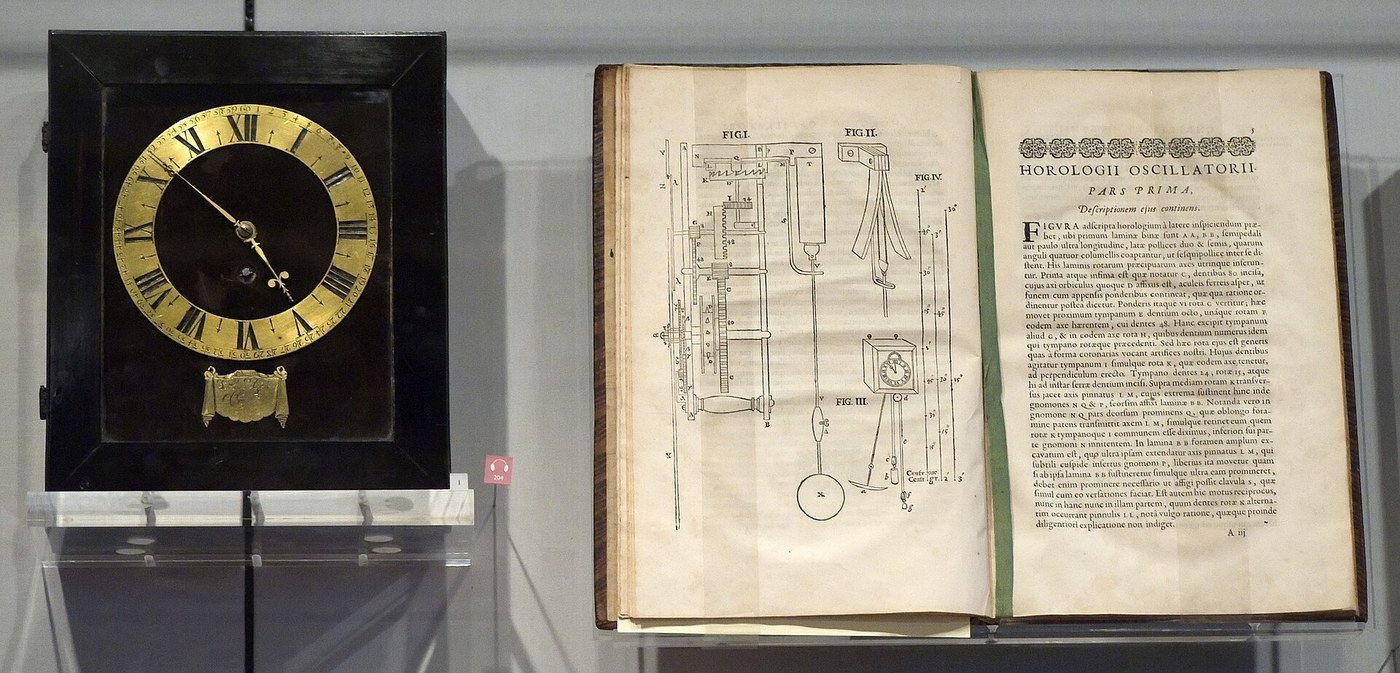


Pendulum Clock
안내
Hang a pendulum and time it properly
Hang a pendulum and time it properly
Timing one swing badly is the classic way to get a wrong answer.
- Hang a dense bob on fine line from a firm support.
- Measure the length from the pivot to the CENTRE of the bob.
- Time 20 complete swings and divide by 20.
이 단계의 재료:
 낚싯줄(외줄)1 실패
 스톱워치1 개
 자1 개
자1 개Change the mass — and watch nothing happen
Change the mass — and watch nothing happen
The most surprising result in the whole exercise.
- Keep the length identical.
- Swap the bob for one two or three times heavier.
- Re-time twenty swings.
이 단계의 재료:
 디지털 주방 저울1 개
Change the length and find the square-root law
Change the length and find the square-root law
Now vary the one thing that does matter, and plot it.
- Time the pendulum at several lengths — 10, 20, 40, 80 cm.
- Note that doubling the length does NOT double the period.
- Plot period against the square root of length; it should be a straight line.
T = 2π√(L/g)
Quadrupling the length doubles the period. A one-second pendulum — one second per swing — comes out at about 99 cm, which is why longcase clocks are the height they are. The case was built around the physics.Weigh the Earth with a piece of string
Weigh the Earth with a piece of string
Rearrange the formula and your pendulum becomes a gravimeter.
- Take your best length and period measurements.
- g = 4π²L / T²
- Compare with 9.81 m/s².
Find the limit of the law
Find the limit of the law
The isochronism everyone quotes is an approximation. Find where it fails.
- Time twenty swings at a small amplitude, a few degrees.
- Repeat at a large amplitude, 40 degrees or more.
- Compare carefully.
History and context
History and context
Galileo observed around 1602 that a pendulum's swing time barely depends on its amplitude, and near the end of his life sketched a pendulum clock; his son Vincenzio attempted a model after his death. Christiaan Huygens designed a working clock in 1656, had it built by Salomon Coster, and patented it in 1657. He published the full theory in Horologium Oscillatorium in 1673, including the cycloidal correction and the theory of the centre of oscillation.
The improvement was enormous. Clocks went from losing roughly fifteen minutes a day to losing about fifteen seconds, and the anchor escapement — which allows a much smaller swing — brought that down further. That is why clock faces gained a minute hand: before pendulums, minutes were not worth displaying.
What it could not do is keep time at sea. A pendulum depends on gravity and a steady support; a rolling deck ruins both. Huygens tried marine pendulum clocks repeatedly and they failed, and the longitude problem waited for John Harrison's spring-driven chronometers a century later — a different solution to the same problem, covered in its own blueprint.
What replaced it: the quartz oscillator, and then the caesium atomic standard. But the logic is unchanged — find something with a stable natural period, count its cycles. A quartz watch is a pendulum clock whose pendulum is a vibrating crystal.
CC0 퍼블릭 도메인
이 블루프린트는 CC0로 공개되었습니다. 어떤 목적으로든 자유롭게 복사, 수정, 배포 및 사용할 수 있습니다.
제품 구매를 통해 메이커를 지원하세요. 판매자가 설정한 메이커 커미션 을 받거나, 이 블루프린트의 새로운 반복을 만들어 연결로 포함시킬 수 있습니다.