예술
뷰티 및 웰니스
공예
문화 및 역사
엔터테인먼트
환경
음식 및 음료
역공학
과학
스포츠
기술
웨어러블


The Trigger and the Pistol Grip: The Switch You Do Not Have To Let Go Of
A brace gives you two hands on the work and all the feel in the world, and it stops when your arm does. Put a motor behind the chuck and you have solved the power and created a new problem: the switch is somewhere else.
Black and Decker's answer was not more power. It was a grip shaped like a revolver butt with the switch built into it, so the hand that holds the tool is the hand that starts it — and the tool is never, even for an instant, hanging on the bit.
That shape is still in your hand today. This rung takes it apart: what the grip does for the load path, what the ratchet inside the switch does that a knob cannot, and why the choice of bit matters more than the choice of motor.
초급
About 2 hours with a drill on the bench
안내
1
1
Find the load path, with the tool switched off
Find the load path, with the tool switched off
Unplug the drill, or take the battery out, and put it on the bench. This whole step is done cold.
Hold it as you would to drill a horizontal hole in a wall and notice where the weight wants to go. The mass is the motor, and the motor sits behind and above your hand. The tool wants to rotate nose-down about your wrist, and the only thing at the nose is the bit.
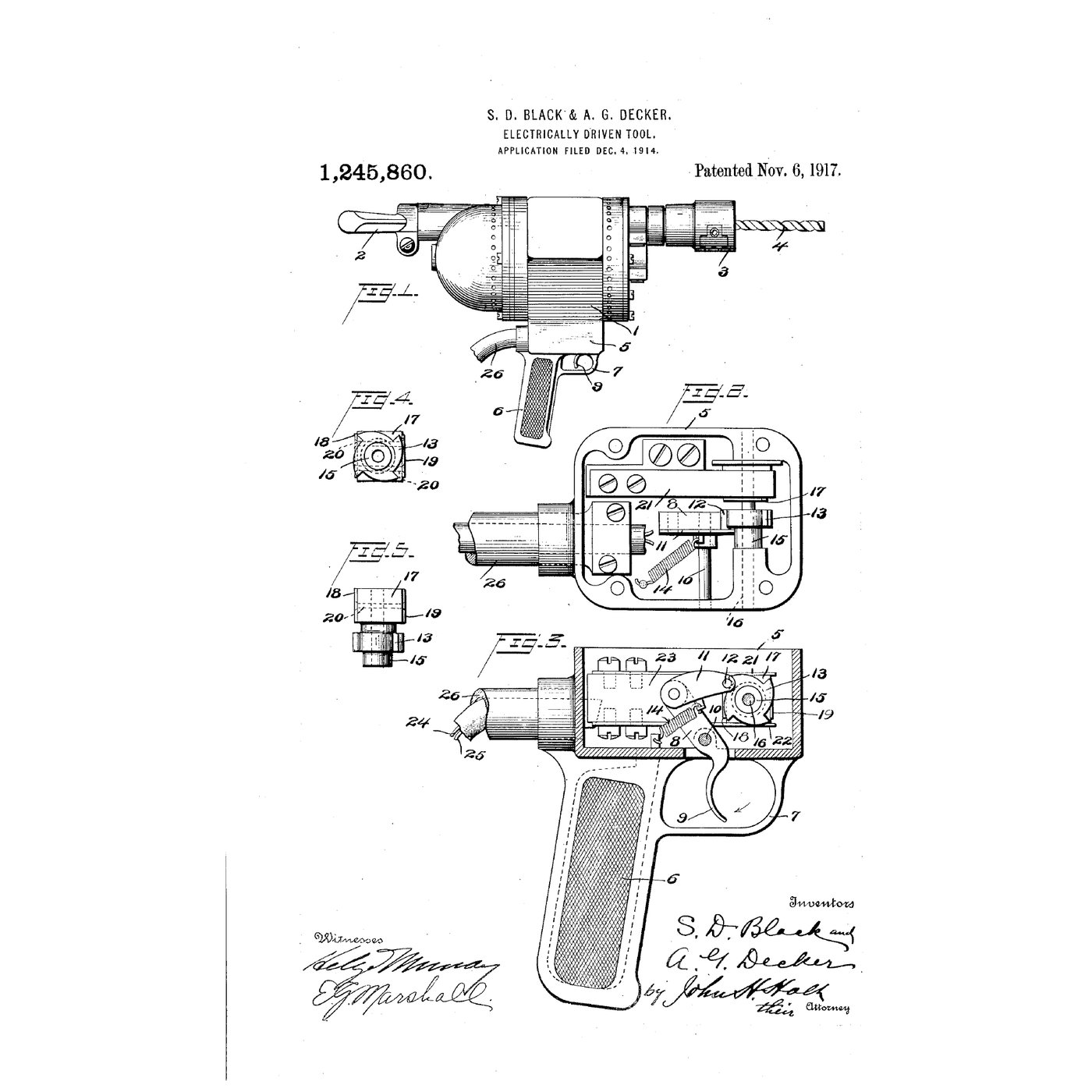
Now find the centre of gravity: balance the drill across one finger and mark where it balances. On most drills it falls close to the top of the grip. That is not an accident — the patent says the tool 'should be supported under the center of gravity', and the grip is put there so your hand carries the mass instead of the bit carrying it.
Measure the overhang from the grip centreline to the chuck nose with the steel rule and write it down. That distance times the mass is the bending moment the bit sees the moment you stop supporting the tool — and step 4 works out what that is worth.
필요한 도구:
 유선 드릴
유선 드릴 자
자2
2
The switch is a ratchet, and that is the whole trick
The switch is a ratchet, and that is the whole trick
The patent numbers every part, and the mechanism reads cleanly once you have the numbers.
The switch box **5** is cast integral with the motor casing **1**. Below it hangs the pistol grip support **6**, and forward of the grip is the trigger guard **7**. The trigger is a lever **8** turning on a spindle **10**, with a downward extension **9** that moves inside the guard.
Now the part that matters. Pivoted to the top of that lever is a pawl **11** carrying a right-angle pin **12**, and that pin rests on the periphery of a **four-toothed ratchet 13**, held against it by a coil spring **14**. Fast to the same sleeve **15** is a four-sided insulating block **17** carrying contact plates **18** and **19**, riveted together at **20**. That block turns between two contact springs **21** and **22**.
Pull the trigger and the pawl indexes the ratchet ONE tooth. Four teeth, four faces on the block, so successive pulls put a conducting face across the springs, then an insulating one, then conducting again. On, off, on, off — and the patent is explicit that the ratchet 'moves always in the same direction'.
That is why the tool has no up or down, no in or out, and nothing to remember. In the inventors' own words there is 'nothing more to do than merely pull a trigger after the fashion of firing a revolver or gun'. A rotating switch that only goes one way cannot be left in a state you did not intend.
필요한 도구:
유선 드릴 드라이버 세트
 멀티미터
멀티미터3
3
Prove the switch, and prove the chuck, without cutting anything
Prove the switch, and prove the chuck, without cutting anything
**The switch.** With the tool unplugged, set the multimeter to continuity and put the probes on the two plug pins with the trigger released, then held. You should read open, then closed. On a variable-speed trigger you will instead watch resistance fall smoothly as you squeeze — a later invention living in the same handle.
**The chuck.** Fit the largest bit in the set and nip the chuck up by hand only. Clamp the bit in the bench vise, and try to turn the drill body by hand. It will slip. Now tighten properly — all three key positions on a keyed chuck, not just one — and try again. It will not. A chuck grips on three jaws advancing together on a scroll, and one key position tightens one jaw hardest and leaves the geometry lopsided.
**The runout.** Put a bit in, rest the caliper jaw lightly against the shank near the chuck and rotate by hand, then repeat 60 mm further out. Any wobble at the chuck is multiplied at the tip by the ratio of the two distances. That is why a bent bit drills an oversize hole, and why the hole is always bigger than the bit, never smaller.
필요한 도구:
유선 드릴 드릴 비트 세트멀티미터
 바이스(만력)
 디지털 캘리퍼스 6인치
4
4
Why the bit, not the motor, sets the limit
Why the bit, not the motor, sets the limit
Jupyter 노트북 불러오는 중…
필요한 도구:
디지털 캘리퍼스 6인치5
5
History and context
History and context
**US 1,245,860**, Samuel Duncan Black and Alonzo Galloway Decker of Baltimore, assignors to The Black & Decker Manufacturing Company. Filed 4 December 1914, granted 6 November 1917. Long expired.
The two had set up in a Baltimore loft in 1910 with 600 dollars, making whatever paid: a milk-bottle cap machine, a cotton-picking machine, a postage-stamp coater. The drill was the thing that stuck.
What they patented is worth being precise about, because it is easy to say they invented the portable electric drill and that is not true. Portable electric drills existed — the patent says so in its own first paragraph, describing 'a portable electric drill of known construction'. What was new was the **handle**: a pistol grip under the centre of gravity, with a trigger switch in it, so the tool could be started and stopped without changing grip.
It is a human-factors patent wearing an electrical patent's clothes, and it won because the problem it solved was the one that broke bits and dropped tools. Every corded and cordless drill since has the same silhouette, and so do the saws, grinders and drivers in the rest of this batch — the grip propagated faster than any of the mechanisms did.
**Honest limits.** One speed suits one bit diameter, as step 4 shows; the gearbox and the variable-speed trigger both arrive later to fix it. The ratchet switch has no OFF you can verify by looking. And a pistol grip is the wrong shape for overhead work, which is why the side handle and the D-handle exist alongside it and never went away.
관련 블루프린트
이 블루프린트들은 지식을 공유합니다 — 기술, 재료 또는 원리

CC0 퍼블릭 도메인
이 블루프린트는 CC0로 공개되었습니다. 어떤 목적으로든 자유롭게 복사, 수정, 배포 및 사용할 수 있습니다.
제품 구매를 통해 메이커를 지원하세요. 판매자가 설정한 메이커 커미션 을 받거나, 이 블루프린트의 새로운 반복을 만들어 연결로 포함시킬 수 있습니다.