
Building a Primitive Fishing Rod — Sapling Pole & Bone Hook
안내
Select and Prepare the Pole
Select and Prepare the Pole
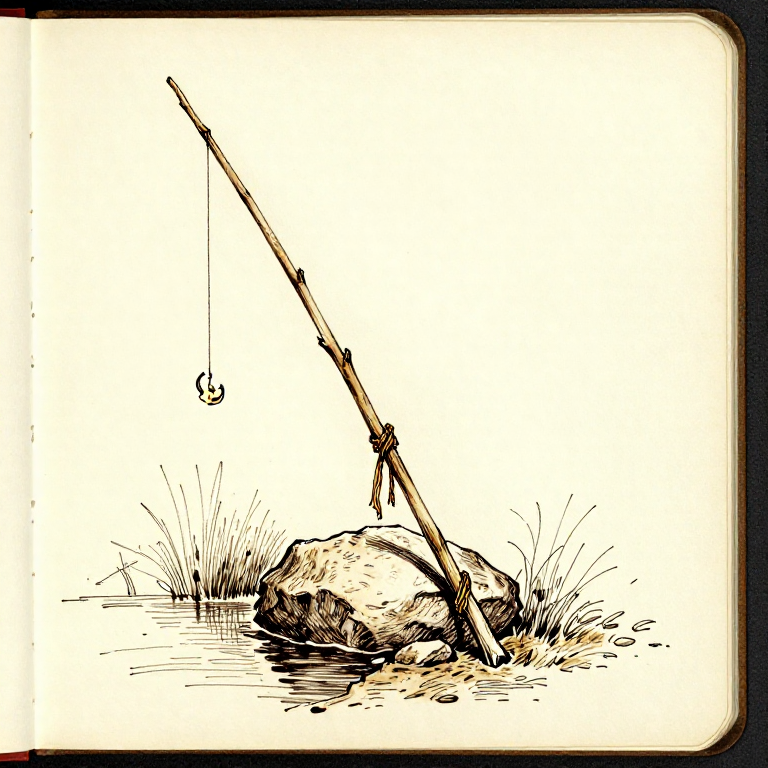
Find a straight, flexible sapling — hazel, willow, or birch work best. The pole should be 2-3 metres long and taper naturally from a thumb-width base to a pencil-thin tip. Cut it at the base with a flint knife using a scoring-and-snapping motion. Strip all side branches and leaves. Green wood bends without breaking; if the tip snaps when flexed into a gentle arc, the wood is too dry or brittle — choose another.
이 단계의 재료:
 Flexible sapling (hazel or willow)1 pole, 2-3m long m
 Cordage3-4m length m
 Bone fragment (leg bone of deer or similar)1 piece 개
 Natural bait (grubs, worms)as needed 개
필요한 도구:
 Flint knife or scraper
 Sandstone (Abrasive)
Prepare the Line
Prepare the Line
Use reverse-wrap cordage made from plant fibers — nettle bast, lime inner bark, or twisted sinew all work. The line should be slightly longer than the pole (3-4m). If you have not yet made cordage, see the Plant Fiber Rope blueprint for the reverse-wrap technique. Test the line by pulling firmly — it must hold at least 2-3 kg without snapping.
Carve the Bone Hook
Carve the Bone Hook
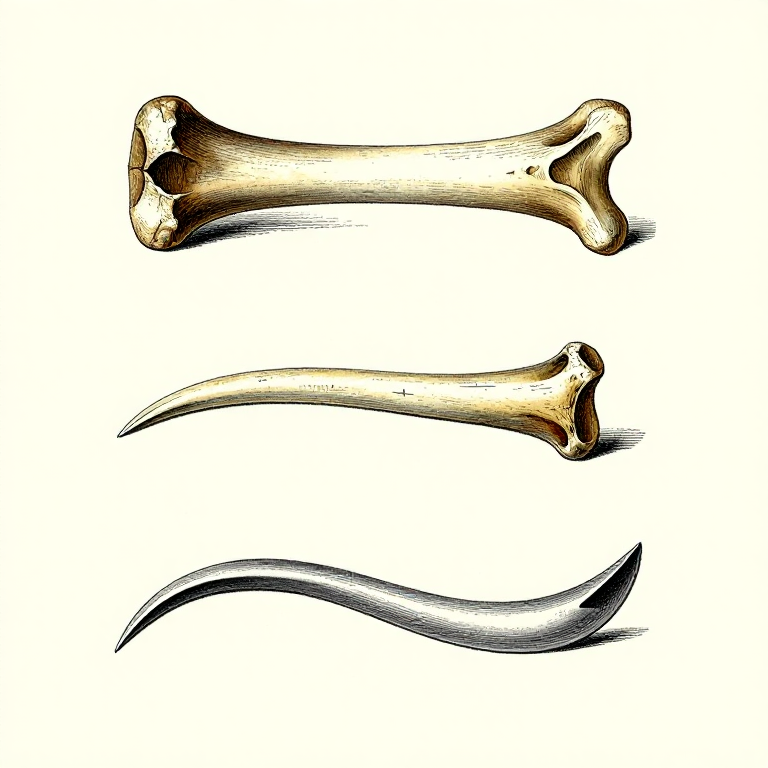
Select a dense bone fragment — the cannon bone of a deer works well. Score the outline of a hook shape (about 3cm long) into the bone surface using the sharp edge of a flint flake. The hook needs a shank (straight section for tying the line), a bend, and a point. Repeatedly score the outline until you can snap the rough shape free. Then grind the point sharp on a sandstone slab using a circular motion. Carve a small notch or groove near the top of the shank for securing the line.
Attach Line to Pole and Hook
Attach Line to Pole and Hook
Lash the line to the pole tip using a clove hitch backed by a simple overhand knot. The attachment should be tight enough that pulling the line does not slip, but if the tip breaks under load, the line stays attached to the next section down. At the hook end, tie the line into the groove on the shank using a snell knot — wrap the line around the shank 5-6 times, then pass the end through the loop at the top. Pull tight. The wraps create friction that prevents the knot from slipping under load.
Bait and Fish
Bait and Fish
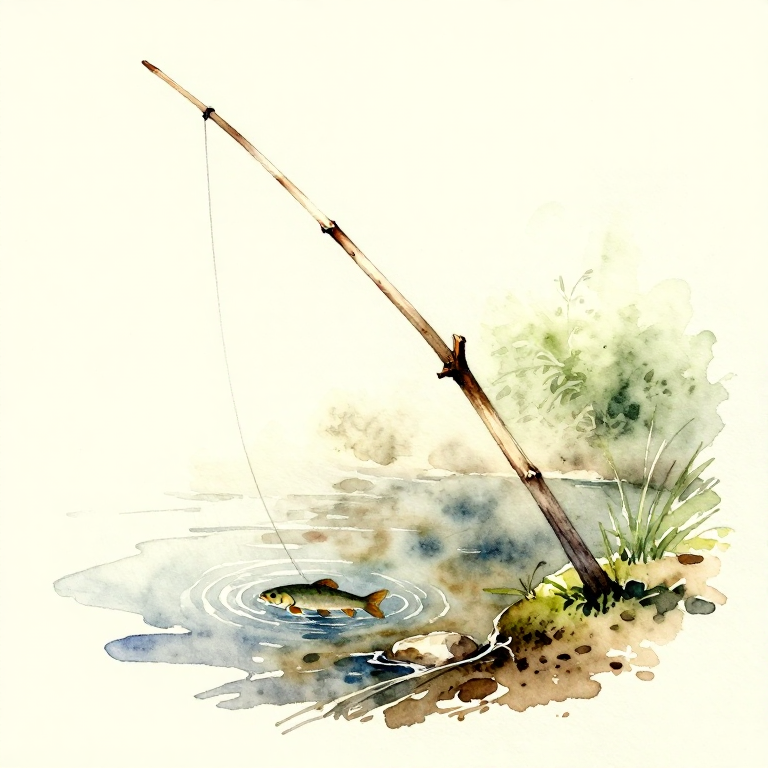
Thread natural bait — grubs, earthworms, or small insects — onto the hook point so the barb is partially concealed. Lower the baited hook into calm water near submerged logs, undercut banks, or weed beds where fish shelter. Hold the pole steady and watch for the line to twitch or the pole tip to dip. When a fish takes the bait, lift the pole tip firmly but smoothly to set the hook. Do not jerk violently — bone hooks are brittle and may snap under sudden force. Guide the fish to shore using steady side pressure.
재료
6- 1 pole, 2-3m long m플레이스홀더
- 3-4m length m플레이스홀더
- 1 piece 개플레이스홀더
- 1 pole, 2-3m long 개플레이스홀더
- 1 piece 개플레이스홀더
- as needed 개플레이스홀더
필요 도구
2- 플레이스홀더
- 플레이스홀더
CC0 퍼블릭 도메인
이 블루프린트는 CC0로 공개되었습니다. 어떤 목적으로든 자유롭게 복사, 수정, 배포 및 사용할 수 있습니다.
제품 구매를 통해 메이커를 지원하세요. 판매자가 설정한 메이커 커미션 을 받거나, 이 블루프린트의 새로운 반복을 만들어 연결로 포함시킬 수 있습니다.