예술
뷰티 및 웰니스
공예
문화 및 역사
엔터테인먼트
환경
음식 및 음료
역공학
과학
스포츠
기술
웨어러블
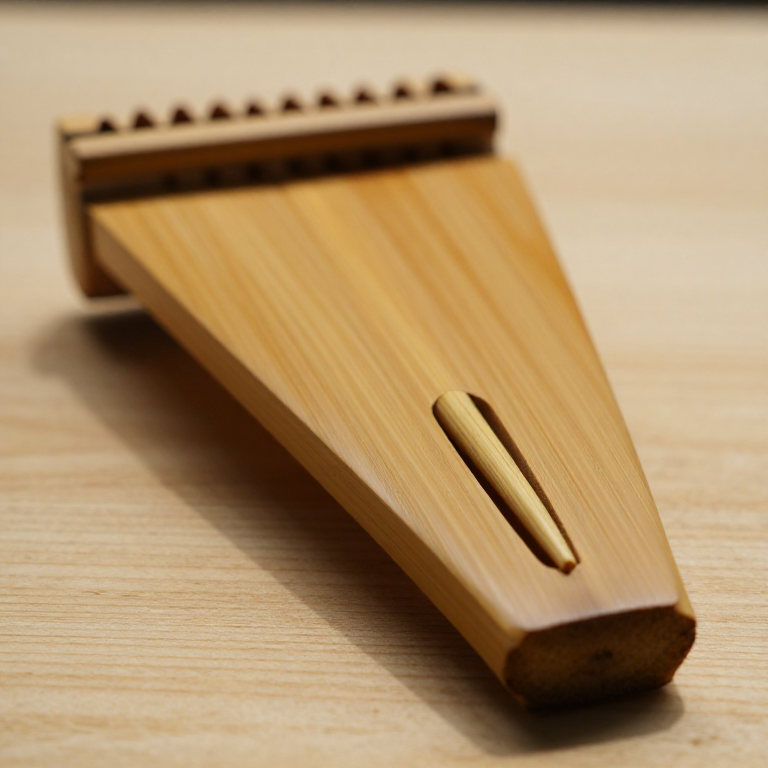


Making a Bamboo Jaw Harp — A Plucked Tongue Instrument
Cut a springy tongue into a strip of bamboo, hold the frame to your lips and pluck it: the tongue drones at one pitch while your mouth picks out a melody of overtones above it. The ancient idioglot jaw harp — a plucked idiophone and a simple, buildable school project in harmonics and mouth resonance.
초급
30 minutes
안내
1
1
One tongue, a mouth full of notes
One tongue, a mouth full of notes
A jaw harp is a springy tongue set in a frame. You pluck the tongue and your own mouth becomes the loudspeaker that shapes the sound.
2
2
Cut a bamboo strip
Cut a bamboo strip
Split and trim a flat strip of bamboo about 12 cm long and 1.5 cm wide, with a smooth, even surface.
이 단계의 재료:
 Bamboo1 개
필요한 도구:
 Sloyd Carving Knife
3
3
Mark the tongue
Mark the tongue
In the centre, mark a thin tongue about 6 cm long and 3 mm wide, joined to the frame at one end and free at the other.
4
4
Cut the first slit
Cut the first slit
Carefully cut a long straight slit down one side of the marked tongue, all the way through the bamboo.
필요한 도구:
Sloyd Carving Knife5
5
Cut the second slit
Cut the second slit
Cut the matching slit down the other side so the tongue is free along its length, still attached only at its base.
필요한 도구:
Sloyd Carving Knife6
6
Thin the tongue
Thin the tongue
Shave the tongue thinner and even, so it flexes and springs freely. A thinner tongue vibrates faster and sounds higher.
필요한 도구:
Sloyd Carving Knife7
7
Test the spring
Test the spring
Flick the free tip of the tongue with a finger. It should twang and buzz on its own for a moment. If it is stiff, thin it a little more.
8
8
Add a pull-string (optional)
Add a pull-string (optional)
For the classic Asian style, tie a short string to the tongue's tip; a sharp sideways tug plucks it cleanly each time.
이 단계의 재료:
 Abaca Tying Twine1 개
9
9
Hold it to your lips
Hold it to your lips
Rest the frame lightly against your slightly parted lips, tongue pointing into your mouth, without touching or blocking it.
10
10
Pluck and listen
Pluck and listen
Pluck the tongue's tip (or tug the string). A steady buzzing drone fills your mouth. This single pitch is the tongue's own note.
11
11
Shape notes with your mouth
Shape notes with your mouth
Slowly change the shape of your open mouth and breathe gently in and out. You pick out different overtones — a melody floating over the drone.
12
12
Compendium — how one tongue makes many notes
Compendium — how one tongue makes many notes
The tongue vibrates at a single fixed pitch set by its own springiness — thinner and shorter tongues buzz faster and sound higher. That buzz is rich in harmonics: quiet notes at two, three, four times the fundamental frequency, all sounding at once. Your mouth is a resonating chamber that acts like a filter; by changing its size and shape you tune the cavity to reinforce one harmonic at a time, so you can play a tune while the tongue's pitch never changes. It is exactly the mouth-resonance trick of the musical bow, which is why the two instruments are cousins. A jaw harp is a plucked idiophone (a lamellophone): the same free-vibrating-tongue idea, multiplied into many tuned tongues, becomes the mbira and kalimba, and set vibrating by air it becomes the free reeds of the harmonica, accordion and reed organ. The bamboo idioglot form — tongue cut from the frame itself — is the ancient one, found across Asia and Oceania as the Vietnamese dan moi and Philippine kubing; metal-framed jaw harps came later with metalworking.
관련 블루프린트
이 블루프린트들은 지식을 공유합니다 — 기술, 재료 또는 원리
CC0 퍼블릭 도메인
이 블루프린트는 CC0로 공개되었습니다. 어떤 목적으로든 자유롭게 복사, 수정, 배포 및 사용할 수 있습니다.
제품 구매를 통해 메이커를 지원하세요. 판매자가 설정한 메이커 커미션 을 받거나, 이 블루프린트의 새로운 반복을 만들어 연결로 포함시킬 수 있습니다.