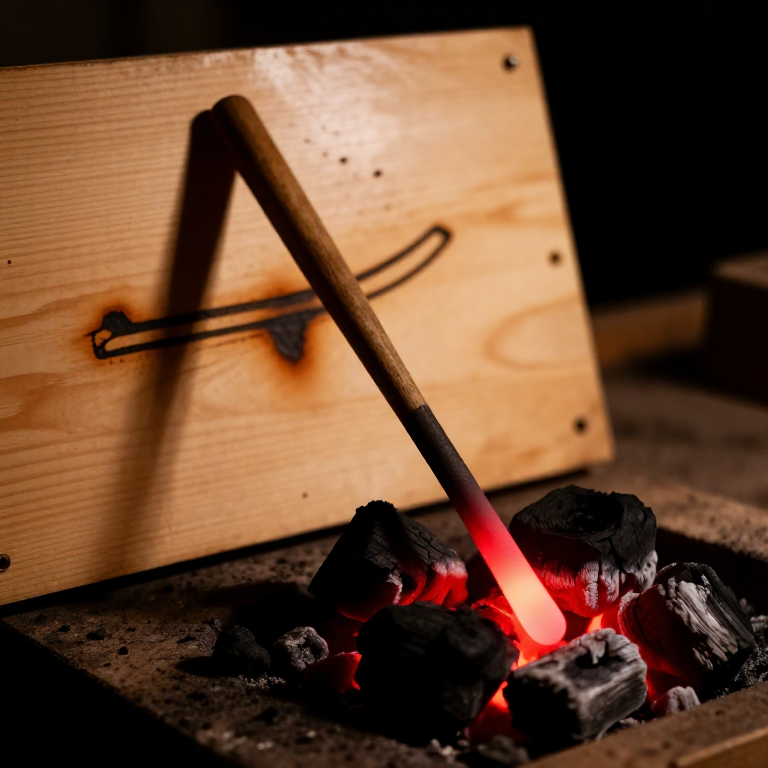


Pyrography with a Hot Poker
Pyrography is drawing by burning. An iron heated in a fire, touched to wood, chars a line — and unlike ink or paint, that line is not on the surface, it is the surface, permanently altered. It cannot fade, wash off or flake.
Before electric tools, the whole craft ran on a simple problem: the iron is hottest the moment it leaves the fire and cools continuously as you work. So the same pressure and the same speed give a different tone every few seconds. You cannot fight that. You work with it — hot iron for the dark accents, cooling iron for the mid-tones, and back to the fire.
That constraint is why traditional pokerwork looks the way it does: confident short strokes, tonal variation everywhere, and almost never a long unbroken line of even weight.
안내
Work somewhere ventilated
Work somewhere ventilated
Work outdoors or with a window open and a fan drawing smoke away. Burning wood produces smoke you should not sit in for hours, whatever the species.
Choose a pale close-grained wood
Choose a pale close-grained wood
Use lime, birch, maple or sycamore. Pale wood maximises contrast with the burn, and even grain means the iron travels at a constant rate.
이 단계의 재료:
 경목 블록1 개
Avoid resinous softwood
Avoid resinous softwood
Skip pine and spruce. Resin pockets flare and spit when the iron touches them, and the burn jumps unpredictably from soft earlywood to hard latewood.
Sand to 220 grit
Sand to 220 grit
Sand smooth through 120 then 220 grit and dust it off. Any scratch left in the surface will char darker than its surroundings and show as a permanent line.
이 단계의 재료:
 사포1 장사포1 장
Transfer the design lightly
Transfer the design lightly
Trace the design on with a hard pencil, pressing gently. A deep pencil groove burns darker and you will see it forever under the finish.
이 단계의 재료:
 카본 전사지1 장
Heat the poker in the coals
Heat the poker in the coals
Bury the iron tip in hot charcoal until it is dull red. Beyond dull red the iron burns through rather than marks, and scorches a wide halo around every stroke.
이 단계의 재료:
 덩어리 숯1 kg
필요한 도구:
 낙화 인두
낙화 인두Test on scrap every time you reheat
Test on scrap every time you reheat
Touch the reheated iron to a scrap of the same wood first. This tells you the tone before you commit it to the piece — there is no undo in pyrography.
Burn the darkest accents first
Burn the darkest accents first
Use the iron at its hottest, straight from the fire, for the darkest marks. Work outward to lighter tones as it cools — the tool's cooling curve is your tonal range.
필요한 도구:
낙화 인두Keep the iron moving
Keep the iron moving
Never pause with the iron down. A stationary hot tip burns a deep pit within a second, and a pit cannot be sanded out without removing the drawing around it.
Pull with the grain, not across
Pull with the grain, not across
Draw strokes along the grain where you can. Crossing the grain, the iron drags at the hard latewood and skips, and the line comes out ragged.
Build tone with stippling and hatching
Build tone with stippling and hatching
Make mid-tones from many small marks rather than by pressing harder. Pressure deepens the burn but does not lighten it — density of marks is the only real grey scale you have.
필요한 도구:
낙화 인두Brush off the char
Brush off the char
Brush the loose black char away with a stiff brush. Loose char smears into the pale wood and greys the whole piece down.
Oil the finished panel
Oil the finished panel
Wipe on boiled linseed oil and wipe off the surplus. Oil deepens the burn and the wood together, and the contrast lifts noticeably.
이 단계의 재료:
 끓인 아마인유50 ml
History & Context
History & Context
An old and widely-reinvented craft. Decorating wood, gourds and leather by burning appears independently across many cultures, for the obvious reason that it needs only fire, metal and something to mark. It is one of those techniques that has no single origin because the ingredients are universal.
Why the tool defines the look. A fire-heated iron loses heat from the moment it leaves the coals, so tone is a function of time-since-reheating as much as of the maker's intention. Traditional pokerwork therefore favours short confident strokes and constant tonal variation. Electric pyrography pens, which hold a set temperature indefinitely, made long even lines and flat shading possible — and consequently modern work often looks quite different from historical work. Neither is more correct; they are different instruments.
What the burn actually is. Heat drives off water and volatiles and leaves carbon behind — the same pyrolysis that makes charcoal, run shallow and under control. That is why the mark is permanent: it is not a pigment sitting on the wood, it is the wood chemically changed. It is also why the mark cannot be lightened, only deepened.
Pale wood, dark line. The craft depends entirely on contrast, so it drove a preference for pale close-grained timbers — lime and sycamore especially, which are also the carver's woods for the same reasons: even density and no strong figure competing with the work.
A note on safety, honestly stated. This is hot work with a real fire and it produces smoke, so it needs ventilation and attention. It is not, however, a toxic-materials process — no chemical is being extracted or handled, and the risk is the same category as any hot craft such as forging or kiln work. Young makers should be able to learn it with supervision, and historically they did.
재료
6- 1 개플레이스홀더
- 1 장플레이스홀더
- 1 장플레이스홀더
- 1 장플레이스홀더
- 1 kg플레이스홀더
- 50 ml플레이스홀더
CC0 퍼블릭 도메인
이 블루프린트는 CC0로 공개되었습니다. 어떤 목적으로든 자유롭게 복사, 수정, 배포 및 사용할 수 있습니다.
제품 구매를 통해 메이커를 지원하세요. 판매자가 설정한 메이커 커미션 을 받거나, 이 블루프린트의 새로운 반복을 만들어 연결로 포함시킬 수 있습니다.