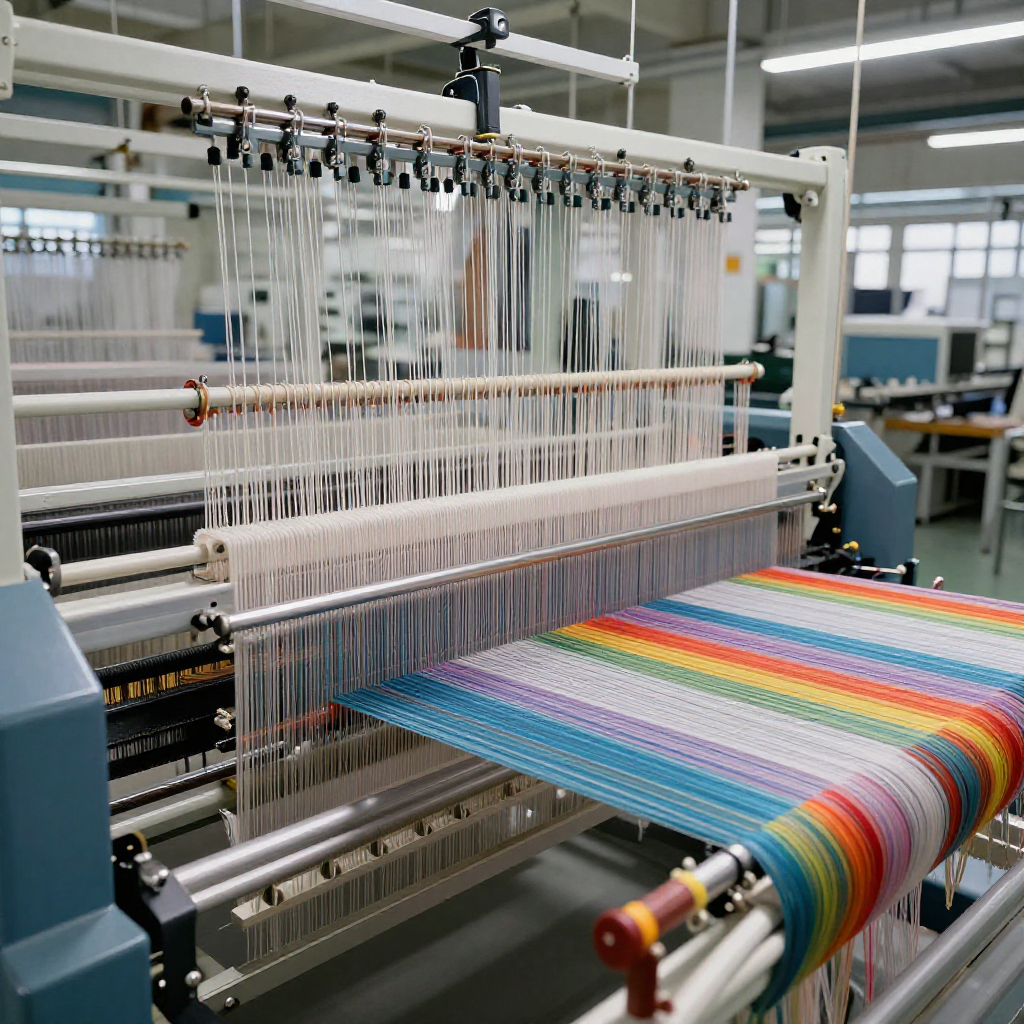


The Rapier Loom — Shuttleless Weaving That Ended 200 Years of Shuttle Technology
In the 1950s and 1960s, several European manufacturers — notably Dornier in Germany, Sulzer in Switzerland, and Nuovo Pignone in Italy — developed and commercialized rapier looms: weaving machines that insert the weft thread using a pair of flexible or rigid rapier arms instead of a flying shuttle. The rapier loom was the first shuttleless weaving technology to achieve widespread commercial success, and it initiated the obsolescence of shuttle-based weaving that had dominated textile production since John Kay's flying shuttle of 1733.
The mechanism is elegant. A 'giver' rapier carries the weft thread from one side of the warp, advancing to the center of the fabric. A 'receiver' rapier enters from the opposite side. The two rapiers meet in the center, the receiver grips the weft thread from the giver, and both rapiers retract — pulling the weft thread across the full width of the warp in a single pick. Because the rapier tips are small and lightweight, they move faster and consume far less energy than accelerating a heavy shuttle back and forth. A rapier loom inserts 500–700 picks per minute, versus 180–220 for a Northrop automatic shuttle loom.
The rapier loom's advantages over shuttle looms are dramatic: higher speed, lower noise (no shuttle impact), lower vibration, wider fabric widths (up to 4 meters), ability to handle a wider variety of yarn types, and dramatically reduced maintenance. The elimination of the shuttle also eliminated the bobbin — weft yarn is drawn directly from large stationary packages, ending the entire bobbin-winding preparation stage. By 1990, rapier and other shuttleless looms had replaced shuttle looms in virtually all developed countries. Today, rapier looms account for roughly 30% of global woven fabric production, alongside air-jet looms (50%) and projectile and water-jet looms (20%).
안내
Understand why the shuttle had to go
Understand why the shuttle had to go
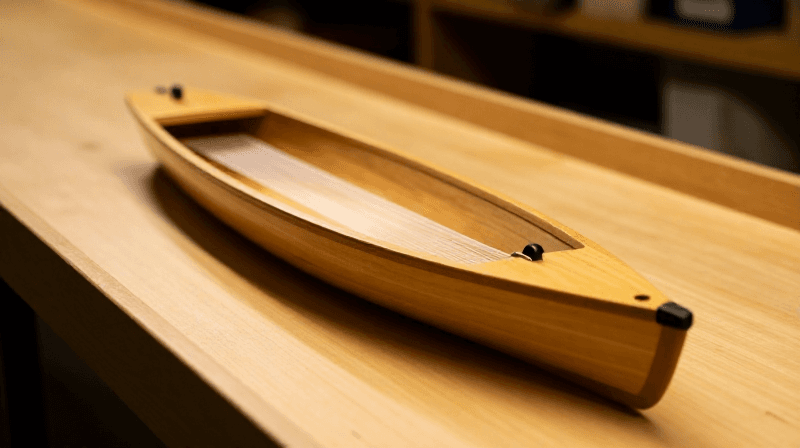
The shuttle loom's fundamental limitation is the shuttle itself. A shuttle weighs 300–500 grams and must be accelerated to 40–50 km/h on each pick, then decelerated to a stop in the shuttle box. This cycle — accelerate, fly, decelerate — creates enormous vibration, noise (over 100 dB), and mechanical stress. The shuttle also carries its own weft supply (a small bobbin), which limits the amount of weft available before requiring a bobbin change. Every component of the shuttle mechanism — picker sticks, check straps, shuttle boxes, buffers — wears rapidly and needs constant maintenance. The rapier loom eliminates the shuttle entirely.
Prepare the warp beam
Prepare the warp beam
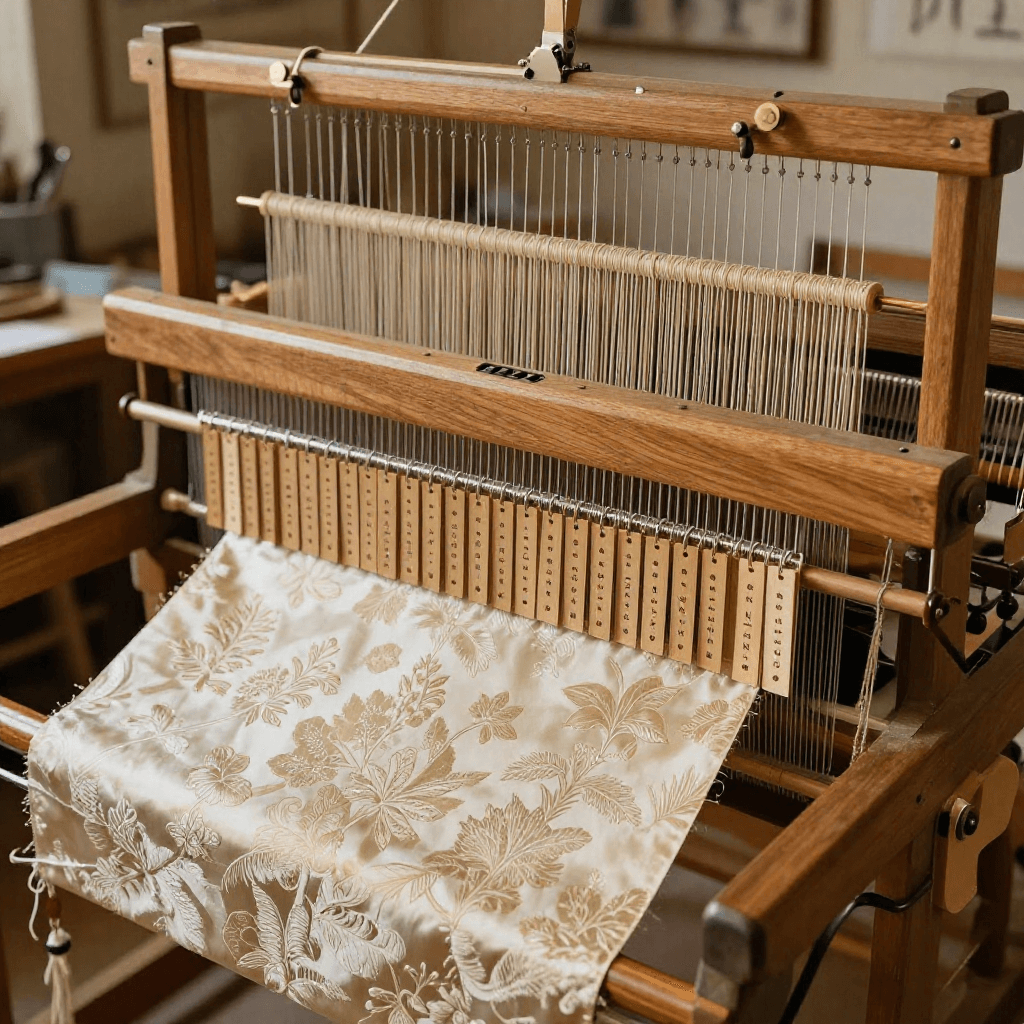
Wind a warp beam using standard warping procedures — the warp preparation for a rapier loom is identical to that for a shuttle loom. Thread the warp ends through drop wires (for warp-break detection), through the heddle eyes of the harness frames (for shedding), and through the reed (for beat-up and thread spacing). Rapier looms typically accommodate 2–16 harness frames for dobby weaving, or a Jacquard head for complex pattern weaving. The warp beam holds enough yarn for hundreds of meters of fabric production.
이 단계의 재료:
 날실용 실1 kg
필요한 도구:
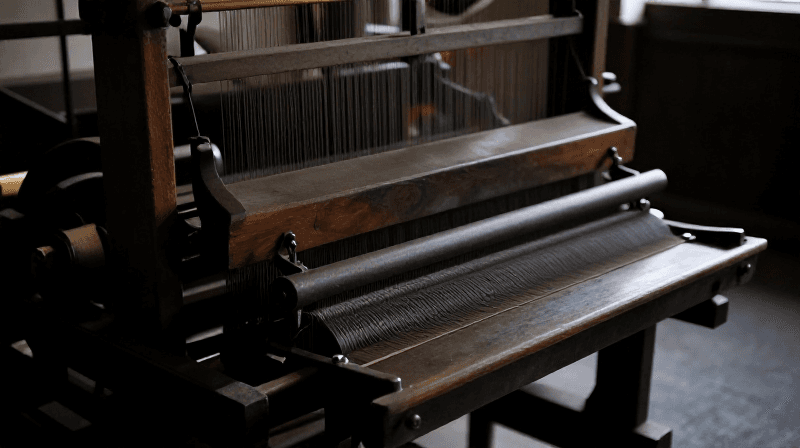
 역직기
역직기Set up the weft supply packages
Set up the weft supply packages
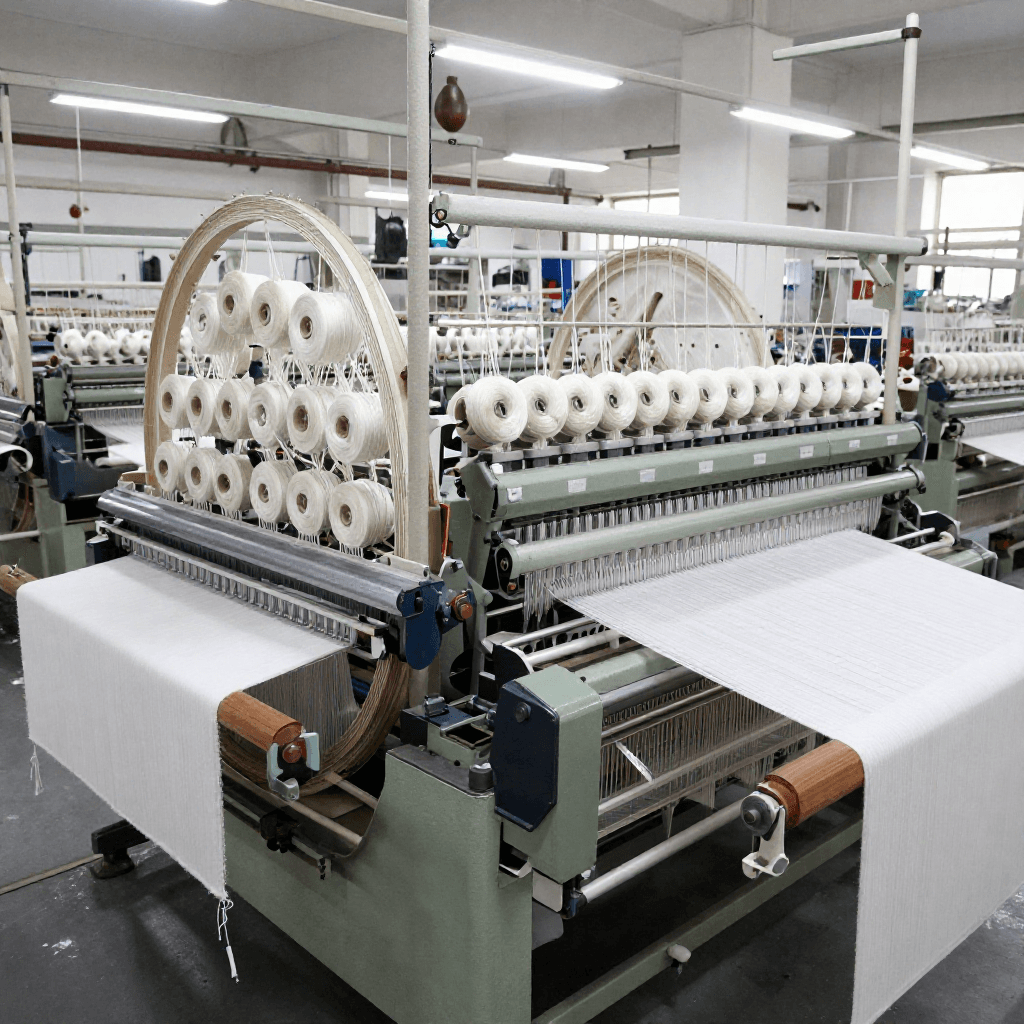
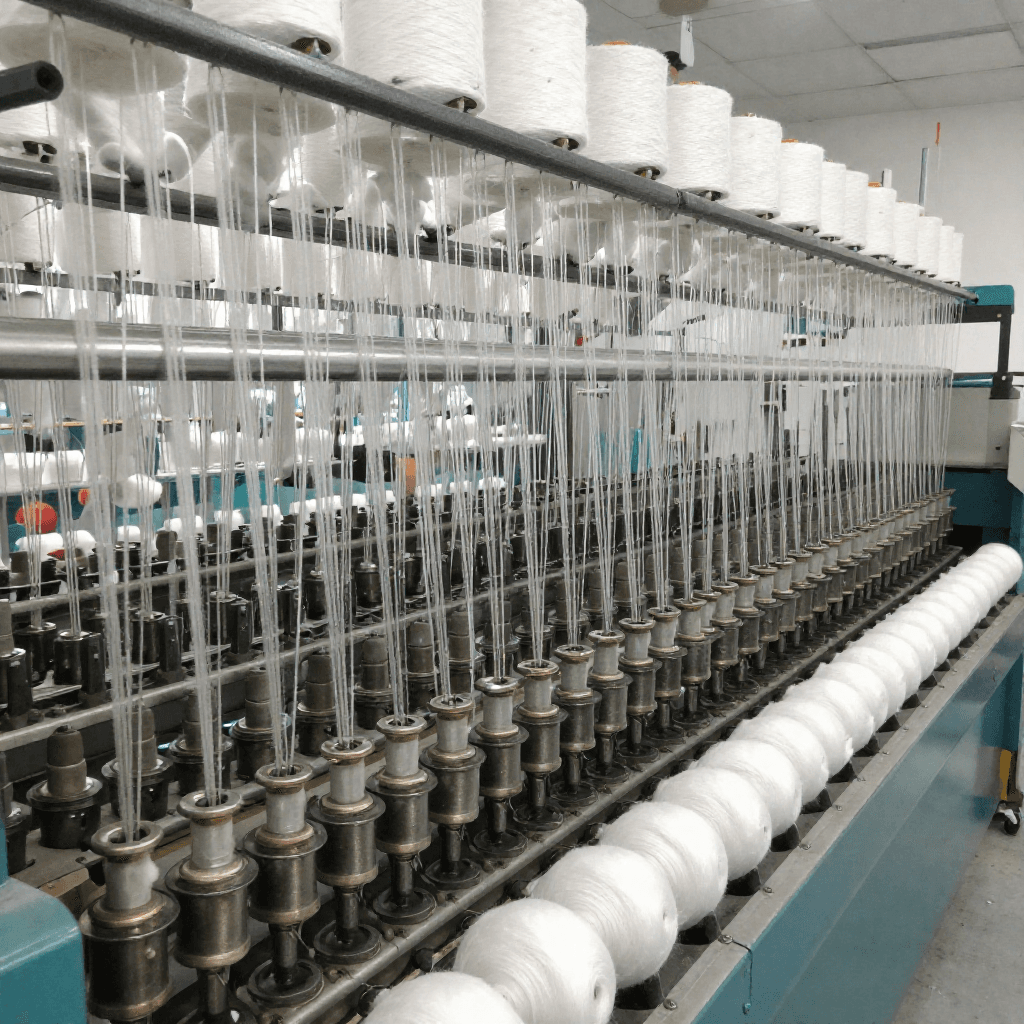
Unlike a shuttle loom, which requires hundreds of pre-wound bobbins, a rapier loom draws weft directly from large stationary yarn packages — cones or beams holding several kilograms of yarn each. Mount the weft packages on a creel (a rack) at the side of the loom. The yarn runs through a tension device, a weft accumulator (which pre-measures each pick length), and a yarn guide to the giver rapier. Multiple weft packages can be loaded simultaneously for multi-color weaving — the loom selects which weft to insert on each pick.
이 단계의 재료:
 씨실1 kg
Observe the shedding motion
Observe the shedding motion
The harness frames rise and fall in sequence according to the weave pattern, creating the shed — the V-shaped opening between upper and lower warp threads through which the weft will be inserted. On a rapier loom, shedding is typically driven by a cam mechanism (for simple weaves), a dobby head (for complex dobby weaves), or a Jacquard head (for intricate figured fabrics). The shed must be fully open before the rapier tips enter, and must remain open until both rapiers have retracted. The timing is controlled electronically on modern rapier looms.
Watch the giver rapier carry the weft to center
Watch the giver rapier carry the weft to center
The giver rapier — a thin, flexible steel band or rigid rod with a small gripper head at its tip — enters the shed from the left side carrying the weft thread. The gripper head clamps the weft securely. The rapier moves to the center of the warp width at high speed, driven by a linkage mechanism, cam, or linear motor. Flexible rapiers (used in most modern looms) follow a guide channel that curves around a drum on the loom frame, uncoiling into the shed as they advance. The giver rapier carries the weft to the exact center of the fabric width.
Watch the receiver rapier complete the transfer
Watch the receiver rapier complete the transfer
Simultaneously, the receiver rapier enters the shed from the right side, advancing to the center. When both rapier tips meet at the center, the receiver's gripper clamps onto the weft thread and the giver's gripper releases it — a handshake that takes milliseconds. Both rapiers then retract to their respective sides: the receiver pulls the weft across the second half of the fabric width, completing the full pick. The weft thread now spans the entire warp width. A cutter trims the weft at the selvedge, and the cycle repeats.
Observe the beat-up motion
Observe the beat-up motion
After the rapiers retract, the reed — mounted on a swinging sley — swings forward and pushes the newly inserted weft thread firmly against the fell of the cloth (the edge where fabric meets unwoven warp). This beat-up motion is identical in principle to shuttle looms, but rapier looms beat up at higher frequency. The beat-up force and timing determine fabric density (picks per centimeter). A heavier beat produces denser fabric; a lighter beat produces open, airy fabric. Modern rapier looms beat up 500–700 times per minute.
Understand the selvedge formation
Understand the selvedge formation
On a shuttle loom, the continuous shuttle creates a self-contained selvedge — the weft thread loops around the edge warp threads. On a rapier loom, the weft is cut at each selvedge after every pick, creating cut ends. Two methods form the selvedge: a leno device twists pairs of edge warp threads to lock the cut weft ends, or a tuck-in device folds the cut weft ends back into the fabric. Both produce a clean, stable selvedge suitable for garment cutting without fraying.
Monitor the electronic weft detection system
Monitor the electronic weft detection system
Modern rapier looms use optical or piezoelectric sensors to detect every weft insertion. If the weft breaks, fails to transfer at the center, or is missing, the sensor triggers an immediate loom stop — typically within one pick. The electronic monitoring system also tracks weft tension, rapier timing, and selvedge quality. This is a fundamental advance over shuttle looms, where weft defects might propagate through several centimeters of fabric before being detected by the mechanical weft fork.
Take up the finished cloth
Take up the finished cloth
The woven fabric passes over a breast beam and is wound onto a cloth roll at a rate synchronized with the weaving speed. The take-up motion advances the warp by exactly the right amount after each pick to maintain the specified pick density. At 600 picks per minute and 30 picks per centimeter, the loom produces 20 centimeters of fabric per minute — roughly 120 meters per 10-hour shift. A single operator can tend 8–12 rapier looms (compared to 16–24 Northrop shuttle looms), but the output per loom is three times higher.
Appreciate multi-color weft selection
Appreciate multi-color weft selection
A major advantage of rapier looms over shuttle looms is multi-color weft insertion. Up to 8 different weft colors can be pre-loaded, each on its own package. An electronic selector chooses which weft the giver rapier picks up on each pick — enabling complex color patterns without stopping the loom. On shuttle looms, changing weft color requires changing the entire shuttle or bobbin, a slow and disruptive process. This capability makes rapier looms ideal for fashion fabrics, upholstery, and patterned textiles where color variety is essential.
Understand the rapier loom's place in weaving history
Understand the rapier loom's place in weaving history
The rapier loom completed the automation trajectory that began with Kay's flying shuttle in 1733: from hand-thrown shuttle, to spring-thrown shuttle, to power-driven shuttle, to automatic bobbin-changing shuttle (Northrop), to no shuttle at all. The elimination of the shuttle removed the single heaviest, fastest-moving, most dangerous, and noisiest component in the entire loom. The rapier's flexible band or rod, weighing grams instead of hundreds of grams, moves through the shed at higher speed with a fraction of the energy. Today, rapier looms excel where versatility matters — frequent style changes, multi-color work, delicate or fancy yarns — while air-jet looms dominate high-volume commodity weaving. Together, shuttleless technologies have made the flying shuttle a museum piece.
연결된 블루프린트 재료
이 블루프린트로 만드는 것
관련 블루프린트
이 블루프린트들은 지식을 공유합니다 — 기술, 재료 또는 원리
CC0 퍼블릭 도메인
이 블루프린트는 CC0로 공개되었습니다. 어떤 목적으로든 자유롭게 복사, 수정, 배포 및 사용할 수 있습니다.
제품 구매를 통해 메이커를 지원하세요. 판매자가 설정한 메이커 커미션 을 받거나, 이 블루프린트의 새로운 반복을 만들어 연결로 포함시킬 수 있습니다.