
Rubber Tree and Natural Rubber — Traditional Latex Extraction in the Amazon
안내
Know the rubber tree (Hevea brasiliensis)
Know the rubber tree (Hevea brasiliensis)
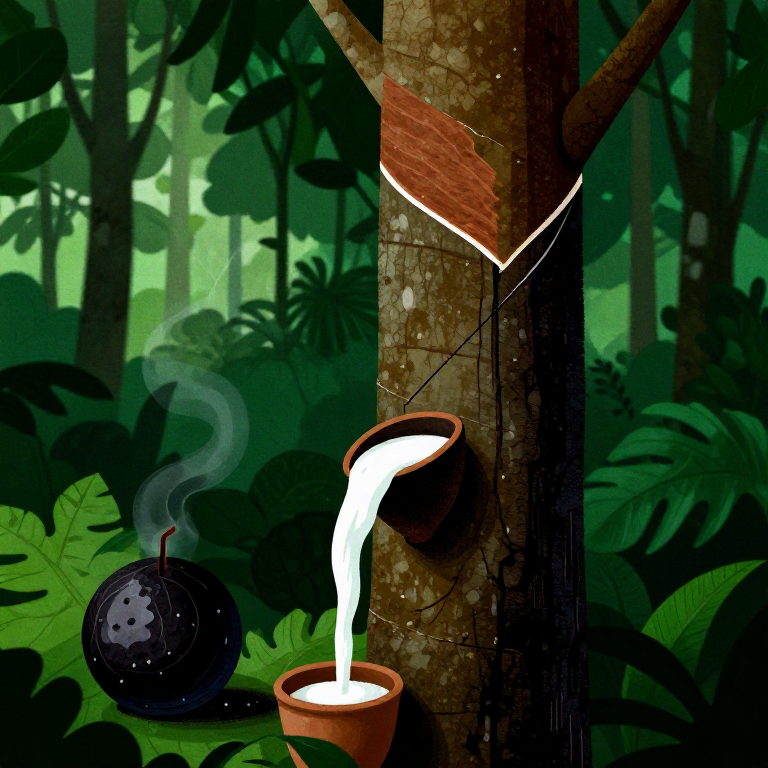
The rubber tree (Hevea brasiliensis) is a tree of the Euphorbiaceae family, native to the Amazon basin. It reaches 25-30 meters in height, with a straight trunk 30-60 cm in diameter and a broad crown. The bark is smooth, grayish, with leaf scar marks. The leaves are compound trifoliate (three leaflets) with smooth margins, arranged alternately. The tree produces capsular fruits with three seeds that explode when ripe, launching seeds several meters — hence the family name (Euphorbiaceae, from the Greek euphorbia). Latex is produced in laticifer vessels located in the inner bark (secondary phloem). Fresh latex is a milky white emulsion containing 30-40% rubber particles (cis-1,4-polyisoprene) suspended in water, along with proteins, sugars, minerals, and lipids.
Understanding the history of the rubber cycle
Understanding the history of the rubber cycle
The first rubber cycle (1879-1912) transformed the Brazilian Amazon. Global demand for rubber for bicycle and automobile tires attracted thousands of rubber tappers, mainly Northeasterners fleeing droughts. Manaus became one of the richest cities in the world — the Amazonas Theatre (1896) was built with materials imported from Europe. Brazil held the worldwide monopoly on rubber until 1876, when Henry Wickham smuggled 70,000 Hevea seeds to the Kew Botanical Garden in England. The seedlings were sent to Ceylon (Sri Lanka) and Malaysia, where organized plantations surpassed Amazonian extractive production. By 1913 Asian plantation rubber already dominated the world market, and the Amazonian cycle collapsed. Today, Thailand and Indonesia are the largest world producers. In Brazil, rubber tappers like Chico Mendes (1944-1988) fought for the creation of Extractive Reserves to preserve the traditional way of life and the forest.
Identifying rubber trees in the forest
Identifying rubber trees in the forest
필요한 도구:
 Machete (facão)
Prepare the tapping knife and equipment
Prepare the tapping knife and equipment
이 단계의 재료:
 Latex Collection Cup (tigela 300ml)20 개
 Metal Spout (bica/calha)20 개
 Fixing Wire5 미터
필요한 도구:
 Rubber Tapping Knife (faca de seringa)
 Sharpening Stone (pedra de amolar)
 Kerosene Headlamp
Walk the rubber trail at dawn
Walk the rubber trail at dawn
필요한 도구:
Kerosene HeadlampRubber Tapping Knife (faca de seringa)Make the tapping cut in the bark
Make the tapping cut in the bark
필요한 도구:
Rubber Tapping Knife (faca de seringa)Install the spout and collection cup
Install the spout and collection cup
이 단계의 재료:
Latex Collection Cup (tigela 300ml)1 개Metal Spout (bica/calha)1 개필요한 도구:
 Wire Cup Holder
Collect the latex from the cups
Collect the latex from the cups
필요한 도구:
 Latex Collection Bucket (balde 20L)
Strain the latex
Strain the latex
필요한 도구:
 Stainless Steel Strainer (40-60 mesh)
 Clean Cotton Cloth (for filtering)
Prepare the fire for smoking
Prepare the fire for smoking
Smoking (traditional smoking) is the historical method used by rubber tappers to coagulate and preserve latex. Build a small fire on the ground or in a clay oven (smoker), using fruits and oleaginous seeds from the forest that produce dense white smoke. Traditionally babassu coconuts (Attalea speciosa), tucumã pits (Astrocaryum aculeatum), or Brazil nut pods (Bertholletia excelsa) are used. These oleaginous seeds produce smoke rich in acetic acid, formaldehyde, and phenolic compounds that coagulate the latex and function as antifungal and antibacterial agents, preserving the rubber. Avoid resinous wood (pine) that gives dark color and undesirable odor. The smoke should be dense and white — clear and hot smoke indicates excessive combustion. The smoker should have a directed upper opening where the rubber tapper positions the stick with the forming rubber ball.
이 단계의 재료:
 Babassu Palm Nuts5 kilogram
필요한 도구:
 Clay Smokehouse
 Fire Starter
Smoke the latex to form a rubber ball
Smoke the latex to form a rubber ball
이 단계의 재료:
 Fresh Filtered Latex5 리터
필요한 도구:
 Wooden Smoking Paddle (pau de defumação, 1.2m)
 LadleClay Smokehouse
Remove the ball from the spit and inspect
Remove the ball from the spit and inspect
When the ball reaches the desired size (typically 20-60 kg), cut it along the spit with a sharp knife to remove it. The ball should be uniform in color (dark amber to brown), elastic to the touch, with no pockets of raw latex inside. Cut a thin slice to inspect: the interior should be homogeneous, with no white layers (uncoagulated latex) or air bubbles. Good quality smoked rubber (fine rubber) is translucent when cut into thin slices against the light. Rubber with raw layers or contamination is classified as 'sernambi' — inferior quality. The traditional classification ranges from 'fine' (best) to 'entrefine' and 'sernambi' (worst). Well-smoked fine rubber can be stored for months without degradation thanks to the antifungal properties of smoke.
필요한 도구:
 Knife
KnifeCare for the health of rubber trees
Care for the health of rubber trees
Store and transport rubber
Store and transport rubber
Smoked rubber balls must be stored in a dry, covered location with good ventilation, away from direct sunlight. Smoked rubber is hygroscopic — it absorbs moisture in humid environments, which favors fungal growth on the surface. In Amazonian tradition, the balls were transported by canoe through rivers and streams to the rubber tappers' warehouses (patrons), where they were weighed and exchanged for supplies in the aviamento system — a debt system that tied the rubber tapper to the land. The balls were then sent downriver to Belém or Manaus for export. Today, Amazonian natural rubber is valued by programs such as the 'Native Rubber Seal' of the Chico Mendes Extractive Reserve. Native rubber from the Amazon, although representing a small fraction of world production, has invaluable cultural and environmental value — each smoked rubber ball represents the preservation of the standing forest and the ancestral knowledge of rubber tappers.
필요한 도구:
 Weighing Scale
 Covered Storage Area
재료
5- 플레이스홀더
- 21 개플레이스홀더
- 5 미터플레이스홀더
- 5 kilogram플레이스홀더
- 플레이스홀더
필요 도구
15- 플레이스홀더
- 플레이스홀더
- 플레이스홀더
- 플레이스홀더
- 플레이스홀더
- 플레이스홀더
- 플레이스홀더
- 플레이스홀더
- 플레이스홀더
- 플레이스홀더
- 플레이스홀더
CC0 퍼블릭 도메인
이 블루프린트는 CC0로 공개되었습니다. 어떤 목적으로든 자유롭게 복사, 수정, 배포 및 사용할 수 있습니다.
제품 구매를 통해 메이커를 지원하세요. 판매자가 설정한 메이커 커미션 을 받거나, 이 블루프린트의 새로운 반복을 만들어 연결로 포함시킬 수 있습니다.