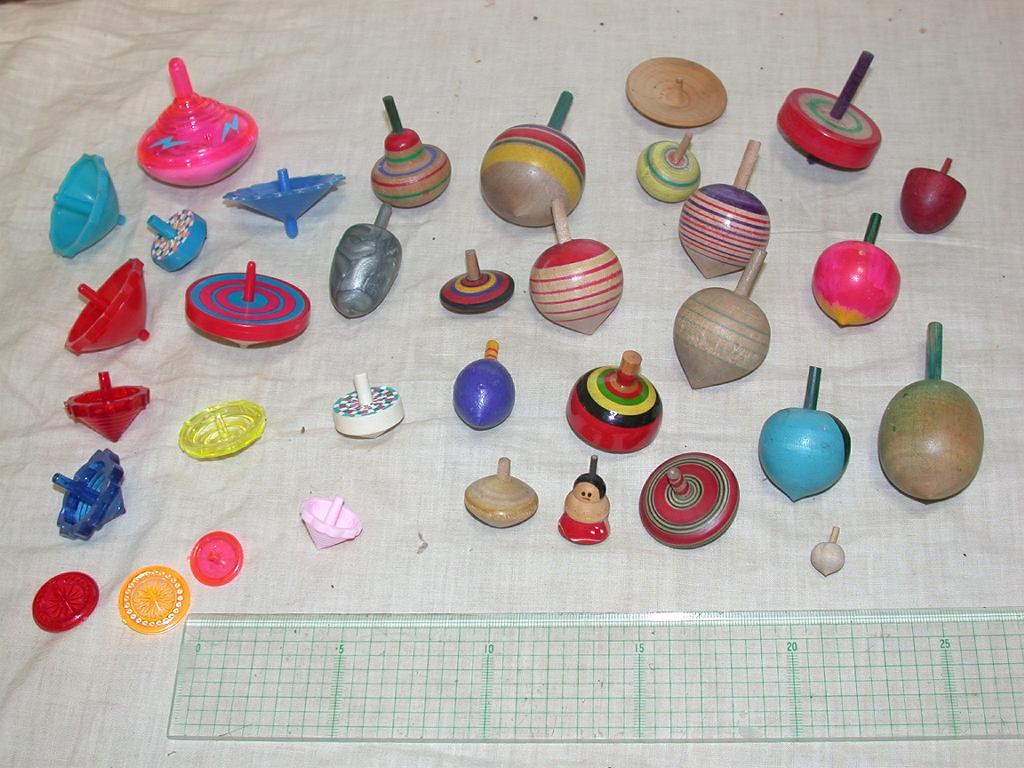


Spinning Top
A spinning top stands up because it is spinning. Stop it and it falls over immediately — the same object, the same balance point, but no longer stable. That is genuinely strange, and it is the reason tops are one of the oldest toys known: they behave in a way that looks like a violation of ordinary experience.
Tops turn up in archaeological contexts across the world, in clay, wood, bone and stone. Like the buzzer, this is an object humans invent independently wherever they have something round and a way to make it turn.
Three things decide whether yours spins for two seconds or two minutes: the tip must be small and hard, the mass should sit low and out at the rim, and the whole thing must be balanced about the axis. Get those right and the physics does the rest.
안내
Cut a blank with the grain along the axis
Cut a blank with the grain along the axis
Cut a hardwood blank 60 mm square by 70 mm long, with the grain running along the future spin axis. Cross-grain at the tip splinters away in minutes.
이 단계의 재료:
 Hardwood Block1 개
필요한 도구:
 Hand Saw
Find and mark both centres
Find and mark both centres
Mark the exact centre of both end faces by drawing the diagonals. Everything from here is measured from that axis, and an error here can never be corrected.
필요한 도구:
 Compass
Turn or carve to a disc with a stem
Turn or carve to a disc with a stem
Shape the blank into a wide flat disc about 55 mm across with a short stem above it. Keep the disc thin — you want the mass out at the rim, not gathered at the middle.
필요한 도구:
 Chisel Set (Wood)
Keep the mass low
Keep the mass low
Put the disc in the lower third of the height. A low centre of mass is far more stable — a top with the weight high tips over as soon as it slows.
Shape the tip to a small dome
Shape the tip to a small dome
Round the point into a small hard dome, roughly 2 to 3 mm across — not a needle. A needle digs in and stops; a dome rolls on a tiny contact patch with very little friction.
필요한 도구:
 Needle File Set
Fit a hard tip
Fit a hard tip
Drill the point and glue in a steel ball bearing or brass pin. Wood on wood wears within a few dozen spins and the top starts wandering.
이 단계의 재료:
 Ball Bearing1 개
Sand progressively
Sand progressively
Sand through 120, 220 then 400 grit, keeping the shape symmetrical. Sanding harder on one side is the commonest way a good blank becomes an unbalanced top.
이 단계의 재료:
 Sandpaper (120 Grit)1 장Sandpaper (220 Grit)1 장Sandpaper (400 Grit)1 장
Test the balance by spinning
Test the balance by spinning
Spin it and watch the rim. A balanced top's rim stays in one plane; an unbalanced one shows a visible wobble. Sand a little off the heavy side and test again.
Oil the surface
Oil the surface
Wipe on linseed oil and wipe off the surplus. Oil seals the wood against the moisture in fingers, which would otherwise swell one side and unbalance it.
이 단계의 재료:
 Linseed Oil (Boiled)50 ml
Time it on different surfaces
Time it on different surfaces
Time the spin on glass, on wood and on cloth. Record all three. Glass wins by a wide margin, and the gap is a direct measurement of friction at the tip.
Watch it precess before it falls
Watch it precess before it falls
As it slows, the axis starts sweeping a slow cone rather than falling straight over. That is precession. Note how long the top survives after precession begins — it is often most of the total spin time.
History & Context
History & Context
Why a spinning top does not fall. Gravity pulls the tilted top down, which should topple it. Because it is spinning, that pull does not produce a fall — it produces a sideways swing of the axis instead. The top's angular momentum redirects the toppling force through 90°, so rather than falling the axis slowly circles. This is precession, and it is the same effect that keeps a bicycle upright and makes a gyroscope useful for navigation.
Why the tip matters most. Nearly all the energy loss is friction at the contact point, and friction there also applies a torque that drags the axis down. A small hard dome minimises both. This is why competitive spinning tops use hardened steel or ceramic tips and why step 6 is worth the trouble.
Mass at the rim, low down. Two separate requirements that are easy to confuse. Mass at the rim increases the moment of inertia, so the top stores more rotational energy and spins longer. Mass held low lowers the centre of gravity, so it is more stable against tipping. A wide thin disc sitting low satisfies both, which is why nearly every traditional top converges on that shape.
Found everywhere. Tops appear in archaeological contexts across the world in clay, wood, bone and stone, and are recorded in cultures with no contact with one another. Like the buzzer whirligig, this is an object that gets invented repeatedly — the ingredients are a symmetrical object and a way to twist it.
From toy to instrument. The physics that makes a top charming makes gyroscopes work. A spinning mass resists changes to its axis, which is exactly what you need to hold a stable reference in a moving vehicle. Ships, aircraft and spacecraft navigated for decades on the principle you can hold in your hand here.
재료
6- 플레이스홀더
- 부터₩17
- 플레이스홀더
- 플레이스홀더
- 플레이스홀더
- 50 ml플레이스홀더
CC0 퍼블릭 도메인
이 블루프린트는 CC0로 공개되었습니다. 어떤 목적으로든 자유롭게 복사, 수정, 배포 및 사용할 수 있습니다.
제품 구매를 통해 메이커를 지원하세요. 판매자가 설정한 메이커 커미션 을 받거나, 이 블루프린트의 새로운 반복을 만들어 연결로 포함시킬 수 있습니다.