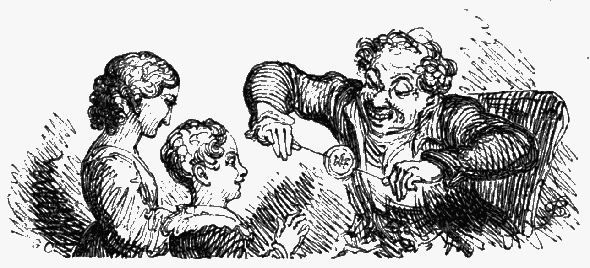


Thaumatrope
A disc of card with a bird on one side and an empty cage on the other, hung on two twisted strings. Spin it and the bird is inside the cage. Nothing has moved; the two pictures simply arrive at your eye faster than your visual system resolves them apart.
The thaumatrope reached London toy shops in 1825 and became the first of the optical toys that ended, eighty years later, in cinema. It is also the cheapest possible piece of apparatus for measuring something real: the rate at which two alternating images stop being two.
Build it, then find your own fusion threshold by slowing the spin until the bird leaves the cage.
안내
Cut two discs 60 mm across
Cut two discs 60 mm across
Cut two 60 mm discs from heavy card. Two discs glued back to back are stiffer than one and stop the drawings showing through.
이 단계의 재료:
 카드지1 장
필요한 도구:
 공예용 칼
공예용 칼 자가 복원 커팅 매트
Mark the string axis on both discs
Mark the string axis on both discs
Draw a line across the centre of each disc and mark it at both edges. The strings go on this line, and the disc will spin about it.
필요한 도구:
 자
자Draw the cage on the first disc
Draw the cage on the first disc
Draw an empty birdcage centred on the first disc, in strong dark lines. Thin pencil work disappears at speed; the effect wants high contrast.
Draw the bird upside down on the second disc
Draw the bird upside down on the second disc
Draw the bird on the second disc inverted relative to the cage. The disc flips end over end about the string axis, so an upright drawing on the back face would appear upside down when the two fuse.
Check the alignment before gluing
Check the alignment before gluing
Hold both discs to a window with the axis marks lined up and check the bird lands inside the cage. Adjust now — after gluing there is nothing to be done.
Glue the discs back to back
Glue the discs back to back
Glue the two discs together with the axis marks aligned and the drawings facing outward. Press flat under a book until dry; a warped disc wobbles instead of spinning.
이 단계의 재료:
 PVA 목공용 접착제2 ml
Punch two holes on the axis
Punch two holes on the axis
Punch a small hole at each end of the axis line, 3 mm in from the edge. Symmetry matters — an off-centre hole makes the disc spin unevenly and the images will not register.
Thread a loop of string through each hole
Thread a loop of string through each hole
Thread a 150 mm loop of cotton thread through each hole and knot it. The 1825 version used sewing silk for exactly this job.
이 단계의 재료:
 무명실1 미터
Wind and release
Wind and release
Hold a loop in each hand, twirl the disc to twist both strings, then pull the loops apart. The disc spins as the twist unwinds and the bird appears in the cage.
Count the spin rate
Count the spin rate
Film the disc on a phone at a known frame rate, or count turns against a stopwatch while a partner times ten seconds. Write down the turns per second at which the image looks solid.
필요한 도구:
 스톱워치
스톱워치Slow it down until the bird escapes
Slow it down until the bird escapes
Let the spin decay and note the rate at which the two pictures separate again. Each face is shown once per turn, so two faces per turn puts your threshold in alternations per second — typically somewhere in the region of ten per second, and it is worth comparing between people.
Change one variable at a time
Change one variable at a time
Repeat in dim light, then with a low-contrast drawing. Brightness and contrast both move the threshold, which tells you the effect is a property of the visual system and not of the card.
History & Context
History & Context
1825, and a disputed inventor. The thaumatrope — Greek for 'wonder-turner' — was published in London in April 1825 by the physician John Ayrton Paris with the publisher W. Phillips, and Paris is usually credited with it. The attribution is not secure. Charles Babbage recalled in 1864 that the real inventor was the geologist William Henry Fitton, and gave a chain of events: the astronomer John Herschel asked Babbage how to see both faces of a shilling at once, then demonstrated the answer by spinning the coin on a table; Babbage repeated the story to Fitton, who days later produced a card disc suspended between two threads. The blueprint you have just built is Fitton's object, whoever's name ended up on the toy.
What it was sold as. Paris presented it as a demonstration of persistence of vision — the idea that an impression lingers in the eye for roughly an eighth of a second after the light stops. That is the explanation printed on nineteenth-century thaumatrope packaging and repeated in most histories of cinema.
Where that explanation stands now. Persistence of vision is a real retinal effect, but it is not a sufficient account of how alternating or moving images fuse. Modern vision science treats flicker fusion and apparent motion as separate mechanisms involving processing beyond the retina, and the old 'lingering image' story is specifically disputed as the cause of motion in film. The thaumatrope still works exactly as it always did; the textbook explanation attached to it for a century is the part that has been revised.
What came after. The phenakistiscope and zoetrope of the early 1830s added a sequence of images and a shutter, turning two alternating pictures into apparent movement. The thaumatrope is the first step of that line and the only one simple enough to make in half an hour.
이 블루프린트로 만드는 것
CC0 퍼블릭 도메인
이 블루프린트는 CC0로 공개되었습니다. 어떤 목적으로든 자유롭게 복사, 수정, 배포 및 사용할 수 있습니다.
제품 구매를 통해 메이커를 지원하세요. 판매자가 설정한 메이커 커미션 을 받거나, 이 블루프린트의 새로운 반복을 만들어 연결로 포함시킬 수 있습니다.