예술
뷰티 및 웰니스
공예
문화 및 역사
엔터테인먼트
환경
음식 및 음료
역공학
과학
스포츠
기술
웨어러블



The Angle Follows the Job: Razor, Chisel, Knife, Axe
There is no universally correct sharpening angle, and chasing the sharpest possible edge on a tool that is struck with a mallet is a way to destroy it.
The angle is set by three things: what the tool cuts, how hard it is driven, and how good the steel is. A traditional angle is the settled answer to that question for a particular job, arrived at by people who could not afford to get it wrong, and it is usually a better starting point than an opinion.
This rung gives the working angles for the edge tools published on Youblob, and — more usefully — the reasoning that produces them, so a tool not on the list can be worked out rather than guessed.
중급
2 hours
안내
1
1
Three questions decide the angle
Three questions decide the angle
What does it cut? Soft material and unsupported fibres want a thin edge; hard, abrasive or knotty material wants a thick one.
How is it driven? Hand pressure permits a thin edge. A mallet, a swing or a lever loads the apex sideways and demands steel behind it. This is the question people skip, and it is the one that breaks edges.
How good is the steel? Harder and finer-grained steel holds a thinner edge. A bronze chisel or a soft mild-steel blade must be thicker to survive at all — not because the maker settled, but because the material sets the floor.
필요한 도구:
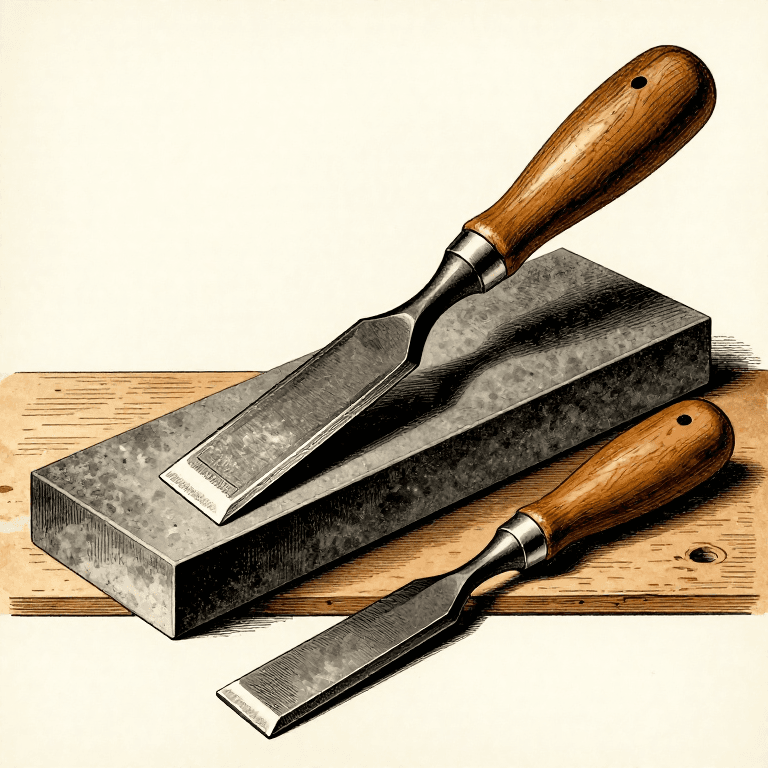
 끌 세트 - 베벨 에지
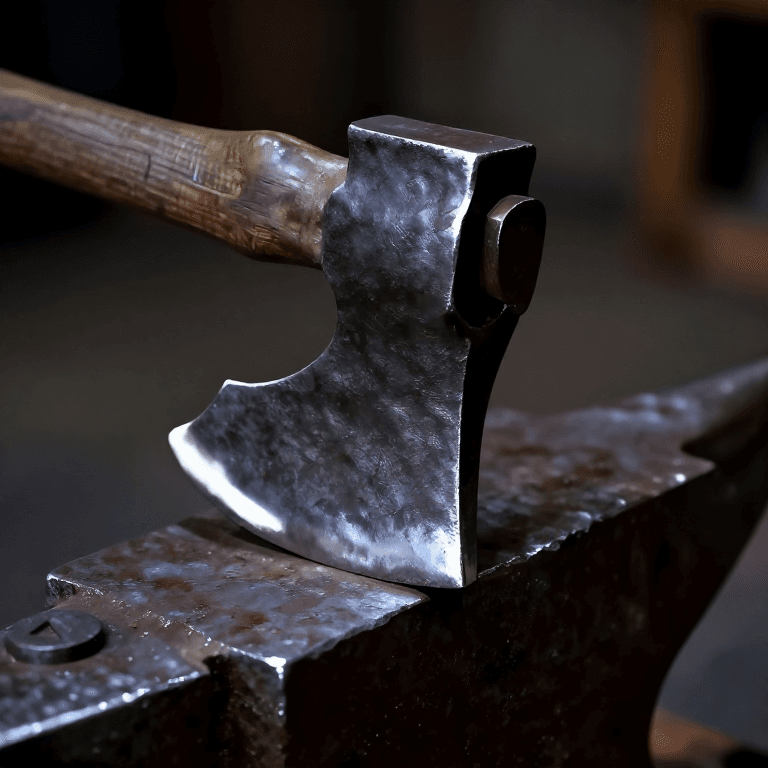
 도끼
도끼 부엌칼
부엌칼2
2
Measure the angle you actually have
Measure the angle you actually have
Set the blade bevel-down on a flat surface with a known stack under the spine and the angle follows from the geometry: sin(angle) = stack height / blade projection. A honing guide converts that directly into a projection setting.
Do this before changing anything. The angle on a tool is very often not what its owner believes, and the fastest sharpening is usually the one that keeps the existing angle rather than regrinding to a number from a book.
Write the measured projection on the tool handle in marker. Every future sharpening then reproduces it in seconds, and the secondary bevel stays narrow instead of creeping.
필요한 도구:
 연마 가이드
 유성 매직
유성 매직 계산기
계산기3
3
The working angles, and the projection to set for each
The working angles, and the projection to set for each
Jupyter 노트북 불러오는 중…
필요한 도구:
연마 가이드계산기4
4
When the edge tells you the angle is wrong
When the edge tells you the angle is wrong
Read the failure and it names the fix. Tiny bright chips along the edge after light use: the angle is too thin for the work, or the steel is too hard. Go two or three degrees blunter on the secondary bevel and try again.
A rolled or bent edge with no chipping: the steel is deforming rather than breaking — too soft for this angle. Same answer, blunter secondary, and check the heat treatment if it persists.
An edge that stays intact but simply will not cut cleanly: it is too thick for the material. Go thinner, a couple of degrees at a time. Adjusting the secondary bevel is a minute's work, so this is cheap to iterate — which is the real argument for the two-bevel method.
필요한 도구:
 확대 루페연마 가이드
 숫돌
숫돌 마른 침엽수 판재
관련 블루프린트
이 블루프린트들은 지식을 공유합니다 — 기술, 재료 또는 원리
CC0 퍼블릭 도메인
이 블루프린트는 CC0로 공개되었습니다. 어떤 목적으로든 자유롭게 복사, 수정, 배포 및 사용할 수 있습니다.
제품 구매를 통해 메이커를 지원하세요. 판매자가 설정한 메이커 커미션 을 받거나, 이 블루프린트의 새로운 반복을 만들어 연결로 포함시킬 수 있습니다.