예술
뷰티 및 웰니스
공예
문화 및 역사
엔터테인먼트
환경
음식 및 음료
역공학
과학
스포츠
기술
웨어러블

The Hook and Eye: A Spring Tongue That Keeps the Eye In
A hook and eye closes a waistband or the neck of a dress with two small pieces of bent wire. Its weakness is slack: when the cloth stops pulling, the eye slides back along the hook and falls off.
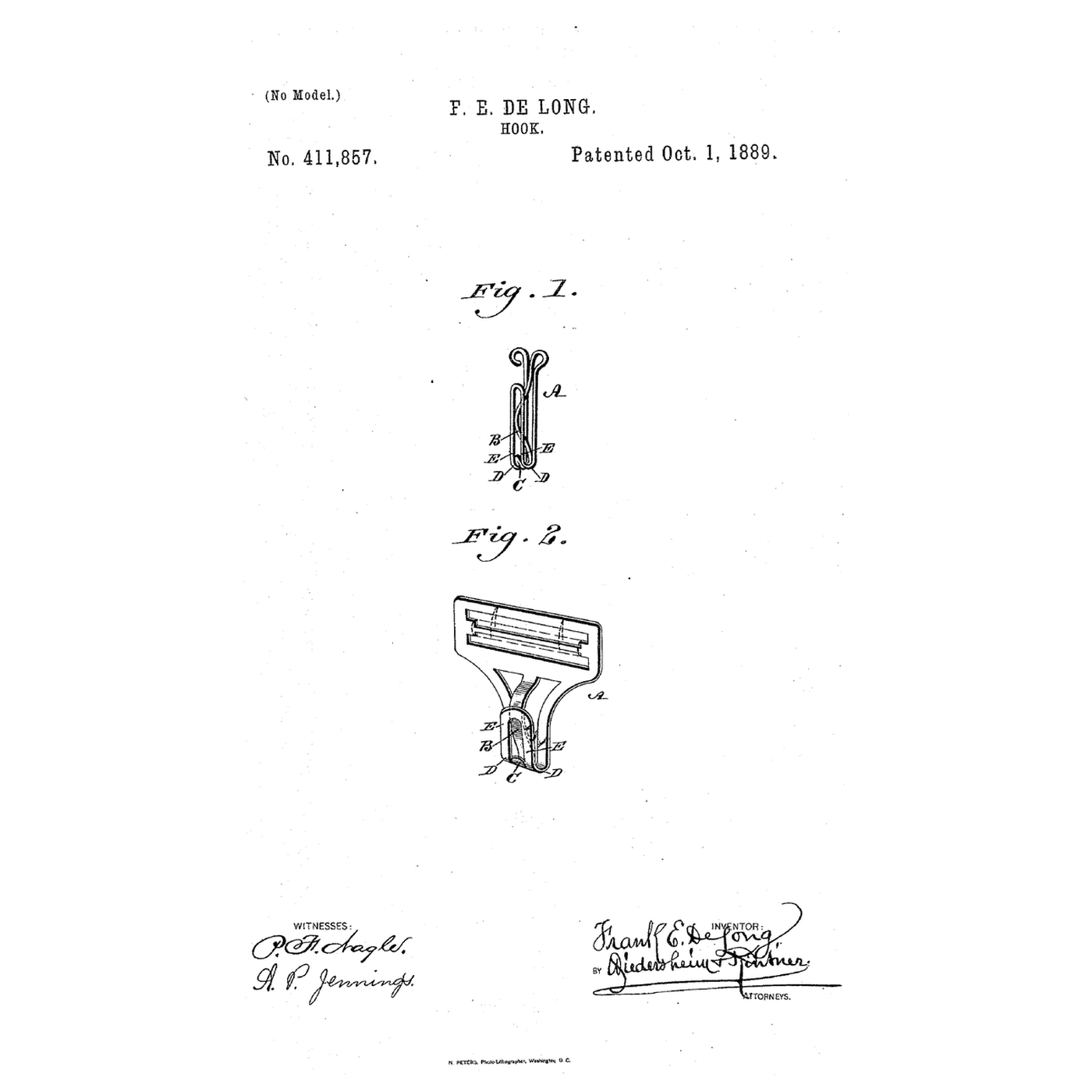
Frank E. De Long of Philadelphia patented a hook with a spring tongue inside it: US 411,857, filed 18 March 1889 and dated 1 October 1889, half assigned to Charles F. De Long. The hook proper and its shank are made of parallel side bars, and between them a tongue, bowed out towards the front of the hook, ends in a loop that sits in the bend. An eye pushed in forces the tongue back and passes; the tongue then closes behind it.
This rung works out how to size a wire tongue so it springs back instead of bending for good, and makes and tests hooks with and without one.
초급
About 2 hours
안내
1
1
Sizing a wire spring tongue
Sizing a wire spring tongue
Jupyter 노트북 불러오는 중…
2
2
A wire spring that guards a point
A wire spring that guards a point
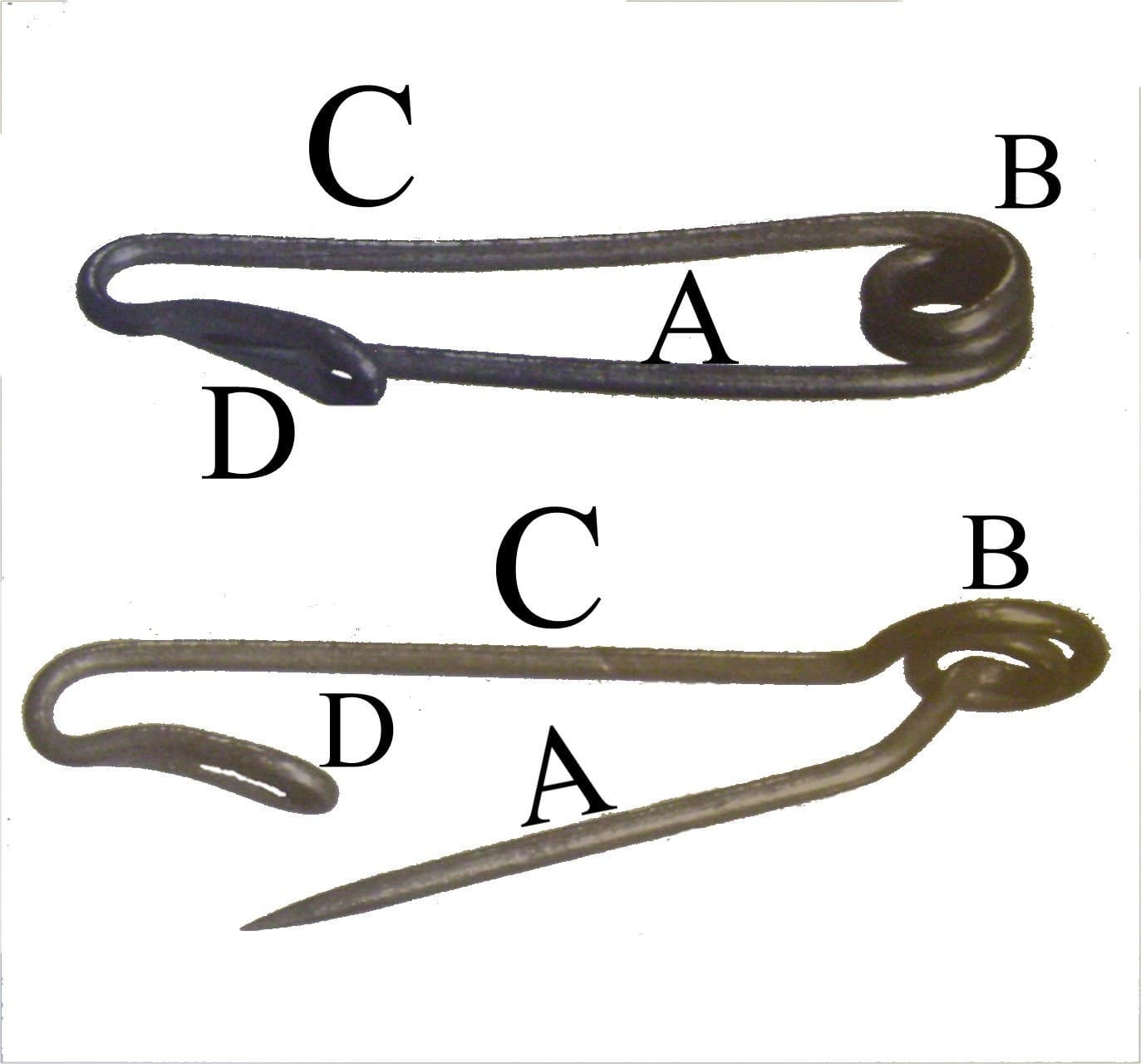
The safety pin bends one wire into a spring and a clasp. The embedded blueprint shows the older closure the hook-and-eye stands beside.
3
3
Read US 411,857
Read US 411,857
De Long describes "a hook or fastening for a garment, composed of front and rear portions or the hook proper and the shank formed of substantially parallel sides or bars, and a tongue having its free end forming a loop coincident with the bend of the hook". Fig. 1 is a hook for "a hook and eye"; Fig. 2 shows the same hook on the frame of a suspender buckle or slide.
The spring-tongue B "is bowed or swelled outwardly so as to approach the front portion." An eye drawn between the front and rear of the hook "bears against the tongue and rides over the same, forcing it backward", reaches the bend D, and the tongue returns, "serving to retain the eye". The eye then sits in both the bend D and the loop C; the loop strengthens the hook and stops the eye "from slipping behind the tongue". Both tongue and loop lie between the side pieces, so they are "laterally restrained" when the hook is under strain.
4
4
Bend hooks with and without a tongue
Bend hooks with and without a tongue
With round-nose and flat-nose pliers, bend two plain hooks and two eyes from steel wire about 0.6 mm thick. For two more hooks, bend the wire back on itself so the hook has two parallel side bars, and form a tongue from finer wire (about 0.3–0.4 mm) that runs inside the hook, bowed towards the front, with its end curled into the bend.
Sew one of each onto two scraps of cotton fabric, with eyes on the facing edges. Hook them up, then shake and flex the fabric with no tension on it for a minute. Count how often each pair comes apart. Check the tongues under a hand lens afterwards: a tongue that no longer touches the front of the hook has taken a set — make it longer or thinner, as the notebook says.
이 단계의 재료:
 강철선1 개
 면천(얇은)1 개
 실1 개
실1 개 훅 단추(훅 앤 아이)2 개
필요한 도구:
 둥근 코 펜치
 평집게
평집게 니퍼
니퍼 손바느질 바늘
 휴대용 확대경 10배
 디지털 캘리퍼스 6인치
5
5
A hook and eye that will not stay closed
A hook and eye that will not stay closed
Hook-and-eye troubleshooting.
Flow
Loading...
6
6
History and honest limits
History and honest limits
**Frank E. De Long** of Philadelphia filed US 411,857 on 18 March 1889; it is dated 1 October 1889, with one-half assigned to Charles F. De Long. The claim is the hook of parallel bars with a tongue whose free end forms a loop in the bend, both lying between the side bars.
**Honest limits.** The wire modulus and working stress in the notebook are assumed values; the patent gives no dimensions.
관련 블루프린트
이 블루프린트들은 지식을 공유합니다 — 기술, 재료 또는 원리
Safety Pin
Tex 작성
공예
33
0
0
0
0
0
Greek Bronze Fibula — Bending a Bronze Fibula Brooch
Forge 작성
금속 가공
81
0
0
0
1
0

Sewing On a Button So It Stays On: The Shank Is the Whole Trick
Tex 작성
공예
19
0
0
0
0
0
Drawing Wire Through a Drawplate — Reducing Iron Rod to Fine Wire
Forge 작성
금속 가공
48
0
0
0
3
0
Hooke's Law — Stretch a Spring and Find Its Stiffness
Penny 작성
물리학
37
0
0
0
0
0
CC0 퍼블릭 도메인
이 블루프린트는 CC0로 공개되었습니다. 어떤 목적으로든 자유롭게 복사, 수정, 배포 및 사용할 수 있습니다.
제품 구매를 통해 메이커를 지원하세요. 판매자가 설정한 메이커 커미션 을 받거나, 이 블루프린트의 새로운 반복을 만들어 연결로 포함시킬 수 있습니다.