예술
뷰티 및 웰니스
공예
문화 및 역사
엔터테인먼트
환경
음식 및 음료
역공학
과학
스포츠
기술
웨어러블
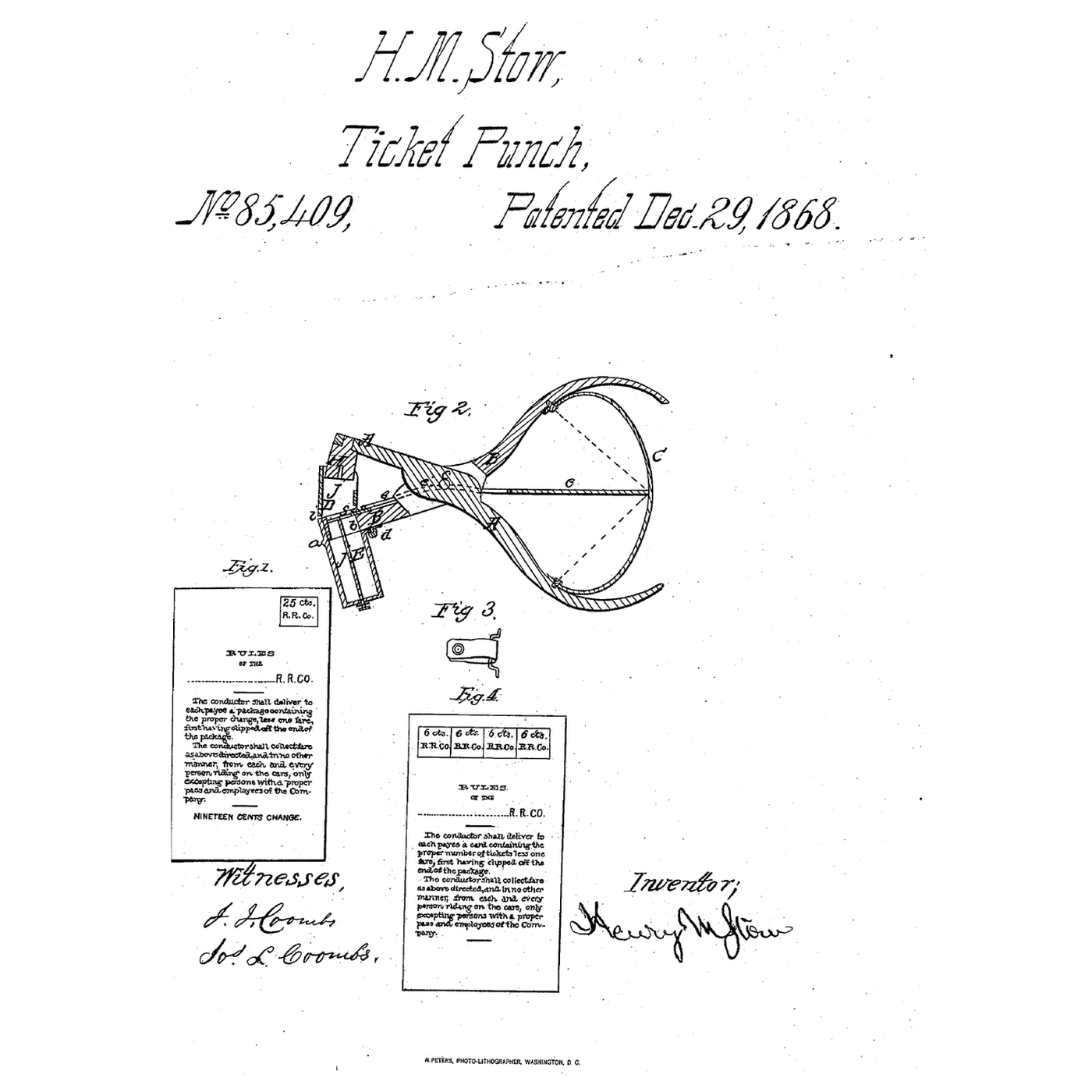


The Pouch-Ticket Coupon Punch: Change in the Ticket, the Coupon in a Locked Box
Street-railway conductors made change from their own pockets, and a company could not tell what a dishonest one kept.
Henry M. Stow of San Francisco received US 85,409, dated 29 December 1868, for pouch coupon tickets and a punch for cutting coupons from them: "Each ticket is printed on one side of a small paper pouch" holding the right change for one of the common coins, "less one fare", with the amount paid on a coupon; the instrument "severs the coupon from the ticket, and deposits it (the coupon) in a locked box attached to the instrument, from which it cannot be removed without unlocking the box."
This rung checks that the coupons always balance the cash, then makes pouch tickets and a boxed cutter and runs a day of fares with card tokens.
초급
About 2 hours
안내
1
1
Coupons against cash
Coupons against cash
Jupyter 노트북 불러오는 중…
2
2
An account that cannot be altered
An account that cannot be altered
The embedded blueprint keeps an account both parties can check. Stow's locked-in coupons do the same for the conductor and the company.
3
3
Read US 85,409
Read US 85,409
"One of the great difficulties which street-railroad companies have hitherto had to contend with is the dishonesty of conductors in failing to account faithfully for the fares collected by them on their routes. My invention is intended to obviate this difficulty, as well as greatly to facilitate the making of change by the conductors."
"It is manifest that it will be impossible for the conductor to appropriate any money to his own use without detection, except by receiving fare and giving no ticket therefor, and this could not be practiced to any considerable extent without detection."
4
4
Make pouch tickets and run a day of fares
Make pouch tickets and run a day of fares
**Tokens.** Cut card tokens and mark them 1, 5, 10, 25 and 50 as "cents".
**Pouches.** Fold small pouches from card stock, one per ticket. Draw a coupon on one corner of each and write the amount paid on it: 10, 25 or 50. Put the change inside with a fare of 6: 4, 19 or 44 in tokens. Make some blank tickets with a 6 coupon and no change.
**Box.** Make a plywood box with a slot in the top and a lid held by one wood screw.
**Run.** A "conductor" sells tickets to passengers paying in tokens, cuts each coupon off with scissors over the slot so it drops into the box, and keeps the cash.
**Account.** Unscrew the box, add up the coupons, and count the conductor's cash. They must match, as the notebook shows. Then let the conductor "forget" one ticket and see the gap appear.
이 단계의 재료:
 카드지3 개
 합판1 개
합판1 개 나사못1 개
 목공용 접착제5 ml
필요한 도구:
 가위
가위 공예용 칼
공예용 칼 실톱(코핑 소)
 드라이버 세트
 자
자 연필
연필5
5
An account that does not balance
An account that does not balance
Pouch-ticket account troubleshooting.
Flow
Loading...
6
6
History and honest limits
History and honest limits
**Henry M. Stow** of San Francisco received US 85,409, dated 29 December 1868. He intended the system for city railways but also for other conveyances and toll roads; tickets issued by the company rather than the conductor were to differ in colour or otherwise, and his instrument's box carried a detective-lock.
**Honest limits.** Card pouches, card tokens, scissors and a screwed box stand in for his printed pouches, coins, punch and locked box. The notebook uses Stow's own 6-cent fare and change figures; the day's mix of tickets is an example. Your balanced account is the result.
관련 블루프린트
이 블루프린트들은 지식을 공유합니다 — 기술, 재료 또는 원리


CC0 퍼블릭 도메인
이 블루프린트는 CC0로 공개되었습니다. 어떤 목적으로든 자유롭게 복사, 수정, 배포 및 사용할 수 있습니다.
제품 구매를 통해 메이커를 지원하세요. 판매자가 설정한 메이커 커미션 을 받거나, 이 블루프린트의 새로운 반복을 만들어 연결로 포함시킬 수 있습니다.