협업
예술
뷰티 및 웰니스
공예
문화 및 역사
엔터테인먼트
환경
음식 및 음료
역공학
과학
스포츠
기술
웨어러블

The Sad Iron: Keeping the Heat in the Face, Not the Hand
Before electricity, clothes were pressed with solid irons — 'sad' meant heavy — heated on the stove and swapped as they cooled. They burned the hand through a hot handle, sent heat up into the ironer's face, and cooled fastest at the point.
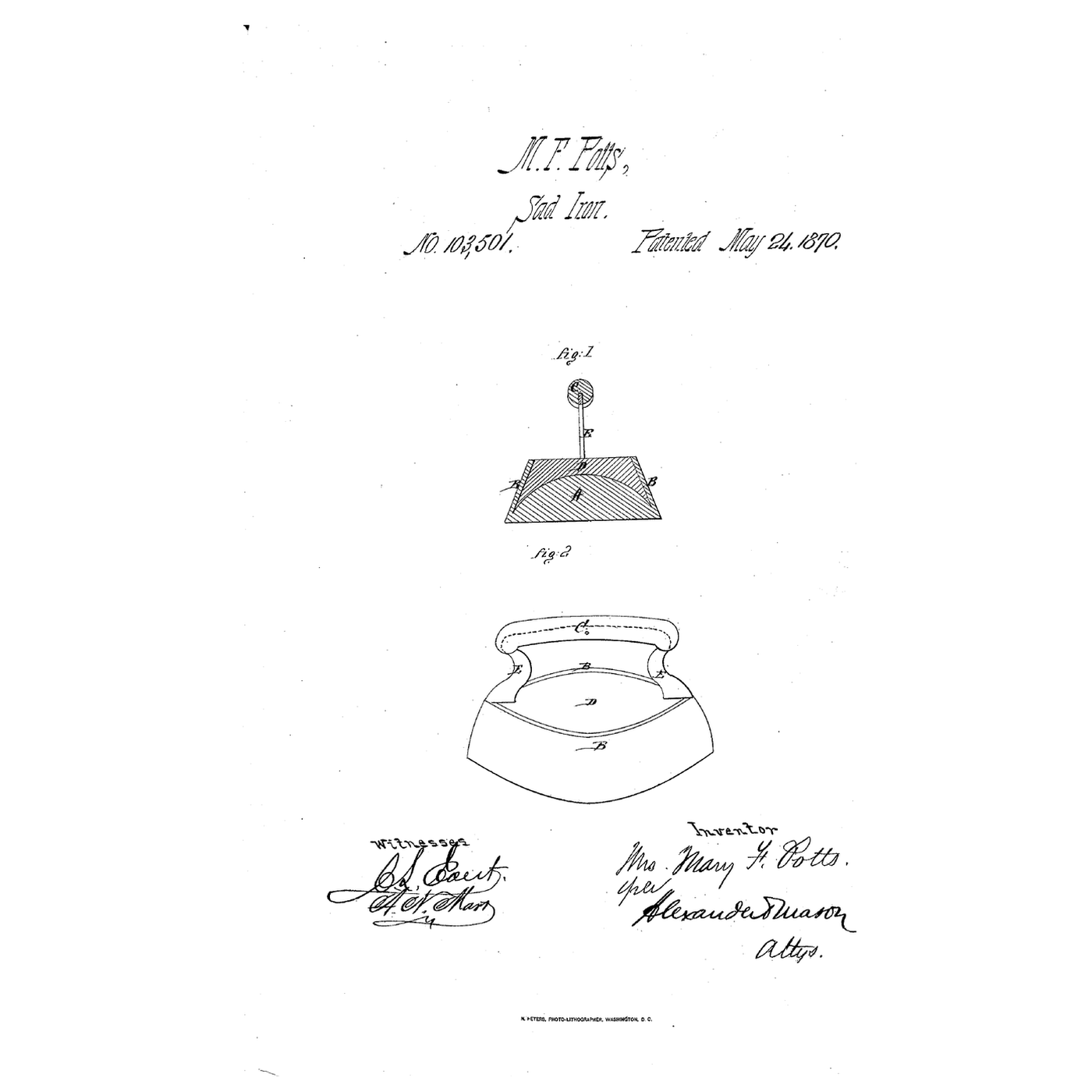
Mary Florence Potts of Ottumwa, Iowa, patented two answers. US 103,501, dated 24 May 1870, makes the iron a metal shell filled on top and sides with a non-conductor such as plaster of Paris, pointed at both ends, with a wooden handle covering the metal one. US 113,448, dated 4 April 1871, adds a detachable semicircular handle that clips onto any of several hot irons, so the user keeps one cool handle and the wrist stays in line "as a person pushes a plane".
This rung models the stored heat and where it leaks, and tests an insulated block against a bare one.
초급
About 3 hours
안내
1
1
Stored heat and the insulated top
Stored heat and the insulated top
Jupyter 노트북 불러오는 중…
2
2
Read the two patents
Read the two patents
**US 103,501 (1870):** body A flat below, rounded on top and sides, with two pointed ends; the hollow filled with a non-conductor D "flush with all the sides" that "prevents radiation of heat from every part of said iron except the bottom or face"; a wooden handle C whose ends turn down over the iron uprights E so the hand cannot touch hot metal.
**US 113,448 (1871):** a curved, semicircular handle A on a metal plate B; a latch C whose lip D passes under a cross-bar d cast inside the iron, held by a spring f so it cannot fall out when the iron is turned over; recesses h at each end that stop the handle moving sideways. The iron itself is now hollowed from the middle, with the metal made thicker at the ends, "where most heat is needed".
3
3
The filling she used
The filling she used
Potts filled her irons with plaster of Paris among other non-conductors. The embedded blueprint covers how plaster sets and what it is made of.
4
4
Test an insulated block against a bare one
Test an insulated block against a bare one
Take two identical steel blocks or cast-iron weights of about 1 kg. Leave one bare. On the other, build a 10 mm jacket of plaster of Paris over the top and sides, leaving the base clean, and let it dry for two days.
Heat both in an oven to about 200 °C (check with the infrared thermometer), then set each on a folded damp cotton towel on a board — the 'cloth'. Every two minutes read the base temperature through the towel's edge and the top surface. The insulated block's base stays hot longer and its top stays cool enough to hold near. Use oven gloves throughout.
이 단계의 재료:
 강 봉재2 개
 소석고(플라스터 오브 파리)1 kilogram
 면 거즈1 개
 합판1 개
 물1 리터
필요한 도구:
 적외선 온도계
 스톱워치
 가죽 작업 장갑
 디지털 주방 저울
5
5
Ironing with a stove-heated iron
Ironing with a stove-heated iron
What went wrong with sad irons and why.
Flow
Loading...
6
6
History and honest limits
History and honest limits
**Mary Florence Potts** of Ottumwa, Iowa, was granted **US 103,501** (24 May 1870) and **US 113,448** (4 April 1871). Her detachable-handle irons were made in large numbers and are now common collectors' pieces; the electric iron replaced them in the twentieth century.
**Honest limits.** The heat-transfer coefficients in the notebook are illustrative and the model treats the iron as one uniform temperature. Plaster sheds water when first heated; dry the jacket fully and heat slowly.
관련 블루프린트
이 블루프린트들은 지식을 공유합니다 — 기술, 재료 또는 원리



CC0 퍼블릭 도메인
이 블루프린트는 CC0로 공개되었습니다. 어떤 목적으로든 자유롭게 복사, 수정, 배포 및 사용할 수 있습니다.
제품 구매를 통해 메이커를 지원하세요. 판매자가 설정한 메이커 커미션 을 받거나, 이 블루프린트의 새로운 반복을 만들어 연결로 포함시킬 수 있습니다.