예술
뷰티 및 웰니스
공예
문화 및 역사
엔터테인먼트
환경
음식 및 음료
역공학
과학
스포츠
기술
웨어러블


The Tesla Turbine: Discs, Not Blades, Driven by the Boundary Layer
Nikola Tesla's turbine has no blades at all. A stack of flat discs with narrow gaps between them turns on a shaft; gas or steam enters tangentially at the rim, spirals inward through the gaps, and drags the discs round by viscosity before leaving near the centre. He patented it in 1913 and claimed it could be run as a turbine or, reversed, as a pump.
It never displaced bladed turbines: its practical efficiency was too low. But it is the clearest demonstration there is of the boundary layer — the thin film of fluid that sticks to every surface — and it is a classic maker build from old CDs.
This rung works out the gap the discs need and builds a CD Tesla turbine run on compressed air.
중급
About 5 hours
안내
1
1
Read the patent's rule for the gap
Read the patent's rule for the gap
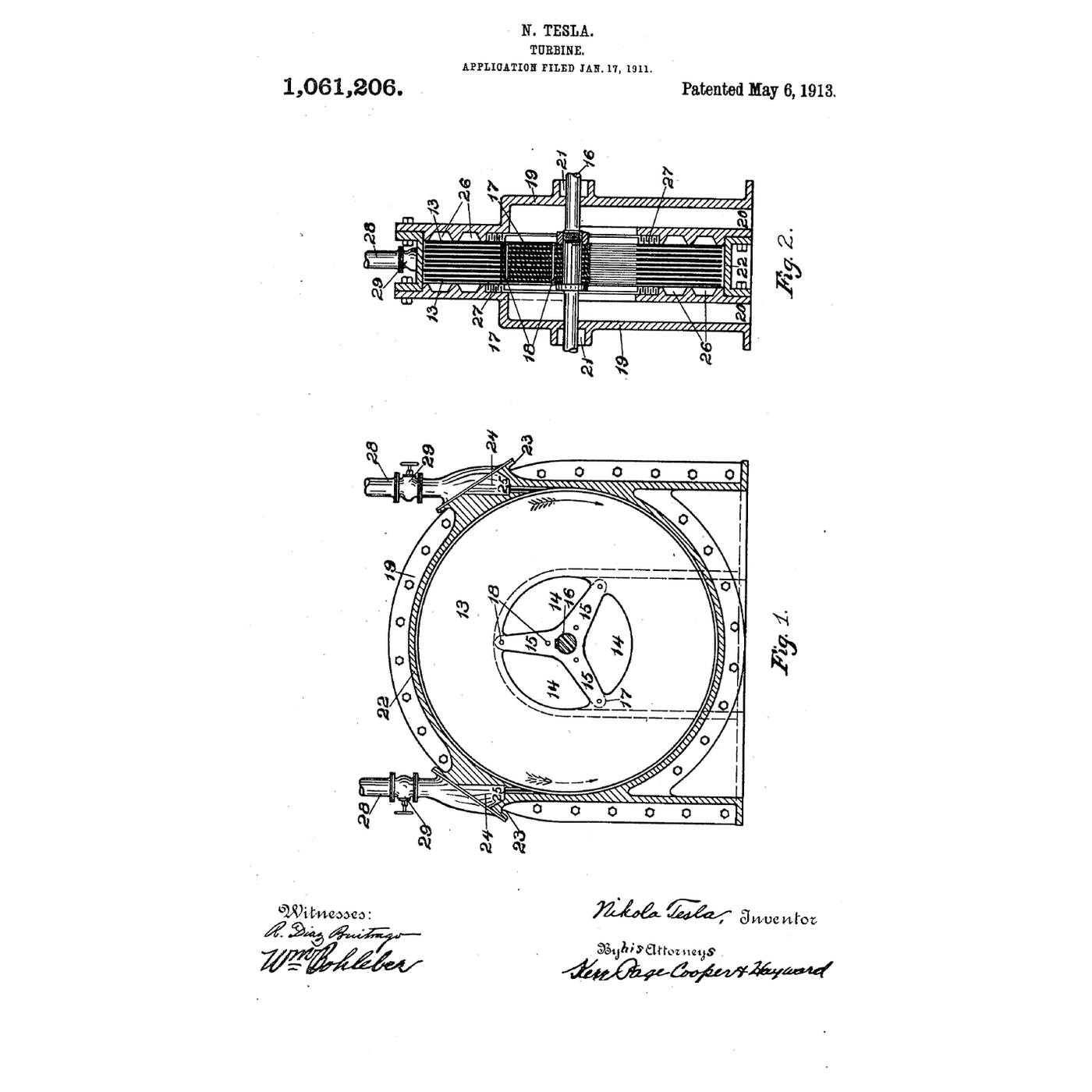
US 1,061,206, 'Turbine', Nikola Tesla. The runner is *"a plurality of flat rigid disks"* keyed to a shaft and spaced by washers, with *"openings"* near the centre for the exhaust. The fluid acts on them through *"adhesion and viscosity"*.
The design rule is in plain words: the spacing *"should be the greater, the larger the diameter of the disks, the longer the spiral path of the fluid and the greater its viscosity"*. Tesla drew only a few widely spaced discs *"for the sake of clearness"* — a real runner has many, close together.
2
2
The boundary layer sets the gap
The boundary layer sets the gap
Jupyter 노트북 불러오는 중…
3
3
Build a CD turbine
Build a CD turbine
Drill out the centres of eight CDs to fit a length of threaded rod as the shaft. Drill six 10 mm exhaust holes round each disc near the centre, all in line. Stack the discs with two thin flat washers between each pair, clamped between nuts.
Print a housing that fits round the stack with 1–2 mm clearance, with one tangential inlet at the rim and exhaust ports in the side plates over the disc holes. Run the shaft in two skateboard bearings in the side plates.
Balance matters: spin the stack slowly by hand and check it does not wobble before any air goes near it.
이 단계의 재료:
 컴팩트디스크8 개
 평와셔20 개
 전산 볼트(나사 봉)1 개
 스케이트보드 베어링2 개
 PETG 필라멘트150 g
필요한 도구:
 무선 드릴
무선 드릴 드릴 비트 세트
 FDM 3D 프린터
 멍키스패너
멍키스패너 디지털 캘리퍼스 6인치
4
4
Run it on compressed air, behind a guard
Run it on compressed air, behind a guard
Stand the turbine behind a clear guard and wear goggles and ear protection. Connect the air compressor through the regulator to the inlet, starting at 0.5 bar.
Read the speed with the tachometer (a strip of reflective tape on the stack) at each pressure, raising it in small steps. **Stop well below 10,000 rpm** — the notebook's rim speeds show why.
Then change the gap: rebuild with one washer between discs instead of two and repeat. Compare free-running speed at the same pressure. The gap that works best is close to the notebook's boundary-layer estimate for air.
필요한 도구:
 공기 압축기 (팬케이크형)
 감압 조정기
 디지털 회전 속도계
 투명 보안경
 청력 보호구
5
5
History and context
History and context
**US 1,061,206, 'Turbine', Nikola Tesla; original application filed 21 October 1909, divided and this application filed 17 January 1911 (Serial 603,049); patented 6 May 1913.** A companion patent of the same family covered the machine run as a pump.
Tesla expected high efficiency and a cheap, rugged machine. In practice the discs flexed at speed, the gaps had to be very fine, and efficiency with steam fell well short of bladed turbines; the bladed Parsons turbine in this catalogue won. Disc pumps survive for abrasive and delicate fluids, where their bladeless shear is gentle.
**Honest limits.** Low efficiency at useful power; discs that flex; very close tolerances; and on a CD build, the hazard of a disc bursting.
재료
5- 8 개플레이스홀더
- 20 개플레이스홀더
- 1 개플레이스홀더
- 스케이트보드 베어링10% 수수료2 개플레이스홀더
- 150 g플레이스홀더
관련 블루프린트
이 블루프린트들은 지식을 공유합니다 — 기술, 재료 또는 원리


CC0 퍼블릭 도메인
이 블루프린트는 CC0로 공개되었습니다. 어떤 목적으로든 자유롭게 복사, 수정, 배포 및 사용할 수 있습니다.
제품 구매를 통해 메이커를 지원하세요. 판매자가 설정한 메이커 커미션 을 받거나, 이 블루프린트의 새로운 반복을 만들어 연결로 포함시킬 수 있습니다.