예술
뷰티 및 웰니스
공예
문화 및 역사
엔터테인먼트
환경
음식 및 음료
역공학
과학
스포츠
기술
웨어러블


The Two-Stroke Engine: The Piston Is the Valve
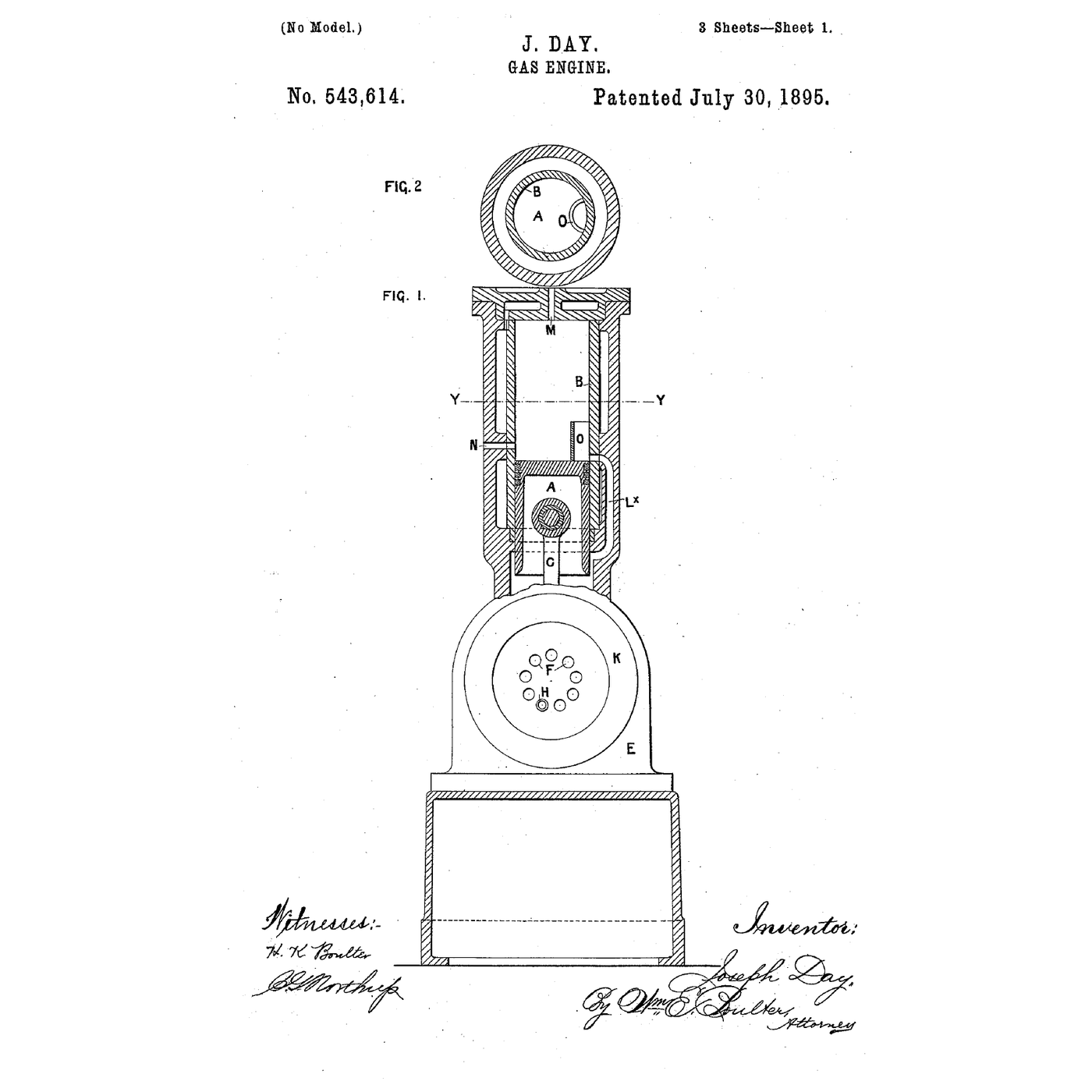
The four-stroke engine fires once every two turns and needs cams, springs and valves to breathe. Joseph Day's engine of 1891–95 fires every turn and has none of them: the piston itself opens and closes ports in the cylinder wall, and the sealed crankcase under the piston acts as a pump that pre-compresses the fresh charge.
Its own specification puts it simply: the piston *"serves as a slide-valve"*, doing away with *"eccentrics, cams, valve-rods"*. That makes it light, cheap and powerful for its size — the engine of chainsaws, mopeds and outboard motors.
This rung computes its port timing from the crank geometry and cuts the ports into a card cylinder on the slider-crank model to watch them open.
중급
About 3 hours
안내
1
1
Read Day's patent
Read Day's patent
US 543,614, 'Gas Engine', Joseph Day, patented 30 July 1895. The aim is *"a gas-engine in which eccentrics, cams, valve-rods, and other positively-actuated"* parts are done away with, *"the piston itself"* serving *"as a slide-valve"*. The explosive mixture is drawn into the crankcase chamber by the up-stroke, compressed there by the down-stroke, and delivered into the upper part of the cylinder when the piston uncovers the port; the piston also uncovers the exhaust port. Day's drawing still shows a valve admitting the charge to the crankcase — look for it.
2
2
Port timing from the geometry
Port timing from the geometry
Jupyter 노트북 불러오는 중…
3
3
Cut ports and watch them open
Cut ports and watch them open
On the slider-crank model from the crank rung, wrap a card tube round the slider's path as a 'cylinder' and mark on it the piston crown's position at top dead centre. Cut an exhaust window starting 60 % of the stroke below that mark, and a transfer window starting 72 % down, on the opposite side.
Turn the crank slowly with the protractor underneath and note the angle at which the crown first uncovers each window, and when it covers it again. Compare with the notebook.
이 단계의 재료:
 종이 지관1 개
필요한 도구:
 각도기
각도기 자
자 유성 매직
유성 매직4
4
History and context
History and context
**US 543,614, 'Gas Engine', Joseph Day, patented 30 July 1895.** Day was an engineer in Bath, England, and had patented crankcase compression in Britain before this US patent; the two-stroke spread quickly to motorcycles and small boats.
**Honest limits.** The ports are open together, so some fresh charge escapes with the exhaust — wasteful and polluting in a carburetted engine. The crankcase carries the charge, so lubricating oil is usually mixed into the fuel and burned. The two-stroke survives where power for its weight matters more than economy.
관련 블루프린트
이 블루프린트들은 지식을 공유합니다 — 기술, 재료 또는 원리

CC0 퍼블릭 도메인
이 블루프린트는 CC0로 공개되었습니다. 어떤 목적으로든 자유롭게 복사, 수정, 배포 및 사용할 수 있습니다.
제품 구매를 통해 메이커를 지원하세요. 판매자가 설정한 메이커 커미션 을 받거나, 이 블루프린트의 새로운 반복을 만들어 연결로 포함시킬 수 있습니다.