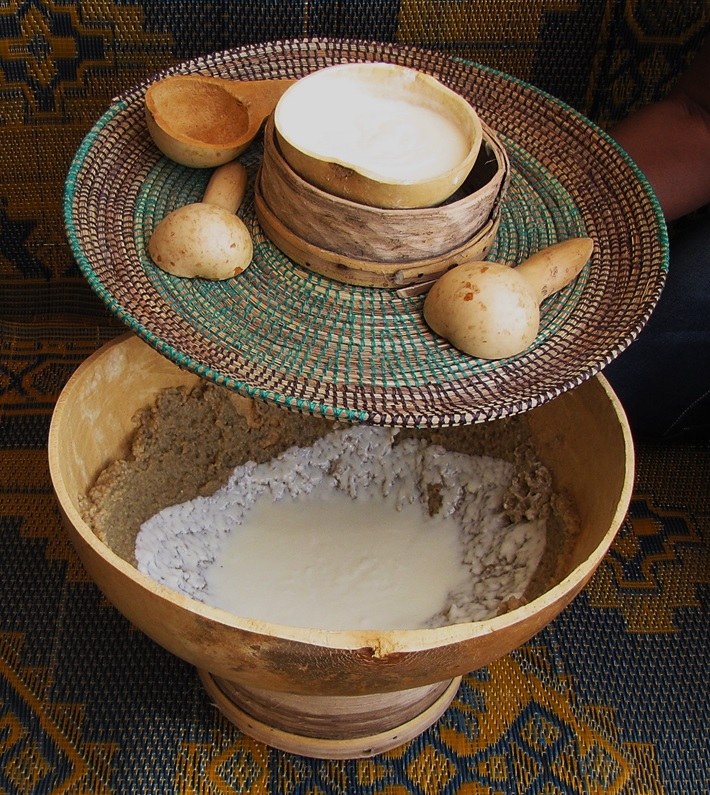


Uji
Uji is the everyday breakfast of East Africa: millet, sorghum or maize flour cooked with water until smooth. But real home uji is not the kind you cook on the spot — it is fermented uji, where the flour is left with water for two or three days before it is cooked.
Fermenting is not laziness and it is not forgetfulness. Naturally occurring good bacteria change the flour, the porridge takes on a slight sourness, and — this is the important part — the iron it contains becomes far easier for the body to absorb. That is why our grandmothers gave children this uji, and not the quick kind.
Here we make fermented millet uji, from flour to cup.
안내
Wash your hands and every utensil
Wash your hands and every utensil
Fermenting depends on the good bacteria beating the bad ones. Wash your hands, the container and the spoon in hot water before you start.
Weigh out 250 g of millet flour
Weigh out 250 g of millet flour
Use finger millet flour (wimbi). Sorghum or maize also work, but millet is the most valued for children's uji because it is rich in minerals.
이 단계의 재료:
 Millet Flour250 g
필요한 도구:
 Digital Scale (0.01g)
Mix the flour with one litre of warm water
Mix the flour with one litre of warm water
Stir the flour into lukewarm water until there are no lumps. Start with a little water, then add more — pour it all in at once and you will get lumps that never go away.
Cover with a cloth, not a tight lid
Cover with a cloth, not a tight lid
Cover the container with a clean cloth that lets a little air through. A completely airtight lid shuts out air and changes the fermentation.
Leave it somewhere warm for two days
Leave it somewhere warm for two days
Keep it at ordinary room warmth, around 25-30 °C, for 48 hours. Somewhere cool it will take three days or more.
Stir it once a day
Stir it once a day
Stir morning and evening with a clean spoon. This helps the bacteria spread through the whole mixture.
Look for the signs of good fermentation
Look for the signs of good fermentation
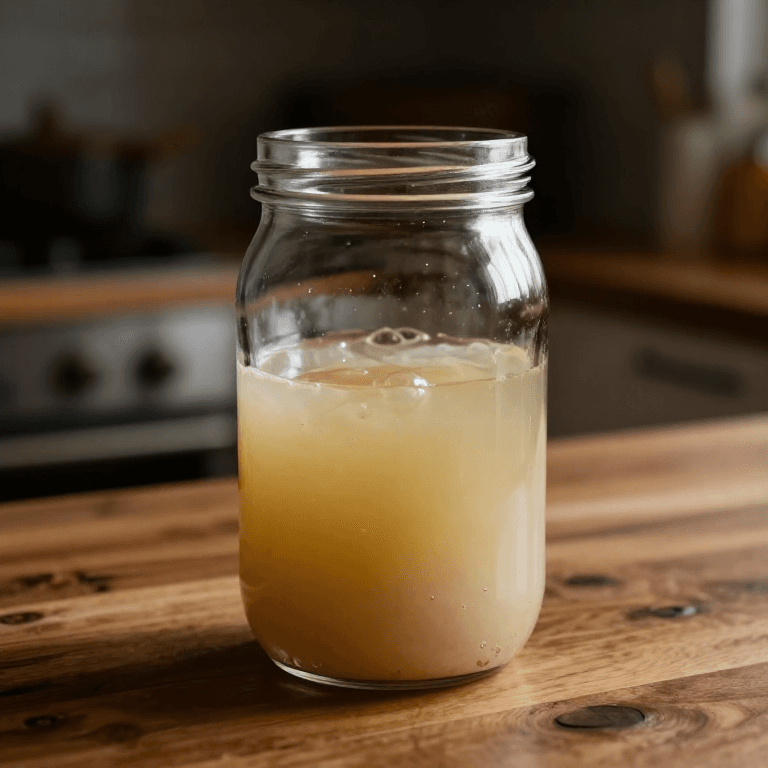
You will see a little foam on top and smell a sourness like fermented milk. The smell should be sour, not rotten.
Throw it out if there is mould or a bad smell
Throw it out if there is mould or a bad smell
If you see coloured mould (green, black, pink) or smell rot, discard the lot. Do not try to scoop out the spoiled part — safety first.
Strain the mixture through a sieve
Strain the mixture through a sieve
Pass it through a sieve or a thin cloth to remove bran and lumps. Smooth uji comes from straining, not from long cooking.
필요한 도구:
 Fine Sieve (2-3 mm mesh, for plaster)
Bring one litre of water to the boil
Bring one litre of water to the boil
Put a litre of clean water on to boil properly. The water must be boiling before you pour the mixture in.
Pour the mixture in slowly while stirring
Pour the mixture in slowly while stirring
Pour the mixture into the boiling water slowly, stirring without stopping. Stop stirring for even a few seconds and you will get lumps.
Cook for 15 minutes over low heat
Cook for 15 minutes over low heat
Lower the heat and keep stirring for 15 minutes until the uji thickens and turns glossy. Undercooked uji tastes of raw flour.
Add sugar or honey if you like
Add sugar or honey if you like
Add a little sugar, honey, or lemon juice to taste. Some people add milk; some drink it just as it is.
History & Context — why fermenting matters
History & Context — why fermenting matters
Grains have their own defences. Millet, sorghum and maize contain something called phytate, which binds iron and zinc and stops the body absorbing them. This is not a grandmother's tale — it is established by scientific research. The natural bacteria at work during fermentation release an enzyme that breaks phytate down, freeing the minerals. Fermented uji delivers considerably more usable iron than the identical uji unfermented. That is the real reason behind the custom.
Safety too. Lactic acid bacteria lower the acidity (pH), and in those conditions disease-causing bacteria cannot grow. In places without refrigeration, fermenting is a way of preserving food — not merely a matter of flavour.
Uji is food for children and for the old. Uji has long been the first food for a child being weaned in East Africa. It is smooth, easily digested, and full of energy. But it is right to say the truth plainly: uji alone is not enough for a growing child — it needs protein foods added to it, such as ground groundnuts, milk or eggs.
On names. "Uji" is the Swahili word used in Kenya and Tanzania. Elsewhere in Africa there are foods made in very similar ways: ogi or pap in West Africa, and Ethiopia's injera (though that is a bread). This is an old way of preparing grain found right across the continent, each place with its own name for it.
재료
1- 250 g플레이스홀더
필요 도구
2- 플레이스홀더
- 플레이스홀더

관련 블루프린트
이 블루프린트들은 지식을 공유합니다 — 기술, 재료 또는 원리


CC0 퍼블릭 도메인
이 블루프린트는 CC0로 공개되었습니다. 어떤 목적으로든 자유롭게 복사, 수정, 배포 및 사용할 수 있습니다.
제품 구매를 통해 메이커를 지원하세요. 판매자가 설정한 메이커 커미션 을 받거나, 이 블루프린트의 새로운 반복을 만들어 연결로 포함시킬 수 있습니다.