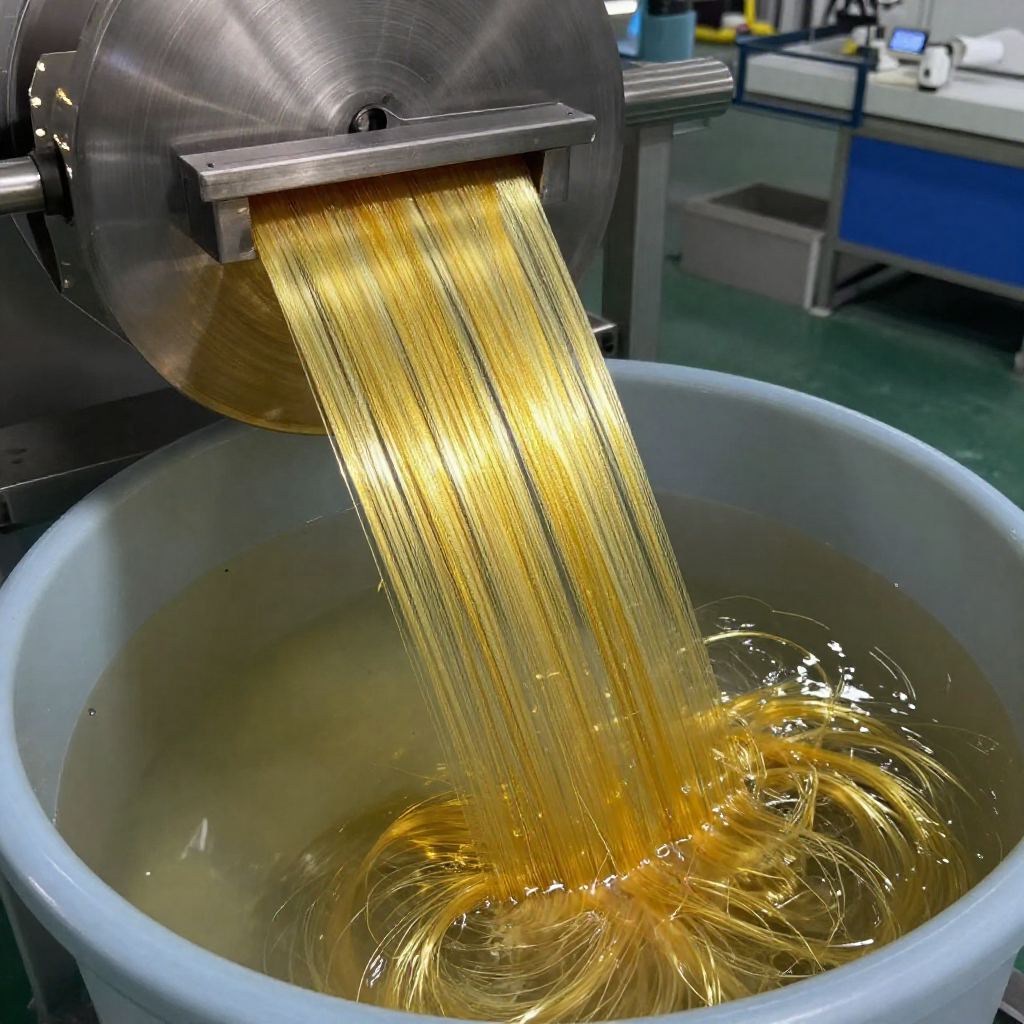


Viscose Rayon — The First Artificial Fiber from Wood Cellulose
In 1892, English chemists Charles Frederick Cross, Edward John Bevan, and Clayton Beadle patented the viscose process — a method of dissolving wood cellulose and regenerating it as continuous filaments that could be woven like silk. By 1905, Courtaulds in Coventry had scaled the process to commercial production. Viscose rayon was the first artificial fiber to compete successfully with natural silk, cotton, and wool — and it was made from wood pulp, one of the cheapest raw materials on earth.
The chemistry is a controlled destruction and reconstruction of cellulose. Wood pulp is treated with sodium hydroxide to form alkali cellulose, then reacted with carbon disulfide to form cellulose xanthate — an orange, honey-thick liquid called 'viscose.' This viscose is aged, filtered, and forced through tiny holes in a spinneret (a metal plate with thousands of sub-millimeter holes) into a sulfuric acid bath that regenerates the cellulose as solid filaments. The filaments are stretched, washed, and wound — the result is a smooth, lustrous fiber with many of silk's properties at a fraction of its cost.
Viscose rayon broke a fundamental assumption that had governed textiles for 10,000 years: that useful fibers must come from plants or animals. For the first time, humans manufactured a textile fiber from molecular components rather than harvesting it from nature. Rayon opened the door to nylon (1935), polyester (1941), and every synthetic fiber that followed. The modern wardrobe — blended fabrics, stretch materials, performance textiles — descends from Cross, Bevan, and Beadle's decision to dissolve a tree and spin it into thread.
안내
Prepare dissolved wood pulp
Prepare dissolved wood pulp
Begin with purified wood pulp — cellulose extracted from spruce, beech, or eucalyptus wood by chemical pulping processes that remove lignin and hemicellulose. The purified cellulose arrives as thick white sheets containing over 90% alpha-cellulose. This is the same molecule as cotton — (C₆H₁₀O₅)ₙ — but sourced from wood instead of cotton bolls. The entire viscose process is about dissolving this solid cellulose and reconstituting it as fiber.
이 단계의 재료:
 Wood Pulp Sheets500 g
Steep the pulp in sodium hydroxide
Steep the pulp in sodium hydroxide
Immerse the cellulose sheets in a 17–20% sodium hydroxide (NaOH) solution at 18–20°C for 1–2 hours. The caustic soda penetrates the cellulose, breaking hydrogen bonds between chains and converting it to alkali cellulose (sodium cellulose). The sheets swell to roughly twice their original thickness. This step is chemically identical to mercerization — the same reaction Mercer discovered in 1844, now applied as a precursor to dissolution rather than as a finishing treatment.
이 단계의 재료:
 Sodium Hydroxide (10% solution)500 ml
Press and shred the alkali cellulose
Press and shred the alkali cellulose
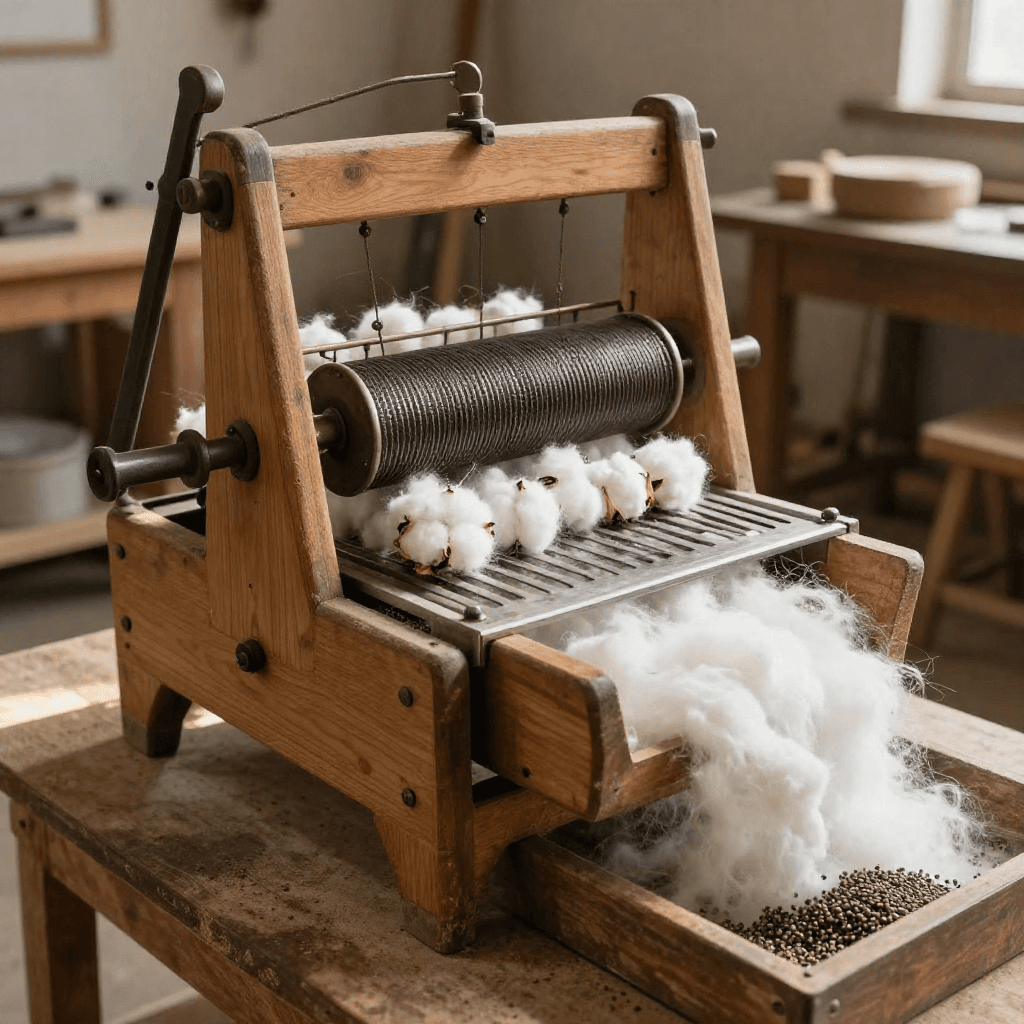
Remove the swollen sheets from the caustic bath and press them between rollers to squeeze out excess NaOH (recovering it for reuse). Then shred the pressed sheets into fine crumbs using a rotating shredder. The crumbled alkali cellulose has a vastly greater surface area than intact sheets, which is essential for the next reaction step — carbon disulfide must contact every cellulose particle evenly.
Age the crumbs to reduce chain length
Age the crumbs to reduce chain length
Spread the alkali cellulose crumbs on trays and store them in a controlled-temperature room (18–22°C) for 2–3 days. During aging, oxygen from the air slowly breaks cellulose chains into shorter lengths through oxidative depolymerization. This reduces the viscosity of the final solution to a spinnable range. Without aging, the viscose would be too thick to force through spinneret holes. Too much aging makes it too thin and produces weak fiber.
React with carbon disulfide to form xanthate
React with carbon disulfide to form xanthate
Place the aged alkali cellulose crumbs in a sealed rotating drum (called a baratte or churn) and add carbon disulfide (CS₂) — approximately 30–35% by weight of the cellulose. The CS₂ reacts with the alkali cellulose over 2–3 hours at 25–30°C, forming cellulose xanthate — an orange, crumb-like solid. Carbon disulfide is extremely toxic (damages the nervous system) and highly flammable (autoignition at 100°C). The reaction must be conducted in sealed, ventilated equipment.
이 단계의 재료:
 Carbon Disulfide200 ml
Dissolve the xanthate in dilute sodium hydroxide
Dissolve the xanthate in dilute sodium hydroxide
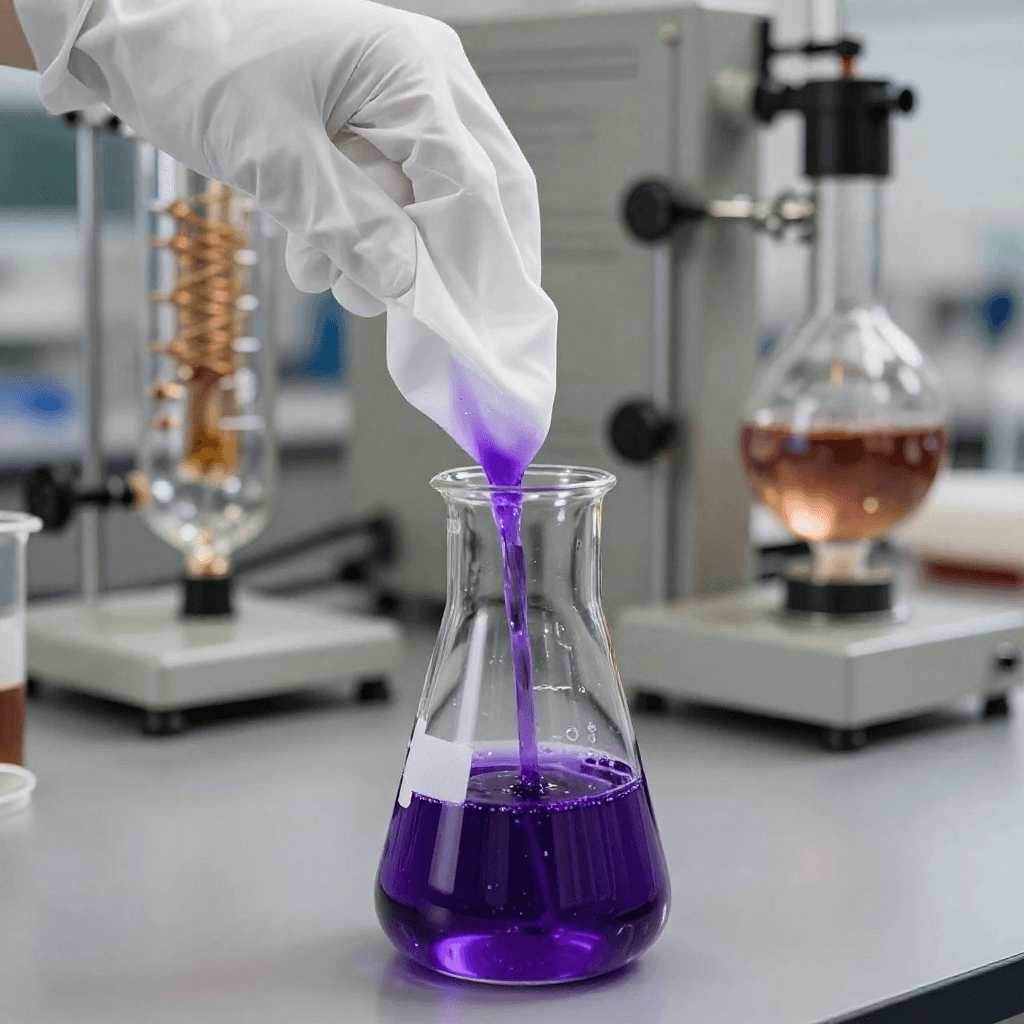
Transfer the orange cellulose xanthate crumbs into a dilute sodium hydroxide solution (5–7%) and stir vigorously for several hours. The xanthate dissolves to form a thick, orange, honey-like liquid — this is 'viscose' (from Latin viscosus, meaning sticky). The viscose solution contains approximately 7–10% cellulose by weight. It must be perfectly homogeneous, free of undissolved particles, and free of air bubbles — all of which would cause defects in the final fiber.
Ripen and filter the viscose
Ripen and filter the viscose
Store the viscose at 10–18°C for 4–5 days (ripening). During this period, chemical changes occur that improve the fiber's properties when it is later regenerated. Filter the ripened viscose through fine mesh screens and deaerate it under vacuum to remove dissolved gas. Any air bubble trapped in the viscose creates a void in the fiber — a weak point that breaks during spinning or weaving.
Extrude through a spinneret into an acid bath
Extrude through a spinneret into an acid bath
Force the viscose through a spinneret — a small metal disc perforated with thousands of tiny holes, each 50–80 micrometers in diameter — directly into a coagulation bath of dilute sulfuric acid (10–15%) containing sodium sulfate and zinc sulfate. As the viscose stream meets the acid, the xanthate groups are stripped away and the cellulose regenerates as a solid filament. Each spinneret hole produces one continuous filament; a spinneret with 1,500 holes produces 1,500 filaments simultaneously.
필요한 도구:
 Glass Distillation Flask
Stretch the filaments to orient the molecules
Stretch the filaments to orient the molecules
The freshly regenerated filaments are soft and weak. Pull them through the acid bath under tension — stretching them by 50–100% of their original length. This mechanical stretching aligns the cellulose molecules parallel to the fiber axis, dramatically increasing tensile strength. The degree of stretch determines the fiber's final strength: more stretch produces stronger, less extensible fiber. This principle — drawing to orient molecules — later became fundamental to all synthetic fiber production.
Wash, bleach, and finish the filaments
Wash, bleach, and finish the filaments
Pass the stretched filaments through a series of washing baths to remove residual acid, sulfur compounds, and salts. The characteristic smell of carbon disulfide clings to unwashed viscose. Bleach lightly with sodium hypochlorite if a white fiber is needed. Apply a soft finish (a light oil or emulsion) to reduce static and improve handling. The finished filaments are smooth, lustrous, and drape beautifully — properties that earned rayon the nickname 'artificial silk.'
Wind the filaments or cut to staple length
Wind the filaments or cut to staple length
For filament yarn (used in linings, lingerie, and dress fabrics), wind the continuous filaments onto bobbins or cones. For staple fiber (blended with cotton or wool), cut the filament tow into short lengths (38–50 mm for cotton-type blends, 60–150 mm for wool-type) and crimp them to give the straight filaments the waviness needed for spinning on conventional cotton or wool machinery.
Understand the environmental and safety hazards
Understand the environmental and safety hazards
The viscose process uses carbon disulfide — a volatile, toxic liquid that attacks the central nervous system, causing blindness, psychosis, and death at high exposures. Early viscose workers suffered severe CS₂ poisoning. Sulfuric acid in the spin bath is corrosive; hydrogen sulfide gas (toxic, smells of rotten eggs) is released during coagulation. Modern viscose plants have enclosed systems and vapor recovery, but the process remains inherently hazardous. Newer alternatives — lyocell (Tencel), which uses a non-toxic solvent — address these concerns.
Recognize rayon's place in textile history
Recognize rayon's place in textile history
Viscose rayon proved that useful textile fibers could be manufactured from molecular components rather than harvested from nature. This was a conceptual revolution. Once chemists understood that fiber properties came from molecular structure — chain length, orientation, crystallinity — they could design fibers to specification. Wallace Carothers at DuPont synthesized nylon in 1935 using this principle. John Rex Whinfield created polyester in 1941. Today, synthetic and artificial fibers account for over 60% of global fiber production. Every one of them traces its lineage to the moment Cross, Bevan, and Beadle dissolved a tree and spun it into silk.
재료
3- 500 g플레이스홀더
- 플레이스홀더
- 200 ml플레이스홀더
필요 도구
1- 플레이스홀더
연결된 블루프린트 재료
관련 블루프린트
이 블루프린트들은 지식을 공유합니다 — 기술, 재료 또는 원리
CC0 퍼블릭 도메인
이 블루프린트는 CC0로 공개되었습니다. 어떤 목적으로든 자유롭게 복사, 수정, 배포 및 사용할 수 있습니다.
제품 구매를 통해 메이커를 지원하세요. 판매자가 설정한 메이커 커미션 을 받거나, 이 블루프린트의 새로운 반복을 만들어 연결로 포함시킬 수 있습니다.