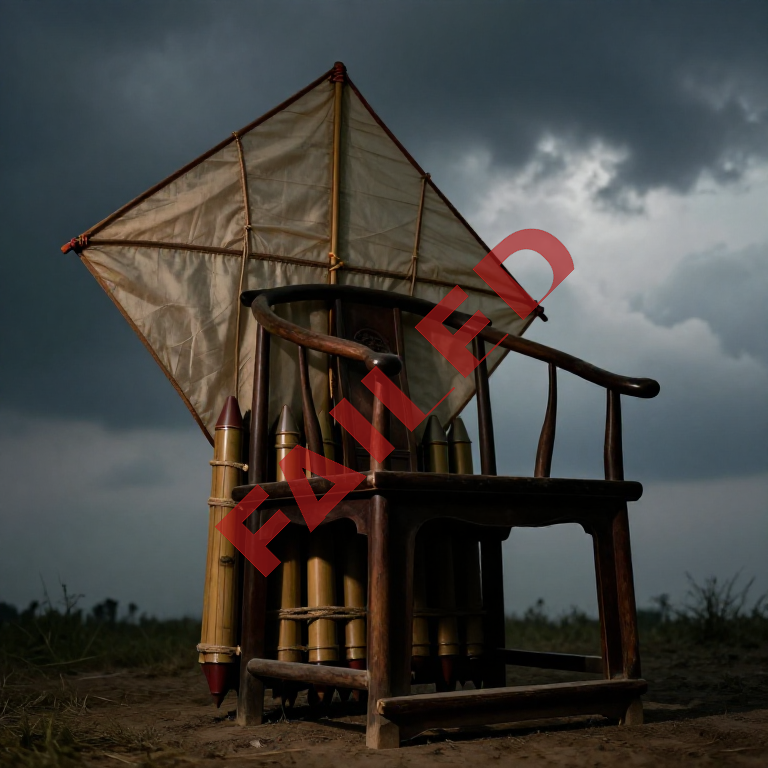


Wan Hu's Rocket Chair — The First Attempt at Human Rocket Flight
Around 1500 AD during the Ming dynasty, a Chinese official named Wan Hu (万户) conceived the boldest experiment in the history of rocketry: he would ride a chair propelled by 47 gunpowder rockets into the sky. According to the legend recorded in later Chinese accounts, Wan Hu had a large wooden chair fitted with 47 fire-arrow rockets strapped beneath and behind the seat, and held two large kites in his hands to assist with lift and control after the rockets burned out.
On the day of the test, Wan Hu seated himself in the chair and ordered 47 servants — one per rocket — to light all the fuses simultaneously. A tremendous roar and explosion followed, filling the air with fire and smoke. When the smoke cleared, both Wan Hu and his chair had vanished completely. He was never seen again.
Whether the legend is historically accurate or a cautionary tale assembled from fragments of real rocketry experiments, Wan Hu's story has endured for over five centuries. In 1970, the International Astronomical Union named a crater on the far side of the Moon 'Wan-Hoo' in his honour — a fitting memorial for a man who dreamed of reaching the heavens using the technology of his time. The experiment failed catastrophically, but the ambition was five centuries ahead of its era. Every astronaut who has ridden a rocket into space has succeeded where Wan Hu did not.
관련 블루프린트
이 블루프린트들은 지식을 공유합니다 — 기술, 재료 또는 원리




CC0 퍼블릭 도메인
이 블루프린트는 CC0로 공개되었습니다. 어떤 목적으로든 자유롭게 복사, 수정, 배포 및 사용할 수 있습니다.
제품 구매를 통해 메이커를 지원하세요. 판매자가 설정한 메이커 커미션 을 받거나, 이 블루프린트의 새로운 반복을 만들어 연결로 포함시킬 수 있습니다.